

The substantial investment comes amid jitters that the government is putting pressure on foreign ventures as it reasserts control over the economy.
International Paper will pay about $400 million for 50 percent of Swiss-registered Ilim Holding, an Ilim Pulp subsidiary that controls four paper and pulp mills and valued at $1.3 billion.
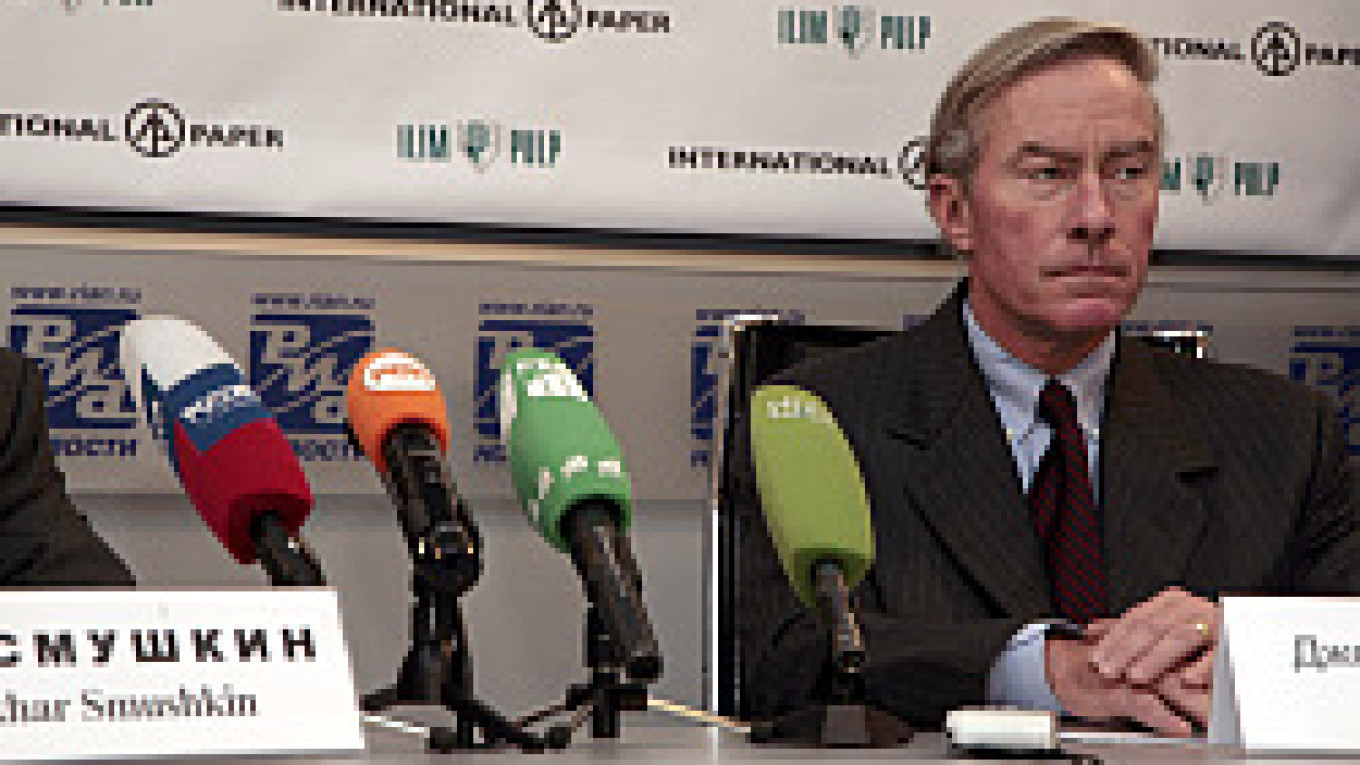
The new joint venture, Ilim Group, will invest $1.2 billion in upgrading its assets and technology over the next three years, International Paper chairman and chief executive John Faraci told reporters.
The four mills now produce 2.5 million tons of forest products every year, bringing pre-tax profits of $250 million, Ilim Pulp chairman Zakhar Smushkin said.
After the investments, they will boost capacity by 40 percent, or by 1 million tons, Faraci said.
Each company will have an equal number of directors on the eight-member board, he said.
The venture will be registered in Russia and have its headquarters in St. Petersburg.
The deal should be finalized in the first quarter of next year.
The announcement came as President Vladimir Putin called for more investment into wood processing and a drop in the export of logs. The government will gradually increase export duties on logs and reduce import duties on wood processing equipment from next year through 2009, Putin said in a televised question-and-answer session with ordinary Russians.
Addressing forestry businesses, Putin said they should stop lobbying to keep tax breaks on the export of logs. "You had better seek lower tax duties on the import of technical equipment, create jobs in Russia, pay taxes and stimulate the development of the relevant machine-building industry in Russia," he said.
Smushkin made a point of saying that the Ilim deal was consistent with government policy.
Faraci said the Russian pulp and paper industry was in a bad need of investment. "Russia will become a net importer of forest products by 2010 if new capacities don't appear," he said.
Roland Nash, chief strategist at Renaissance Capital investment bank, said the deal showed that foreign investors had not lost interest in Russian natural resources despite Royal Dutch Shell's problems with Sakhalin-2. The government has threatened to revoke a key license at the project over purported environmental violations. The move, combined with hassles at other foreign-owned projects, has fueled worries about investing in Russia.
"It's a confirmation of the ongoing excitement that exists among foreign investors. ... International firms want a piece of the pie," Nash said.
"Obviously, everybody would prefer to invest without the political risk, but the sheer scale of natural resources in Russia means it's very attractive even under difficult circumstances."
Al Breach, chief strategist at Brunswick UBS, said the real issue was control, and the purchase of a noncontrolling stake in a Russian business was safe.
He downplayed Wednesday's deal, saying it did not really stand out given the huge amount of foreign investment in Russia. "It's good to see, but nothing real staggering," he said.
A Kremlin spokesman declined to comment on the deal.
International Paper's paper mill in the Leningrad region town of Svetogorsk will not be part of the joint venture, Faraci said. International Paper bought the plant in 1999 and has invested $400 million since then, he said.
Ilim Pulp will not contribute its other assets, including its logging and wood processing enterprises, Smushkin said.
International Paper had sales of $24.1 billion in 2005. It runs 31 pulp, paper and packaging mills in the United States, Europe, Asia and South America.
Smushkin, a core shareholder in the closely held Ilim Pulp, declined to present revenues or sales figures. Ilim Pulp ranks sixth internationally in timber reserves and logging volumes.
Several years ago, the company fought off an attempt by billionaire Oleg Deripaska's Base Element and its partners to take control of two mills. The parties settled the dispute in 2004 but agreed not to disclose the terms, Smushkin said.
A Message from The Moscow Times:
Dear readers,
We are facing unprecedented challenges. Russia's Prosecutor General's Office has designated The Moscow Times as an "undesirable" organization, criminalizing our work and putting our staff at risk of prosecution. This follows our earlier unjust labeling as a "foreign agent."
These actions are direct attempts to silence independent journalism in Russia. The authorities claim our work "discredits the decisions of the Russian leadership." We see things differently: we strive to provide accurate, unbiased reporting on Russia.
We, the journalists of The Moscow Times, refuse to be silenced. But to continue our work, we need your help.
Your support, no matter how small, makes a world of difference. If you can, please support us monthly starting from just $2. It's quick to set up, and every contribution makes a significant impact.
By supporting The Moscow Times, you're defending open, independent journalism in the face of repression. Thank you for standing with us.

Remind me later.