

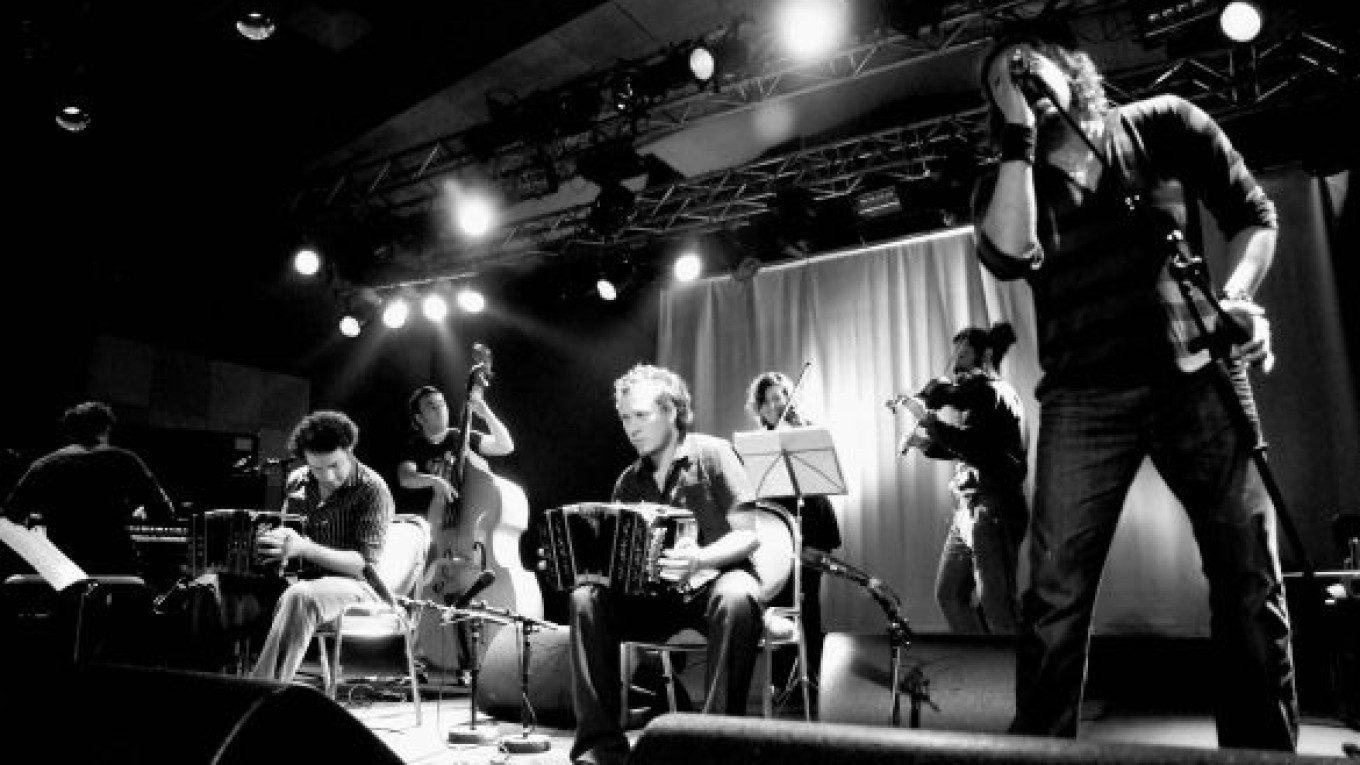
If you missed the 200th anniversary of Argentine independence — March 25, with 6 million people watching parades on the streets of South America and official receptions at embassies around the world — then you can catch up on celebrations Wednesday as Argentine tango ensemble Sexteto Milonguero plays at the Durov Art Cafe.
Sexteto Milonguero will be part of the first traditional milonga ball — where people dance to the sounds of a live tango orchestra — in Moscow.
“There are 30 dance schools specializing in tango just in Moscow, but nobody has ever brought a real Argentine orchestra to perform a milonga ball,” said Inessa Dekhtyareva, from the Russian Association of Tango Teachers, Dancers and Choreographers. Dekhtyareva quit her job in PR almost a year ago to devote herself to the dance. “Tango has a seductive power that enveloped me in such a way that it no longer made sense devoting [time] to anything else.”
The concert has been organized by the local Tangocity dance school and the Argentine Embassy.
Argentina is the birthplace of tango, and the dance is more than half the age of the country itself, developing from the musical style habanera, which appeared in prisons in the last two decades of the 19th century. The sound of tango is inextricably linked with the sound of the bandoneon, a German instrument similar to an accordion that arrived in Argentina at the start of the 20th century.
Sexteto Milonguero draws inspiration from Argentina’s second great wave of tango in the 1940s. The first wave took place in the 1920s.
The group was founded in 2006 by singer Javier Di Ciriaco. “I entered the world of milonga attracted by a milonguera [female tango dancer],” he said in a telephone interview.
With his milonguera, Di Ciriaco started to frequent balls in Buenos Aires, where he met the group of passionate young musicians that now make up Sexteto Milonguero.
There are six others in the group: Marisol Canessa and Mariano Laplume (violin), Diego Braconi and Mauricio Jost (bandoneons), Gervasio Ledesma (piano) and Christian Sepulveda (double bass).
The orchestra will play classic songs and others from their second album, “Siete” (Seven), although Di Ciriaco noted that it is not a straight replaying but with new elements, “such as folk, samba and quartet rhythms,” to give a new birth to the classics.
The milonga ball will include a wide dance floor for milongueros but is also open to those who just want to sit and listen to the music.
Sexteto Milonguero plays June 9 at 8 p.m. at the Durov Art Cafe, 6 Pavlovskaya Ulitsa. Metro Serpukhovskaya, Dobrininskaya. Tel. 952-2064, www.art-durov.ru.
A Message from The Moscow Times:
Dear readers,
We are facing unprecedented challenges. Russia's Prosecutor General's Office has designated The Moscow Times as an "undesirable" organization, criminalizing our work and putting our staff at risk of prosecution. This follows our earlier unjust labeling as a "foreign agent."
These actions are direct attempts to silence independent journalism in Russia. The authorities claim our work "discredits the decisions of the Russian leadership." We see things differently: we strive to provide accurate, unbiased reporting on Russia.
We, the journalists of The Moscow Times, refuse to be silenced. But to continue our work, we need your help.
Your support, no matter how small, makes a world of difference. If you can, please support us monthly starting from just $2. It's quick to set up, and every contribution makes a significant impact.
By supporting The Moscow Times, you're defending open, independent journalism in the face of repression. Thank you for standing with us.

Remind me later.