

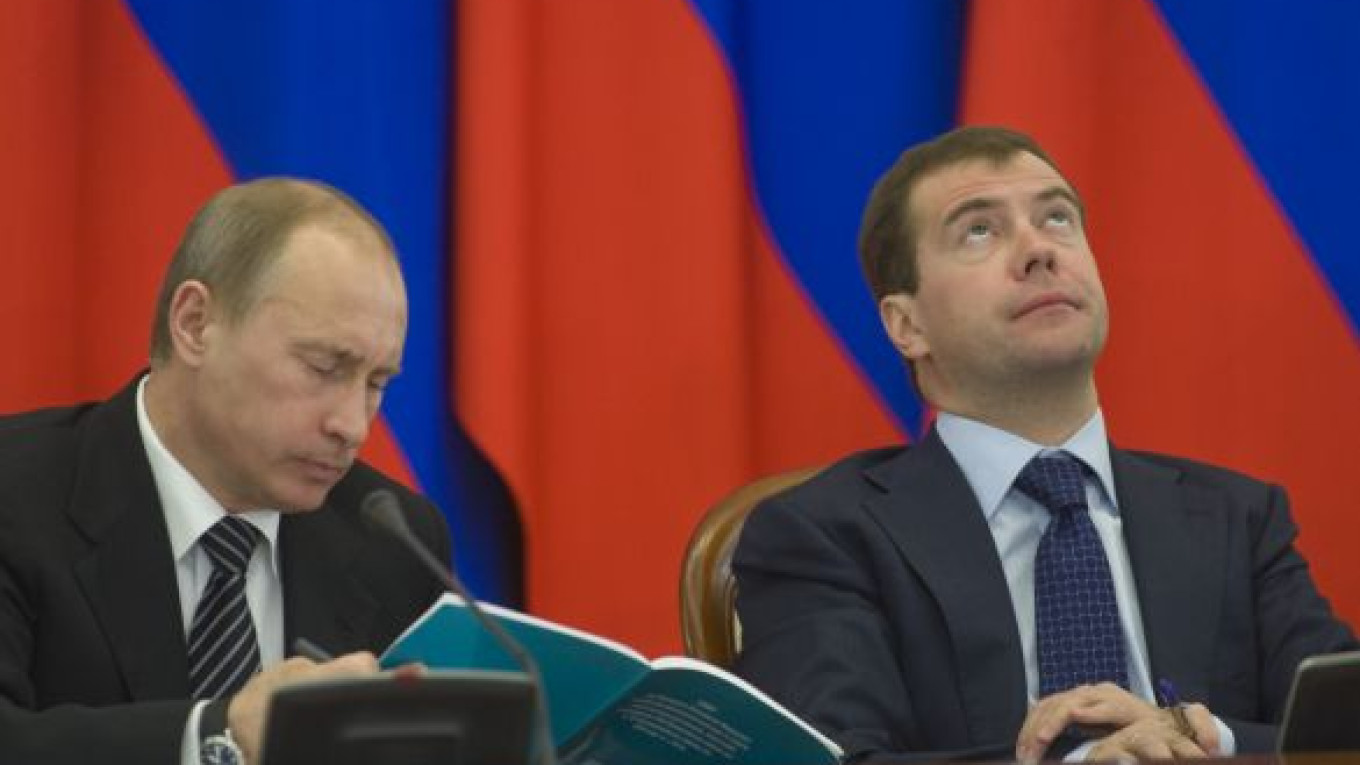
Prime Minister Vladimir Putin has issued reprimands to six deputy ministers, all of whom answer for bureaucratic discipline within their ministries, for not fulfilling presidential orders in a timely fashion, Kremlin spokeswoman Natalya Timakova said.
Reprimands are included in a public servant's records and can be used to revoke bonuses, said Dmitry Peskov, Putin's press secretary. The officials were chosen because they are responsible for overseeing administrative work within their respective ministries, a government official said.
The deputy ministers were Vladimir Azbukin (energy), Anton Siluanov (finance), Natalya Parshikova (sports), Oleg Savelyev (economic development), Sergei Yurpalov (regional development) and Andrei Dementyev (industry and trade).
Last year, only one in six presidential orders was completed on time, while for the first five months of 2010, one in five was finished, Konstantin Chuichenko, head of the Kremlin's control department, told President Dmitry Medvedev on June 21.
At that meeting, Medvedev ordered the government to give him a list of those to blame, including their punishments, "right up to termination." Under the Labor Code, a reprimand is the lightest possible form of punishment.
The government treats the president's orders just as seriously as any other orders, a government official said. The official suggested that people close to Medvedev could be pressing the issue because they are uncomfortable with the prime minister's political clout.
The criticism of the Industry and Trade Ministry relates to technical regulations, Dementyev said. The deputy minister responsible for technical regulations is Vladimir Salamatov, however.
At the start of the year, Medvedev criticized how long it was taking to revise regulations that were supposed to replace Soviet-era standards. The Industry and Trade Ministry is responsible for the work, a government official said, but in 95 percent of cases the delays are because of the long process of agreeing on new standards with other state bodies. Some of the regulations were in the approval process for four years, even though not a word in them had been changed, he said.
It is strange that just one person was punished since the problem is convoluted bureaucratic procedures, one of Dementyev's colleagues said. ?
Siluanov, of the Finance Ministry, said he had to take the reprimand for his colleagues. The deputy minister had already asked people carrying out presidential orders to speed up their work, but now he is planning to step up his oversight and develop a system to hold the relevant deputy minister and department head responsible for lapses.
The Regional Development Ministry will try to prevent future delays, an official there said. Often the violations are related to technical difficulties, for example, when orders arrive by mail with their due date already expired.
The Economic Development Ministry is treating the reprimand of Savelyev as a criticism for all, ministry spokeswoman Svetlana Glikman said. The delays were related to lengthy consultations within the state and with outside experts and business, she said.
"The ministry has developed a series of measures to speed up that work," Glikman said.
Energy Ministry spokeswoman Irina Yesipova said measures had already been taken to hold people more responsible. The Sports, Tourism and Youth Affairs Ministry declined to comment on the reprimand.
A Message from The Moscow Times:
Dear readers,
We are facing unprecedented challenges. Russia's Prosecutor General's Office has designated The Moscow Times as an "undesirable" organization, criminalizing our work and putting our staff at risk of prosecution. This follows our earlier unjust labeling as a "foreign agent."
These actions are direct attempts to silence independent journalism in Russia. The authorities claim our work "discredits the decisions of the Russian leadership." We see things differently: we strive to provide accurate, unbiased reporting on Russia.
We, the journalists of The Moscow Times, refuse to be silenced. But to continue our work, we need your help.
Your support, no matter how small, makes a world of difference. If you can, please support us monthly starting from just $2. It's quick to set up, and every contribution makes a significant impact.
By supporting The Moscow Times, you're defending open, independent journalism in the face of repression. Thank you for standing with us.

Remind me later.