

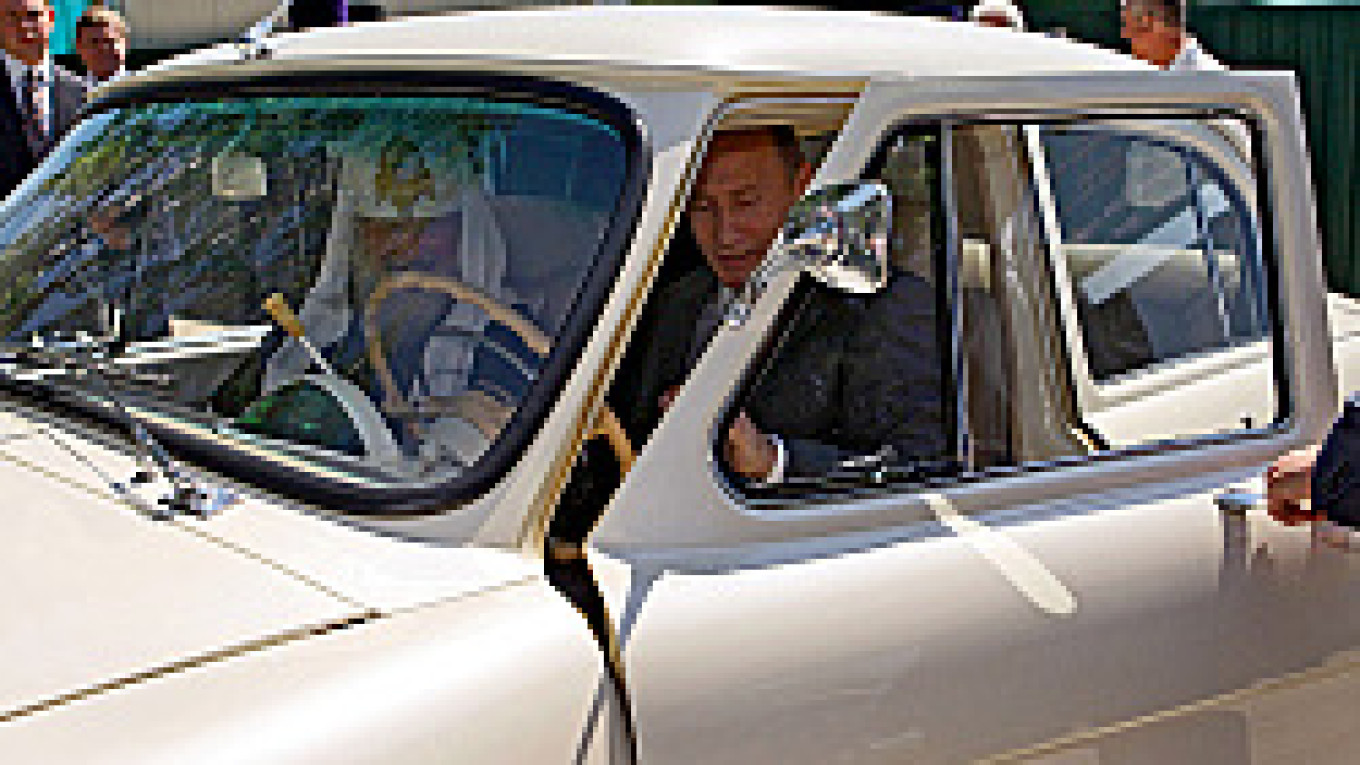
But Prime Minister Vladimir Putin's appearance at a church Saturday just hours after the sale was announced spoke volumes. Putin showed up driving his antique GAZ-21.
Putin drove the gray, Soviet-era Volga model to a foundation-laying ceremony for a Russian Orthodox church in the village of Usovo in the Moscow region. After the ceremony, Putin gave Russian Orthodox Patriarch Kirill a lift to his Novo-Ogaryovo residence.
A Putin spokesman denied that there was a link between Putin's decision to drive the car and the multibillion-dollar sale, which will give Sberbank a 35 percent stake in Opel and GAZ the status of "industrial partner."
"Vladimir Vladimirovich's driving of the Volga on Saturday had no connection with the Opel deal," spokesman Dmitry Peskov said Sunday. "He usually drives it when he goes somewhere on his own business."
But Putin has rarely been seen driving the car off Novo-Ogaryovo's grounds, where he gave former U.S. President George W. Bush a ride shortly after acquiring the vehicle in 2005.
In a country where leaders' actions often speak louder than words, some saw Putin's spin on Saturday as something of a victory lap.
"Putin must have driven the GAZ to symbolize Russia's victory," said Dmitry Oreshkin, an independent political analyst. "This kind of symbolism was used by the Soviet government. It may be cheered by some Russians but frowned upon by foreigners."
The German government chose the Russian-Canadian consortium to buy General Motors-controlled Opel early Saturday, ending more than a month of tense negotiations brokered by German Chancellor Angela Merkel and overseen by U.S. President Barack Obama. The deal saves Opel from the planned bankruptcy of GM, which is expected to be filed Monday.
State-owned Sberbank said Saturday that the deal would give Russia's car industry access to new technologies, while Oleg Deripaska's GAZ said it wanted to organize the production of Opel cars at its plant in Nizhny Novgorod.
The consortium's biggest competitor was Italy's Fiat, which called the talks "a Brazilian soap opera" and withdrew its bid just hours before the decision was announced.
In a sign of how high the stakes were, Italian Finance Minister Giulio Tremonti declared that Fiat had lost the bid just because it played by market rules, while the German economy minister offered his resignation.
As part of the deal, Magna, a car parts producer, will get 20 percent of Opel while GM will keep 35 percent and Opel employees will get 10 percent.
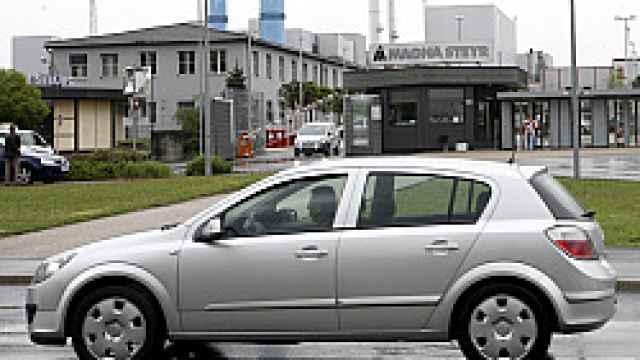
Markus Leodolter / AP
An Opel car passing the Magna Steyr factory in Graz, Austria. GAZ will build 180,000 Opel cars a year in Russia.
|  |
| |
Magna co-chief executive officer Siegfried Wolf said he expected a final contract with GM within four to five weeks, Bloomberg reported.
It was not immediately clear how much money Sberbank was ready to invest in Opel. Sberbank chief German Gref said Saturday that he saw the deal as a big opportunity for Russia's car industry. "This is a great chance for Russia to get one of the most technologically advanced European carmakers at an unprecedented low price," Gref told state-run Vesti television.
"Such an asset would make it possible to restructure the Russian car industry," he said.
Gref gave no further details of the deal. A Sberbank spokeswoman declined further comment on Sunday.
A GAZ spokeswoman said GAZ would need about nine months to retool its plant and plans to produce up to 180,000 Opel cars a year there beginning in 2010.
"We will keep our production facilities busy thanks to this," said the spokeswoman, who spoke under condition of anonymity in line with company policy. "This will also allow us to rise to a higher technological level in production."
No specific Opel models have been chosen for production, which will be organized on the conveyor where the Volga Siber sedan is now produced, the spokeswoman said. The production of the model was launched in July but suspended several times since because of low demand. "It hasn't been decided whether we will fully stop the production of the Volga Siber when we begin to make Opels or continue to produce it in parallel," the spokeswoman said.
The production site that GAZ wants to use was constructed by Magna. "It has 85 percent automated equipment that ideally will be completed with Opel's technology," the spokeswoman said.
GAZ owner Deripaska bought a 18 percent stake in Magna for $1.54 billion in May 2007 but was forced to cede it to bankers in September of last year.
Magna said it also wanted to produce Opel cars. "We want to build Opel cars in Canada," Magna chairman Frank Stronach told Toronto-based Globe and Mail. "If we don't change the culture, North America's got no chance to be in the automobile industry, absolutely no chance." Magna will become Canada's second-largest producer after the merger.
Mikhail Pak, an analyst with Metropol Group, said Opel would be welcome on the Russia market. "In the economy class, it will become a competitor for Ford Focus and Honda Civic," Pak said. "Magna will get a bigger share on the market in Russia by providing Opel service centers with car parts."
Pak said Sberbank's motives for participating in the deal may have been purely financial. "The bank may want to sell its share at a higher price later," Pak said.
Fiat withdrew its bid for Opel on Friday, saying in a statement that it hadn't been provided with enough financial information and felt that last-minute additional funding requests could expose it to "unnecessary" risks. It pledged assets but no cash in its bid.
Fiat CEO Sergio Marchionne extended his criticism at a news conference Friday. "This process is taking on the air of a Brazilian soap opera," he said in Montreal.
Tremonti, the Italian finance minister, said late Friday that Fiat might have lost its bid because it played by market rules and didn't ask for state support.
"Fiat did not ask the Italian government for anything," Tremonti said on the state-run RAI TV channel. He said Fiat "went to Germany to play according to market rules."
Italian Prime Minister Silvio Berlusconi "could have done a lot using his influence" had Fiat approached him for help, Tremonti said.
Further underlining the drama of the competition, German Economy Minister Karl-Theodor zu Guttenberg offered his resignation over the government's decision to pick Magna over Fiat, news reports said. Guttenberg did not support the sale to Magna because of taxpayer risk associated with the accompanying loan provided by the German government.
Merkel said Saturday that Obama had played a key role in influencing the outcome of the negotiations. "I spoke on the phone with the American president yesterday," Merkel said at a news conference Saturday. "That conversation clearly influenced the negotiations last night."
The Opel Deal
|
|
Germany has clinched a deal with Canadian auto parts group Magna, General Motors and the U.S. government to save carmaker Opel from the imminent bankruptcy of its U.S. parent. Below are the key developments in the deal. Cornerstones Of Deal
Ownership Structure The ownership structure of the new company could, according to Magna officials, look like this: Magna 20 percent, Sberbank 35 percent, 35 percent for GM and 10 percent in the hands of Opel staff or Opel car dealers. Carmaker GAZ will serve as an industrial partner for Opel. Magna plans to gain 20 percent of the Russian market in the short term before expanding this to 1 million units, including light commercial vehicles. GAZ??s biggest creditor is Sberbank. No Dividends The newly restructured German Adam Opel will not pay any dividends until state-backed loans to save the carmaker are repaid, a German government official said. Opel??s Main Plants in Europe
|
| Reuters |
A Message from The Moscow Times:
Dear readers,
We are facing unprecedented challenges. Russia's Prosecutor General's Office has designated The Moscow Times as an "undesirable" organization, criminalizing our work and putting our staff at risk of prosecution. This follows our earlier unjust labeling as a "foreign agent."
These actions are direct attempts to silence independent journalism in Russia. The authorities claim our work "discredits the decisions of the Russian leadership." We see things differently: we strive to provide accurate, unbiased reporting on Russia.
We, the journalists of The Moscow Times, refuse to be silenced. But to continue our work, we need your help.
Your support, no matter how small, makes a world of difference. If you can, please support us monthly starting from just $2. It's quick to set up, and every contribution makes a significant impact.
By supporting The Moscow Times, you're defending open, independent journalism in the face of repression. Thank you for standing with us.

Remind me later.