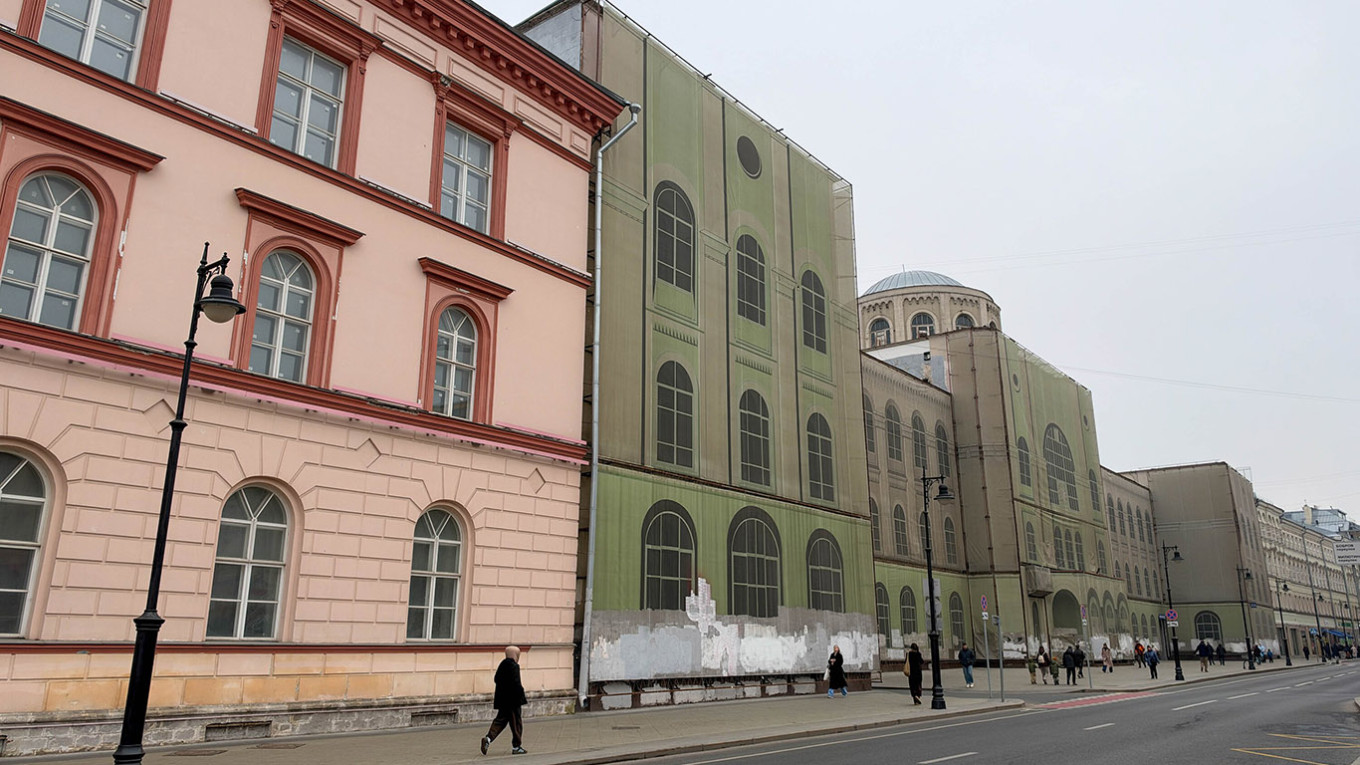
Russian Post has put a historic postal complex in central Moscow up for auction as the state-owned company grapples with mounting losses and debt, the Vedomosti newspaper reported Monday.
The former Moscow Imperial Post Office complex on Myasnitskaya Ulitsa has a starting price of 7.7 billion rubles ($95.5 million). The auction is scheduled for Dec. 9, with bids accepted through Dec. 3.
The property includes 19 buildings and 46 nonresidential units with a combined floor area of 21,400 square meters, according to the Russian Auction House. It occupies a 2.2-hectare site between Myasnitskaya Ulitsa and Chistoprudny Bulvar. Two of the buildings have protected cultural heritage status.
Real estate consultants who spoke to Vedomosti were divided over the asking price.
Maxim Chernyadyev, director of land projects at NF Group, said it was too high given the cost of renovation, a view shared by Dmitry Shelkovsky, head of land assets and development at IBC Real Estate.
But Stepan Zaitsev, deputy commercial director of workspace operator Business Club, described the price of 360,000 rubles ($4,464) per square meter as moderate for Moscow’s historic center.
Earlier this year, the Energy Interregional Holding Association acquired St. Petersburg’s historic Central Post Office building from Russian Post in a deal worth more than 1.2 billion rubles ($14.9 million), according to Vedomosti.
Developer Level Group also bought a complex belonging to Russian Post’s vehicle fleet operation on Moscow’s Ulitsa Dokukina.
Russian Post has reported losses for four consecutive years under International Financial Reporting Standards: 30.4 billion rubles ($377 million) in 2022, 8.1 billion rubles ($100.4 million) in 2023, 17.1 billion rubles ($212 million) in 2024 and 23.7 billion rubles ($293.9 million) in 2025.
Its cumulative losses over that period totaled 79.3 billion rubles ($983.3 million). The company posted a further loss of 10.1 billion rubles ($125.2 million) in the first half of 2026.
Total debt reached 126.5 billion rubles ($1.57 billion) at the end of 2025, with around 20 billion rubles ($248 million) a year spent on debt servicing alone.
Credit rating agency ACRA downgraded the company in August, citing its heavy debt burden and insufficient internally generated income to service its borrowings.
Russian Post has also cut staff. Its workforce shrank by 13% in 2025 to 211,600 employees.
Authorities are seeking new revenue sources for the postal service, including a government proposal to give it exclusive rights to deliver age-restricted products such as sex toys, energy drinks and fireworks.
A law signed in July introduced support measures including mandatory paid electronic services and the elimination of bank commissions on utility payments collected by Russian Post.
The State Duma is also considering legislation that would allow wine sales through the company’s website.
This article was translated with the help of artificial intelligence and was reviewed by a Moscow Times editor before publication. Learn more about our newsroom's AI policy here.
Read this article in Russian at The Moscow Times' Russian service.
A Message from The Moscow Times:
Dear readers,
We are facing unprecedented challenges. Russia's Prosecutor General's Office has designated The Moscow Times as an "undesirable" organization, criminalizing our work and putting our staff at risk of prosecution. This follows our earlier unjust labeling as a "foreign agent."
These actions are direct attempts to silence independent journalism in Russia. The authorities claim our work "discredits the decisions of the Russian leadership." We see things differently: we strive to provide accurate, unbiased reporting on Russia.
We, the journalists of The Moscow Times, refuse to be silenced. But to continue our work, we need your help.
Your support, no matter how small, makes a world of difference. If you can, please support us monthly starting from just $2. It's quick to set up, and every contribution makes a significant impact.
By supporting The Moscow Times, you're defending open, independent journalism in the face of repression. Thank you for standing with us.

Remind me later.