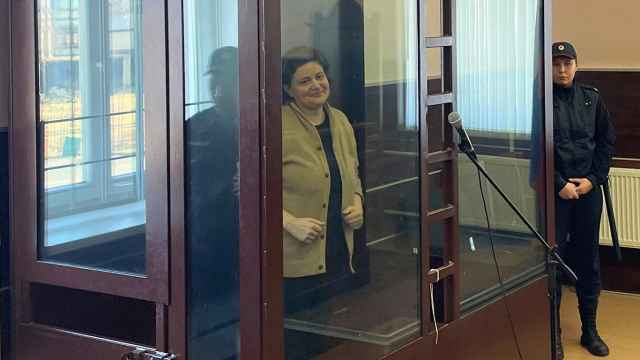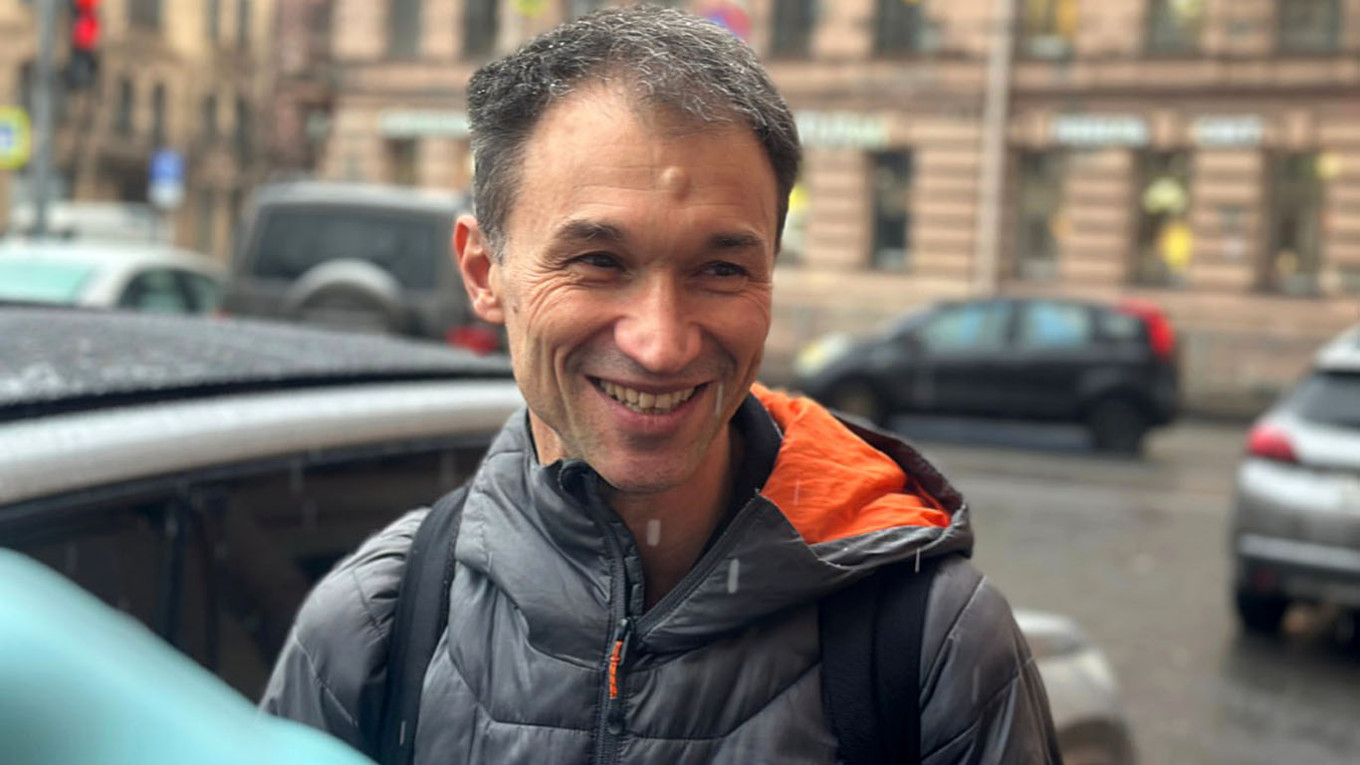
On Dec. 8, 2025, I walked out of a courthouse in St. Petersburg after spending almost five months in pre-trial detention. The court gave me a fine rather than a prison sentence. That same morning, I was still in custody. I had been accused of financing extremist activity over donations of around $40 to Alexei Navalny’s Anti-Corruption Foundation.
The first thing I did was go with my closest relatives and lawyers to a nearby café. We discussed the most practical things: how to pay the fine, how to collect my belongings from the detention centre, what would happen if the prosecution appealed. The lawyers explained that the prosecution could file its appeal on the final day of the statutory deadline. Until then, I was still forbidden to leave the area and, if there was an appeal, the restrictions could remain in place until the city court issued its decision.
I thought I was finally going home. I wanted to see my wife, hug my children, lie down in a normal bed. I had imagined that evening many times during my months of detention.
But on the way home, my family told me that I could not stay in Russia. They believed the prosecution would almost certainly seek an actual prison sentence. It turned out that there were already people ready to organise my departure. At first, I understood that to mean I had at least a day or two. Then everything sped up. We managed to pick the children up from school and have lunch when the coordinator told me that I needed to leave as quickly as possible.
About half an hour later, it became clear that the driver was already ready.
At that moment, my parents called me. Then my older son, who was in Georgia. Everyone congratulated me on my release, told me to relax and finally enjoy some time with my family. I could not tell them that in a few hours I would be leaving again. The fewer people who knew the route, the safer it seemed.
My younger son sat beside me, listened to those conversations and cried. He already knew that I would be leaving in a couple of hours.
I was asked whether I understood that, by leaving now, I might never be able to return to Russia. I said yes.
I very much wanted to stay. More than anything, I wanted to spend at least one night at home with my wife and children. But the fear of ending up behind bars again was stronger. I explained to the children: it was better for us to live apart for a while longer but be able to talk at any time and see each other on video than for me to end up back in prison for several years.
I understood something else as well: I was leaving while my undertaking not to leave the area was still in force. That decision was not without risk either. But I compared that risk with another one — that the prosecution would appeal the verdict and I would be taken back into custody.
The main issue became time. At first, it seemed to me that I might have to cross the border illegally or semi-legally. Then I learned that the crossing would be ordinary, using my passport. Paradoxically, that was exactly what convinced me that I had to leave immediately. Stopping me would be easy if an alert was put out. A few hours after the court hearing, it might not yet be there. A few days later, the likelihood seemed much higher.
I did not know how quickly information moved between agencies. And it was precisely that uncertainty that determined my decision.
I took a small backpack containing a laptop, chargers, one book, a couple of changes of underwear, toiletries, documents and cash. Almost nothing else, so that I could remain highly mobile and support the cover story that had been proposed to me.
We hugged, my wife and children and I, and I walked to the first point on the route. On the way, I checked whether anyone was following me. I was almost certain there was no surveillance: hardly anyone could have expected a person to voluntarily leave his family on the very first day after his release. But I still kept looking back.
At the agreed location, a man was waiting for me with a clean phone containing none of my personal data: a SIM card unassigned to me, a VPN and secure messenger apps. It came with the coordinator’s contacts and instructions already included.
A taxi was ordered for me to the next point. I did not have any bank cards, only cash. On the way, it turned out that the driver did not have change for large banknotes, so we stopped at a hypermarket to get some smaller denominations. For some reason, I remember that small detail very clearly. When you are trying not to leave any digital traces anywhere, an ordinary problem with getting change suddenly becomes part of the operation.
It was almost midnight when I got into another car that was supposed to take me further. The coordinator asked me to make contact with him every two or three hours.
The driver thought I was a businessman from Minsk. I decided not to undermine that story. He offered me a pillow from the boot. I lay down on the back seat and tried to sleep. I could not. The day kept replaying in my head over and over. That morning, I had been in a cell. Now I was driving along a highway at night, not knowing what would happen at the border or what information about me might already have appeared in any databases.
At around six in the morning, we crossed the Russian-Belarusian border. My passport was scanned like it would be at an airport. The few minutes of waiting to see if my documents had been flagged felt very long. Then the officer gave a signal. I could go.
Relief washed over me. Almost immediately, another thought crossed my mind: there is no way back now.
In Minsk, the driver dropped me off at the bus station and I bought a ticket for a bus to Vilnius. Next to me was a man with the same combination of citizenships as me: Russian and Israeli. He had travelled that route many times and explained to me how the border checks worked. At the Belarusian border, I stood in the queue behind him, listened to the questions he was asked and watched how he answered them.
When it was my turn, I first handed over my Israeli passport. When asked how I had entered Belarus, I said that I had arrived by car from Russia that morning. They then asked for my Russian passport. The officer looked at the stamps, asked questions and eventually let me through.
I wrote to the coordinator: “I think that’s it. I’m free.”
But the bus then waited for the other passengers for about another half an hour. The barrier did not open and I was still feeling nervous. Formally, the check was already behind me, but I was still waiting for the final movement forward.
Everything about the process on the Lithuanian side was easier. The border guard asked where I was going. I explained that someone was meeting me in Vilnius.
“For how long?”
“Apparently, forever.”
He let me through.
I was taken to a hotel in Vilnius. Just over a day earlier, I had been in a cell. I collapsed onto the bed and, for the first time in many months, fell asleep on a normal mattress.
The next day, I hardly went anywhere. I restored access to services and changed my passwords — my old phone was still with the investigators. I bought a sweater. At the supermarket, I bought a pile of fruit that I had missed while in pretrial detention.
But even in Vilnius, I still did not tell anyone where I was for several days. My lawyers, family and closest friends had agreed to observe a “period of silence” until it became clear whether there would be an appeal. My parents believed that I was still in St. Petersburg. When my name accidentally appeared in a local housing-search chat and a journalist asked my family whether this meant I was abroad, we had to get the post deleted urgently.
After prison, I began to see my formal status differently. The court’s decision mattered enormously. I had been released but had no answer to the question of what would happen the next day if the prosecution lodged an appeal, if new information entered a database or if another agency made its own decision.
No one ordered me to leave Russia that same night. No one forced me to take a clean phone, use cash, check whether I was being followed, or conceal from my parents where I was. I made all of those decisions myself.
That, for me, was the main change. When the consequences cannot be reliably predicted, people begin to restrict their own behaviour in advance. Not because someone has already issued a new order, but because the cost of a mistake seems too high.
The court released me on December 8, but I only felt safe once I was on the other side of the border.
A Message from The Moscow Times:
Dear readers,
We are facing unprecedented challenges. Russia's Prosecutor General's Office has designated The Moscow Times as an "undesirable" organization, criminalizing our work and putting our staff at risk of prosecution. This follows our earlier unjust labeling as a "foreign agent."
These actions are direct attempts to silence independent journalism in Russia. The authorities claim our work "discredits the decisions of the Russian leadership." We see things differently: we strive to provide accurate, unbiased reporting on Russia.
We, the journalists of The Moscow Times, refuse to be silenced. But to continue our work, we need your help.
Your support, no matter how small, makes a world of difference. If you can, please support us monthly starting from just $2. It's quick to set up, and every contribution makes a significant impact.
By supporting The Moscow Times, you're defending open, independent journalism in the face of repression. Thank you for standing with us.

Remind me later.