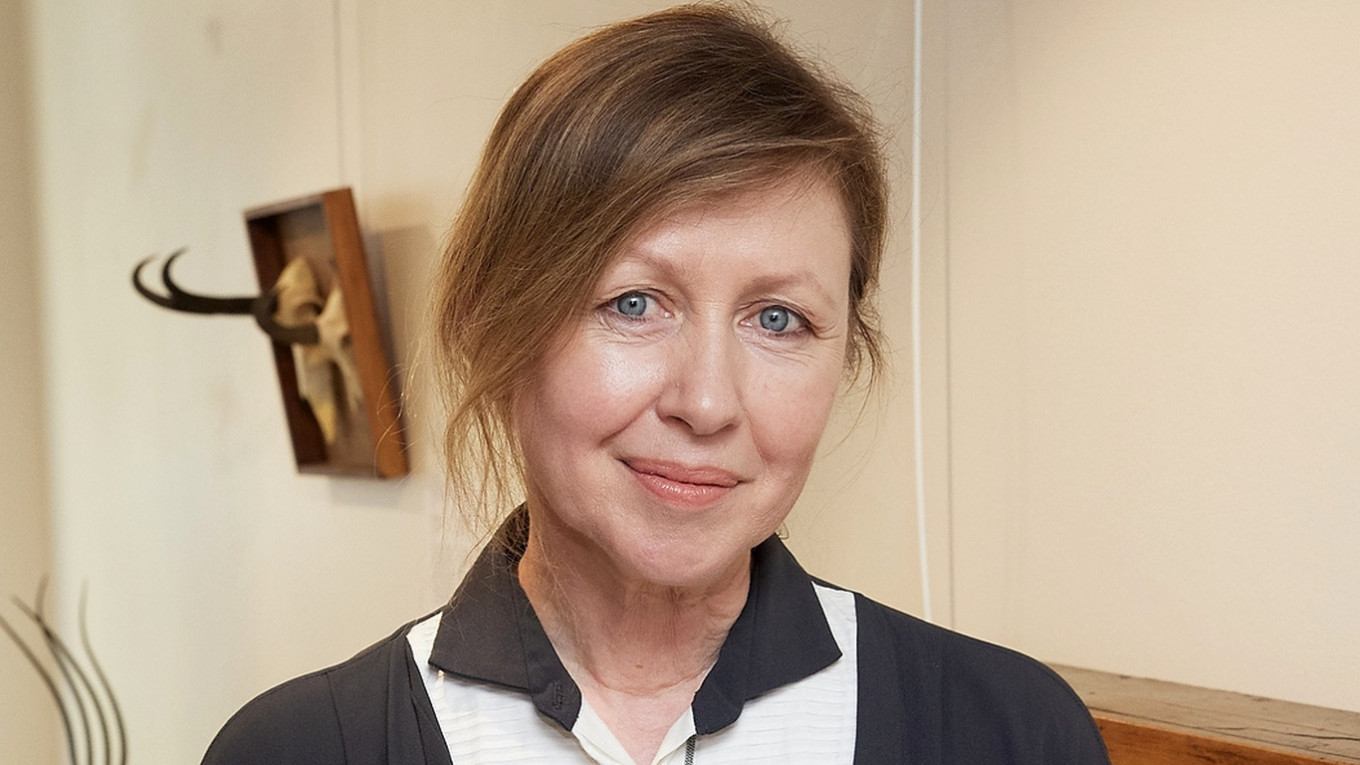
Informal networks and unwritten rules have long shaped how power operates in Russia. According to academic Alena Ledeneva, these forces help explain the country’s recurring swings between openness and isolation, as well as the difficulty of changing the system by replacing its leader.
In “Russian Pendulum: Paradoxes, Practices and Patterns,” Ledeneva examines the informalities that influence Russian politics and society. The book has been shortlisted for the Pushkin House Book Prize, whose winner will be announced in London on Sept. 26.
Ledeneva spoke to Pushkin House Book Prize founder Andrew Jack about Russia’s unpredictable political trajectory, the informal foundations of Vladimir Putin’s rule and why any future leadership will need to confront the system that produced him.
PH: How did you go from Akademgorodok to University College London?
AL: I owe my career path to Mikhail Gorbachev, who opened up the Soviet Union; George Soros and Teodor Shanin who funded and organized summer schools for Soviet sociologists; Tatiana Zaslavskaya, Inna Ryvkina and Anthony Giddens for academic guidance. I had been raised in Akademgorodok in Novosibirsk, a Khrushchev thaw project constructed after a visit to a Midwestern campus. It was deep in Siberia, boasting a nuclear accelerator, placed strategically away from Moscow in case of a nuclear hit. There were a lot of scientific exchanges, CERN among others. We had contacts with sociologists in Hungary and Poland. There were samizdat translations of academic literature. I realized that Akademgorodok was very similar to Cambridge structurally, with botanic gardens, 30 research institutes and a university where the teaching staff were scholars themselves — which was not true for the rest of the Soviet Union. When I got to Cambridge in 1990, I felt at home and ended up with an M.Phil., a Ph.D. and a postdoc there. In 1999, I saw a job advertised at the School of Slavonic and Eastern European Studies. It mentioned Russia, informal networks, informal economies — everything I researched then. I got the job and moved to London.
PH: Why did you decide to write this book?
AL: The story is slightly traumatic. In 2013 I published ‘Can Russia Modernise?’, what I thought to be my last book on Russia. It was the end of a trilogy on the workings of informal networks. It was a shock and a disappointment to see Putin returning for his third term as president in 2012. Since the annexation of Crimea, I have effectively withdrawn from Russian studies. I started something new, the Global Informality Project, during my fellowship at the Paris Institute of Advanced Studies. The project now covers five continents, over 100 countries and 600 researchers. It’s a massive endeavor designed to map how informal networks operate in the world: hidden practices, unwritten rules, open secrets: the know-how that all insiders know and all outsiders have no way of guessing. Placing Russia in this context has been eye-opening. My Russia trilogy might convey the message that Russia is unique. The three massive volumes of the Global Encyclopedia of Informality, based on the network expertise of scholars around the globe, reverse this message. Russia is not unique or exceptional. Specific — yes. But so is every other country, when it comes to tackling complexity and finding shortcuts for problem-solving. The challenge of this new book is both to embrace the universality of patterns of informal power and show their specifics, as well as do so in a concise format and with clarity suitable for students.
PH: Why do you use the metaphor of the pendulum?
AL: The word has been used before me — in boxing, in academic analyses, in the 1919 book called ‘The Russian Pendulum.’ The idea of the pendulum swinging to return is very helpful to imagine a historical trajectory that is not that straightforward. Kondratieff wrote about long-wave cycles. His model did not work when tested on big data, but one can see the intuitive value of the metaphor. The collapse of the Soviet Union took place in 1991, and 30 years on, the Russia-Ukraine war started, closing the era of openness and integration. Russia has become isolationist, and it might take another 30 years or so before a new opening up will happen in Europe.
However, pendulums are supposed to be predictable, which is not the case. The title of the book is also a paradox: Russia’s pendulum is actually unpredictable. Every chapter offers a pattern you need to bear in mind to capture Russia’s unpredictability in politics, the economy and society. They say the only predictable thing about Russia is unpredictability. I suggest the chaotic logic of double pendulums at the subnational level, in Russia’s regions, to illustrate their complexity. I include some key concepts from Russian scholars which might be useful to shift attention away from Moscow or Putin and look at Russia in a longer term.
PH: Will the Russian pendulum continue to swing forever?
AL: This is the point of this book: to identify patterns that need to be transformed. Whenever people oppose Putin’s regime, want him out or state that there is no one else who could take the job, they seem to forget that Putin was once an unknown, and he was once the right person for the job before turning into someone entirely different. There are examples of similar transformations in history. Mikhail Gorbachev famously concluded that there is only so much an individual can do from inside the system, even in a position of leadership. The system shapes and molds you in a certain way and if you are not compliant, it will kick you out. That's going to be the fate of Putin too once he's perceived as a threat, which is now starting to happen.
It’s not just about changing those in charge. The very foundations of the system, associated with the informal power of security services and informal financial flows that serve informal agendas, should be the target. Personalized attacks are not really effective. Systemic tackling of corruption is a rarity. Effective anti-corruption campaigns are successful in relatively small societies of up to 5 million people, best placed on an island, like Singapore or Hong Kong. Russia is a huge country. It's very hard to tackle something nationwide if only because of the scale and regional variety. Of course, the power transfer is essential for development, and changing the person in charge will bring a new impetus, and even direction, to the pendulum. Yet without articulating and challenging the fundamental patterns of Russia’s informal governance, good people will do bad things and step on the same rake of the ‘system made me do it’ logic.
PH: Why did you make the book free to download?
AL: That was intentional. It's not a long book to read for a policy maker or for a think tank, and in a sense, it is a manifesto, a challenge, an appeal to the leadership after Putin. To make it accessible to the wider audience and to students who might not have money to buy it was logical. The UCL press does a great deal to make ideas accessible around the globe. There is a lot of talk about equality, diversity and inclusion, but much of the academic literature is not accessible for the Global South. I discovered that all three volumes of The Global Encyclopedia of Informality (in open access from the UCL Press) achieved 250,000 downloads, and are very popular in India — an extraordinary outreach for an academic book. The universal patterns of informal power tackled in Russian Pendulum will be of interest to all those interested in the inner workings of political and corporate regimes around the globe, not only Russia. Open access is important so it's available for everyone.
PH: Explain the art you show in the book.
AL: I created my first work, ‘The Inner Circle,’ in 2016. A perfect example of informal power, an inner circle is empirically determined by the outsiders’ inability to penetrate it. Insiders enjoy direct access to the center of power, via a private entrance, elevator or phone. Insiders block outer contacts, filter information and monitor each other. The artwork depicts the paradox of how one’s trusted people, belonging to the circle of trust, cannot trust each other and cannot turn one’s back on the rest. The leader’s position is ambivalent: does one lead the pack or follow the pack to make sure everyone is trustworthy? Moving the agenda forward while being locked into informal agreements and obligations, both within and outside the circle, presents a challenge. The paradox of informal power is that the leader is the key broker of the system, but also its hostage.
The key driver for art was the complexity of data in the Global Informality Project. Every day I read entries from all over the globe, and it was so varied and nuanced that I felt I needed a shortcut to hold it together for myself. That idea of a pattern — shared by multiple practices around the globe — has emerged and gradually transformed into the collection of the invisible dimensions of informal power, without much design or thinking about exhibitions. I have used the technique of objet trouvé and assemblage: the objects that seemingly have lost their use in modern society, and which I found at brocantes in southern France, actually captured what it is to be human and how relate to others, especially in the era of the pandemic, polarization and post-humanity. I was lucky enough to present my art in the parallel program of the Venice Biennale in 2018 and to have a personal exhibition in Paris. That was very exciting. I never thought of myself as an artist, I worked on the visualization of the invisible, an informal power that pervades human societies. Later on I discovered that there aren’t so many artistic visualizations of informal power, despite its pervasiveness. So I continue my artwork on the informal ways of making things work.
PH: Explain the music in the book.
AL: The music was composed by Benjamin Woodgates, my son-in-law who is a composer. I discussed my text with him to see if abstracting the patterns into music might serve as a shortcut to understanding, or at least feeling them. He was doubtful at first, but then, when I showed him my art, he really got hooked on the idea. The way the instruments — two marimbas — bring out all these complex structures and undertones is amazing. Some patterns you can hear at the surface level, others are more camouflaged but contribute to this deep, almost unconscious sense of sistema. So we have music that one can hear, feel, understand and that is hopefully transformative and reflects the idea of ambivalence. It was really in the stars. It’s not that I believe in magic, but there was a constellation of the music, art and text — and now the Pushkin House Prize shortlist!
PH: What are your future plans?
AL: My next project is on exit. With my husband, we are going to co-produce a project on exit, hoping it might be an exit for us, respectively, from academia. For me of course, the focus is on exit from the system. I keep trying to help people who leave the system, to find a new purpose, a new way of being. I think the lens of ambivalence, used in the book, highlights the obvious: an exit is also an entry. The informal pattern of revolving doors has a negative connotation but it also conveys an important wisdom: when one door closes, another opens. My new art exhibition, scheduled for the end of May 2027 in Paris, will coincide with the end of Macron’s time as French president. So there will be many exits.
A Message from The Moscow Times:
Dear readers,
We are facing unprecedented challenges. Russia's Prosecutor General's Office has designated The Moscow Times as an "undesirable" organization, criminalizing our work and putting our staff at risk of prosecution. This follows our earlier unjust labeling as a "foreign agent."
These actions are direct attempts to silence independent journalism in Russia. The authorities claim our work "discredits the decisions of the Russian leadership." We see things differently: we strive to provide accurate, unbiased reporting on Russia.
We, the journalists of The Moscow Times, refuse to be silenced. But to continue our work, we need your help.
Your support, no matter how small, makes a world of difference. If you can, please support us monthly starting from just $2. It's quick to set up, and every contribution makes a significant impact.
By supporting The Moscow Times, you're defending open, independent journalism in the face of repression. Thank you for standing with us.

Remind me later.