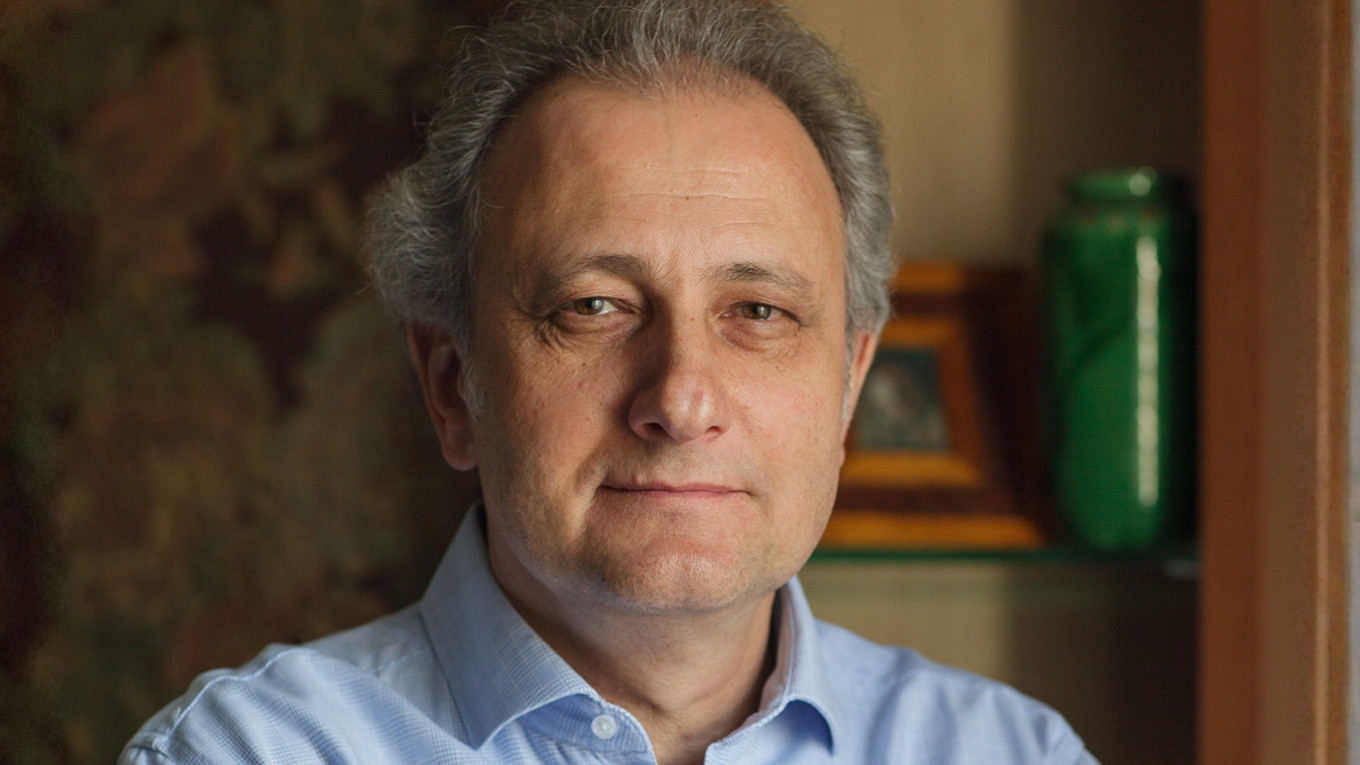
Over more than two decades in power, President Vladimir Putin has built an ideology around Russia’s imperial history, confrontation with the West and his own role as the country’s indispensable leader. Political analyst Andrei Kolesnikov argues that this worldview helped prepare Russia for dictatorship and the invasion of Ukraine.
In “The Closing of the Russian Mind: How Putin’s Ideology Took the Nation Hostage,” Kolesnikov traces the evolution of Putinism from the early promise of authoritarian modernization to repression, militarism and isolation. The book has been shortlisted for the Pushkin House Book Prize, whose winner will be announced in London on Sept. 26.
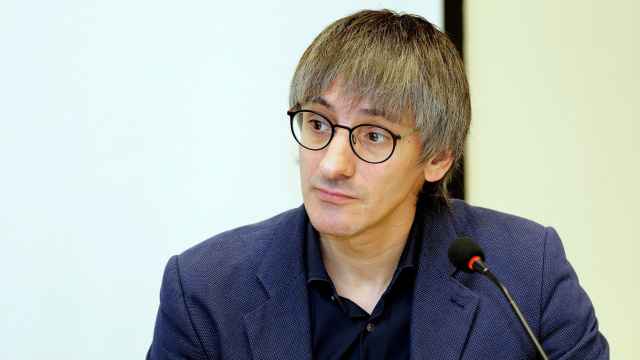
Kolesnikov, a Novaya Gazeta columnist who has been designated a “foreign agent” by the Russian authorities, spoke to Pushkin House Book Prize founder Andrew Jack about his decision to remain in Moscow, the risks of writing from inside Russia, the indoctrination of young Russians and the country’s prospects after Putin.
PH: What is your background?
AK: I graduated from the law department of Moscow State University in Soviet times and worked in the Supreme Court, so I know the system from the inside. It was extremely boring. But the system worked better than now under Gorbachev: it was less politicized, and I was not ashamed to be part of it. I wrote a dissertation and then decided to be a journalist, which was at a very interesting time. I had close ties with the circles of Gaidar, Chubais and other economic reformers. My brother was a speechwriter for Gaidar and Chernomyrdin, which allowed me into the secret life of the authorities. I worked for Izvestia and Ogonyok and wrote as a columnist for the main business newspapers of that time, Segodnya and Vedomosti. All these years I was writing books, primarily on Soviet and Russian political history. I joined Novaya Gazeta 15 years ago. Then I had a very interesting proposal from Carnegie and spent nine years as a senior fellow responsible for domestic politics. The center was closed after beginning of the war, and I was named a foreign agent. I continued my work in Moscow and was part of the team of the Carnegie Russia Eurasia Center in Berlin until it was named an undesirable organization — cooperation with which means inevitable prosecution. I decided to stay in Russia, and I was hired again by Novaya Gazeta.
PH: What is your status in Russia now?
AK: I was labeled a foreign agent. That means I don’t have full civil rights, although that contradicts the Constitution. It’s my right to work, so I continue my research attempting to describe and analyze the current situation. I don’t pay too much attention to restrictions, but I follow some rules. Novaya Gazeta doesn’t have a media license so it is blocked in Russia, but it can publish on the website, Telegram, YouTube and so on. We had a massive search on the premises for unexplained reasons and our investigative journalist Oleg Rodulgin was arrested (now he is under house arrest). The situation is very dangerous for us, although the reputation of Dmitry Muratov at Novaya Gazeta maybe helps us to continue.
PH: Why did you decide to stay?
AK: I don’t want to leave my country. It is still mine. My family, some of my children, grandchildren and the graves of my parents, brother and grandparents are here. Up until now, I still see opportunities to operate inside Russia, to write and analyze. It’s more an emotional than a rational decision, but I clearly understand that if I follow other colleagues who have left, I have no chance to return. It could be forever. No one knows how long the regime could last, but I’m here while it is still possible. I know for sure that my work from inside Russia is a consolation for those who are here. Sometimes people who read the liberal press or watch YouTube broadcasts come up to me and simply say ‘thank you.’ It inspires me.
PH: What rules do you need to follow in your writing?
AK: It’s better not to use the word ‘war.’ It’s used by top officials freely but there are very bad cases of it being used leading to criminal prosecution, even imprisonment. We use substitutes like the ‘special military operation.’ I try to avoid using it even in Western media. It doesn’t help to understand the essence of the events, but it could make my personal life harder. Everyone understands what ‘full-scale invasion’ means. We don’t use non-analytical words. It’s better to explain what it means and to still have a connection and live in today’s Russia. One more very sensitive topic is how to describe military losses. But again, if you dare to work and write and broadcast you can still do it.
PH: What is the key message of your book?
AK: The main idea is that Putin couldn’t launch his special operation without ideology. It was important for me because the idea that he was someone with messianic ideas was not so evident at the very beginning of his first term. I wrote in 2000 comparing him with Mussolini, ideologically and politically: it looked like he would be an authoritarian modernizer. As we know, that ends up not with modernization but with authoritarianism. And the driver of this hand-made catastrophe was Putin’s obsession with the messianic role of Russia, its so-called 1,000-year history, and his desire to be seen as the tsar of the recreated Empire, equal to the leaders of the great powers. He failed to assert himself as a trendsetter in the world using soft power, so he has chosen the military way.
PH: What was the turning point for him?
AK: The first real suspicion that everything would go wrong was when he restored the Soviet anthem in 2000. Then during the re-election in 2003, we saw the failure of the democratic process and the arrest of Khodorkovsky. In 2005, he talked about the collapse of the Soviet Union as the ‘greatest geopolitical catastrophe’ of the 20th century, followed by his 2007 Munich speech which provided a roadmap. In 2012, society demonstrated it want more than simply Medvedev — it wanted the luxury of democracy. Putin saw the enemy, and decided to destroy it. When he returned to the Kremlin in 2012, he began this process of returning Russia to its so-called traditional values and to a real dictatorship. The peak was the annexation of Crimea. For me, one of the main events was the liquidation of [human rights organization] Memorial. At the cornerstone of his ideology, it was extremely important to destroy national memory, to cancel the knowledge of the dark pages of our history.
PH: How significant is his interference in the education system?
AK: It seems that Putin wants eternal life, nearly literally. So it is extremely important for him to nurture the next generation of supporters and voters, since formally we have elections and democracy. He wants a new generation which must be loyal, supporting and serving him including militarily. The educational system has been adapted to this goal, especially in history textbooks. There is the takeover of university education with the ‘fundamentals of Russian statehood’: what was Soviet scientific communism has now become scientific Putinism. It’s important for the regime to isolate the younger generation from western education, so it named different U.S. universities as ‘undesirable.’ As a result we have pure dystopia. The younger generation is very different. Some are making careers inside the system. Some are aggressively loyal, some are not loyal but follow the rules. A lot — mainly boys — are trying to avoid conscription. Not everyone can be indoctrinated. In my years in university, not so many people seriously accepted Soviet ideology. Some were and are partly indoctrinated, with a critical attitude. It’s the same today.
PH: What will be Putin’s legacy?
AK: It looks like he’s a person with a mission. Maybe he sincerely thinks he’s returning this greatness to Russia. Everything he’s doing is not about greed and money, but also about ideology. He cares about his legacy but using an abnormal approach. This regime doesn’t have an image of the future at all. It has problems with goal setting and legacy. Generally, people say they want to live normally, with a return at least to 2021 when there were direct flights to the west, western goods and no war: an authoritarian regime but with a market economy. Maybe this is something like a national idea: don’t think that people want to live in the traditionalist isolated ‘paradise’ constructed in the Putin or Dugin-like brains of an Orthodox secret serviceman.
PH: What happens after Putin?
AK: There are a lot of people who share his view on the place of Russia in the world. The special services are becoming more and more influential. History demonstrates that in personality-based regimes, the disappearance of the original leader changes a lot. For instance, after the death of Stalin, his closest official began liberalization almost overnight. I’m reading a lot now about transition periods in different countries including in Portugal and Spain. It looks like anything is possible if there is a revolution from above, and the impulse from above coincides with the desire for changes from below. For the moment from below, people don’t feel influential enough to demonstrate discontent — the level of political repression is higher than under Brezhnev. Discontent from above is more or less evident, but elites are paralyzed by fear.
PH: What’s your view on Russia’s place in the world?
AK: Putin tries to imitate the Soviet Union but this is not the Soviet Union. He’s losing his empire, and is obsessed by the idea of restoring it. He insists on a multipolar world, but he’s not the most influential pole and fails to use the Brezhnev doctrine in the current circumstances. Trying to restore spheres of influence, he has achieved the diametrically opposite result: he’s losing Central Asia, he’s lost the Caucasus. He’s not so mighty to be equal with the U.S. We saw how he was in a great hurry to meet Xi just after Trump’s meeting in order to demonstrate that he’s equal to the most influential leaders. He wants to establish new rules for the new world order, but for the moment he’s not a trend setter. He’s more a world spoiler.
PH: Are you optimistic about the future?
AK: I’m a historical optimist. For the moment, we don’t see an exit. Putin will not reform this country or liberalize the system, so we have to wait for the end of the story more or less passively, trying to do something — cultivating our own garden but not more. This hot phase will not continue forever because of insufficient resources. A cold phase is coming. The only thing he can suggest to the population is confrontation with the West. That can continue. To rally round the flag, you must have external and internal enemies: suppression inside, by fighting traitors, undesirables and foreign agents; and outside, through permanent hybrid war. In these circumstances the strategy could be based, according to Antonio Gramsci’s formula, on the pessimism of reason but the optimism of the will.
A Message from The Moscow Times:
Dear readers,
We are facing unprecedented challenges. Russia's Prosecutor General's Office has designated The Moscow Times as an "undesirable" organization, criminalizing our work and putting our staff at risk of prosecution. This follows our earlier unjust labeling as a "foreign agent."
These actions are direct attempts to silence independent journalism in Russia. The authorities claim our work "discredits the decisions of the Russian leadership." We see things differently: we strive to provide accurate, unbiased reporting on Russia.
We, the journalists of The Moscow Times, refuse to be silenced. But to continue our work, we need your help.
Your support, no matter how small, makes a world of difference. If you can, please support us monthly starting from just $2. It's quick to set up, and every contribution makes a significant impact.
By supporting The Moscow Times, you're defending open, independent journalism in the face of repression. Thank you for standing with us.

Remind me later.