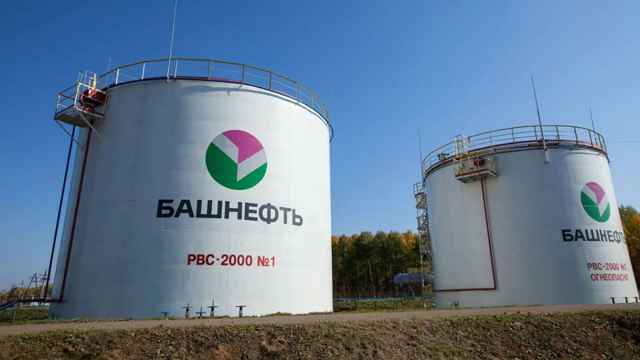

Bukhta Sever, the Arctic oil terminal built for Rosneft’s massive Vostok Oil project, has sent out its first export cargo. Or is about to.
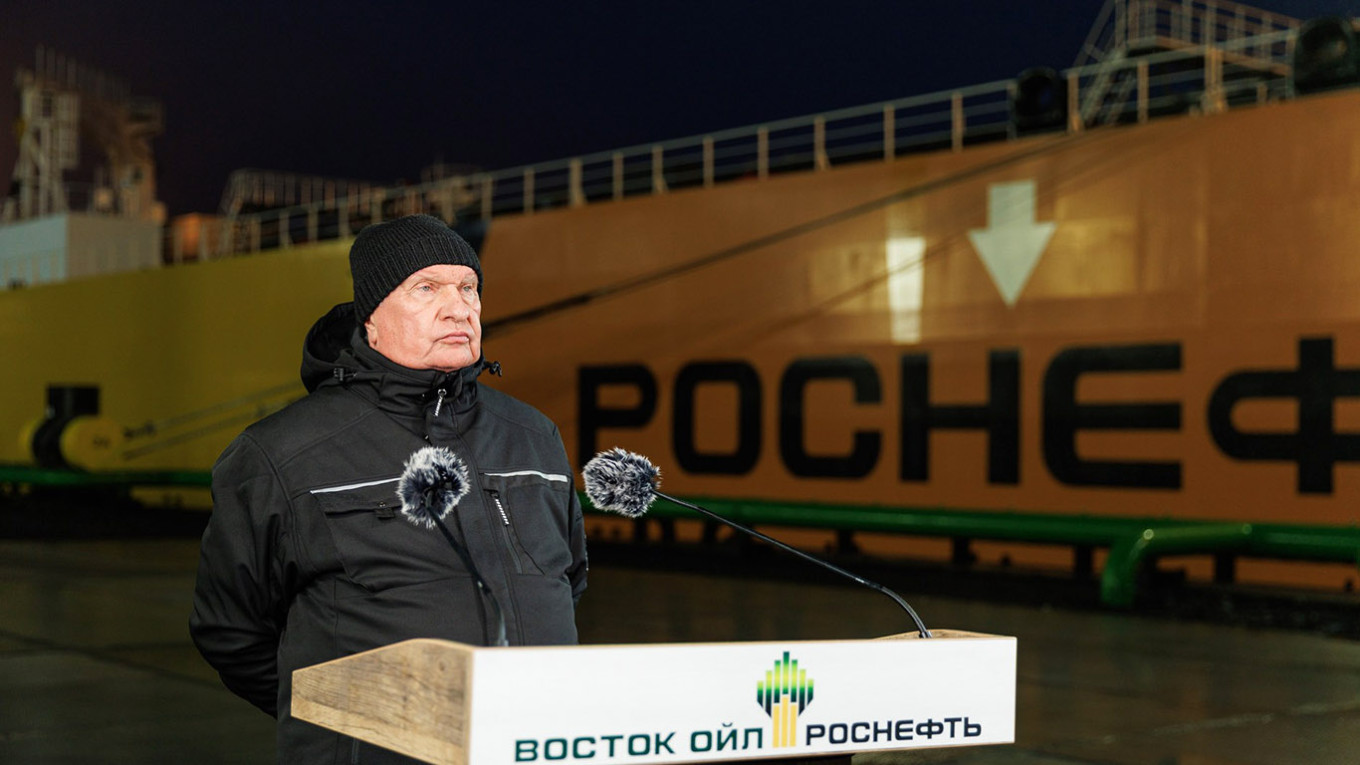
The shuttle tanker Valentin Pikul spent 84 days waiting beside the port’s only loading berth. Now full, it is preparing to head for China along the Northern Sea Route. A sister ship, the Akademik Gubkin, is on its way to the terminal.
The two 120,000-ton tankers were built in sections in South Korea to Samsung’s AST69K design. The sections were then shipped to the Zvezda yard in Russia’s Far East and welded together.
Rosneft says it will need at least 40 tankers to carry oil from Bukhta Sever, plus more than 10 support vessels, some of them ice-class. Most of this fleet exists only on paper.
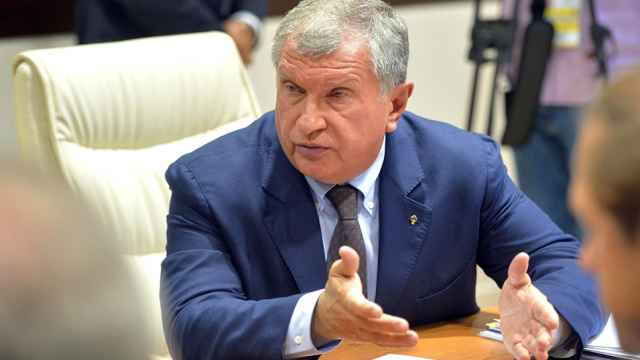
The loading ceremony for the Valentin Pikul followed a familiar script. Rosneft CEO Igor Sechin reported another triumph to President Vladimir Putin, and the numbers grew more impressive as he spoke. Sechin even called the tankers Arc7 vessels, despite shipping registers identifying them as Arc6.
That was the modest part of the performance.
An astonishing 30 million tons
Sechin promised that Vostok Oil would ship about 30 million metric tons of crude during the second half of 2027. Later, if the market cooperates, output could rise to 100 million tons a year.
Thirty million tons in six months works out at roughly 164,000 tons a day. Bukhta Sever would have to load the equivalent of about two Aframax tankers every day, without a break.
Rosneft does not have the ships, and they cannot simply be hired elsewhere because there is no large reserve of ice-capable tankers waiting for work on the world market.
Then there is the route itself. Shipping through the eastern part of the Northern Sea Route is possible for only a few months each year, with heavy icebreaker support. Keeping two tankers a day moving through those waters would strain a mature transport system with a full fleet behind it. Vostok Oil has neither.
Sechin has been reciting some version of this promise for years. In November 2020, he told Putin that the project would reach annual shipments of 30 million tons in 2024. Construction at many of its sites had scarcely started.
Nothing close to 30 million tons was shipped in 2024. The date has since moved to 2027, while the promised rate has doubled: Rosneft now proposes to move the same amount in half the time.
It will not happen. Vostok Oil is unlikely to export 30 million tons during all of 2027, let alone its final six months. The production forecasts are no more convincing than the shipping plan.
The 7-billion-ton “resource base”
Today, Vostok Oil has two main production clusters: Payakha and Vankor. The East Taimyr licenses once bundled into the project have quietly dropped away after disappointing results.
Rosneft still calls Vostok Oil “a new world-class oil province,” claiming a resource base of more than 7 billion tons of premium low-sulfur crude.
The careful wording matters. In Russian petroleum classification, “resources” are a long way from reserves ready for commercial development. The term includes oil that may be present but has yet to be confirmed by adequate exploration drilling.
None of the independent oil specialists interviewed for this article believes that Vostok Oil has 7 billion tons of proven oil.
The Payakha cluster contains two discovered fields, Payakha and West Irkinskoye. Their potentially recoverable reserves have been put at around 1.5 billion tons. Even that figure is shaky. The oil falls into the C1 and C2 categories, either preliminarily appraised or still insufficiently explored. As more wells are drilled, estimates of this kind often shrink by 30% to 50%.
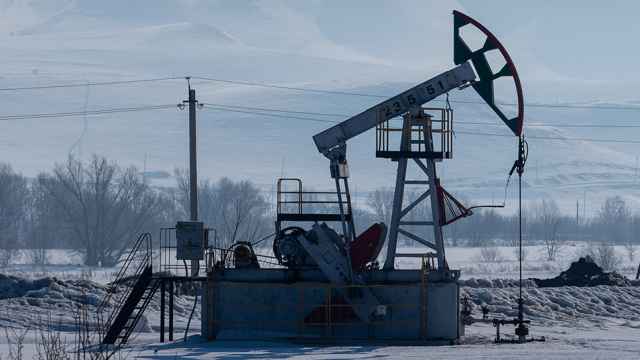
Payakha would be immensely difficult to develop even if the oil is there. The fields sit near the mouth of the Yenisei River amid swamps that are almost impassable in summer. Winter replaces the mud with the brutal conditions of the High Arctic.
The deposits lie more than four kilometers down, trapped in geologically complex formations. Getting the oil out will require hydraulic fracturing. That means bringing in entire fracking fleets, each made up of dozens of trucks carrying heavy equipment, across terrain that barely supports ordinary transport.
The cost of every barrel will be enormous.
Vankor cannot fill the gap. Its five fields — Vankorskoye, Suzunskoye, Lodochnoye, Tagulskoye and Ichemminskoye — have recoverable reserves estimated at about half a billion tons. They have also been producing for years.
The cluster reached its peak in 2017 at around 20 million tons. Water now accounts for as much as 84% of the fluid brought up from its wells. At this stage, Vankor cannot supply much more than 7 million to 8 million tons of oil a year.
Why drag it into Vostok Oil at all? Vankor already has a perfectly serviceable route south into Transneft’s national pipeline network.
Rosneft is nevertheless building a new 790-kilometer pipeline in the other direction, north to the Arctic coast. There is too little oil at Vankor to justify it. The pipeline’s real value is presentational: adding an established producing cluster helps inflate Vostok Oil’s numbers.
Less than a glass
Sechin gave Putin a preview of Vostok Oil’s methods in August 2020. During a Kremlin meeting, he produced a bottle of dark liquid and announced that it contained “premium oil” from West Irkinskoye Well No. 31. The crude, he said, was better than Middle Eastern grades.
Documents from the drilling operation make the gift rather hard to explain.
Testing at Well No. 31 produced just two samples. There was so little oil in the sampling chambers that the laboratory combined them into one, according to a report on core and reservoir fluids from West Irkinskoye wells No. 31 and No. 32.
The combined sample came to about 140 cubic centimeters — less than a glass. Seventy percent was water. Only 30% was oil.
And all of that oil was still at the Tyumen Petroleum Research Center when Sechin met Putin, the records show. Whatever was inside the Kremlin bottle, it did not come from the sample Sechin claimed to be presenting.
That episode captures Vostok Oil rather well. A tiny amount of actual oil had been turned into a bottle for television and a story about a vast new province.
Around 4 trillion rubles have already gone into the project. Independent specialists still see no realistic path to the production figures Sechin keeps promising.
Foreign oil traders appear to have reached the same conclusion. Western and Chinese companies resisted Rosneft’s efforts to bring them in. The company eventually persuaded Trafigura of Singapore to take a stake. A consortium of Vitol and Mercantile & Maritime also joined.
Both soon headed for the exit.
They had seen the project up close and wanted no part of it. Strip away the talk of a new oil province, and Vostok Oil is a staggeringly costly development with uncertain reserves and a transport plan that depends on dozens of ships that have not been built.
The Valentin Pikul is finally loaded. After trillions of rubles, Rosneft has managed to fill one tanker.
Sechin would like Putin to see the beginning of a 100-million-ton oil giant. For now, Bukhta Sever has one berth. One tanker has been filled; everything beyond it remains a promise.
This article was translated with the help of artificial intelligence and was reviewed by a Moscow Times editor before publication. Learn more about our newsroom's AI policy here.
Read this article in Russian at The Moscow Times' Russian service.
A Message from The Moscow Times:
Dear readers,
We are facing unprecedented challenges. Russia's Prosecutor General's Office has designated The Moscow Times as an "undesirable" organization, criminalizing our work and putting our staff at risk of prosecution. This follows our earlier unjust labeling as a "foreign agent."
These actions are direct attempts to silence independent journalism in Russia. The authorities claim our work "discredits the decisions of the Russian leadership." We see things differently: we strive to provide accurate, unbiased reporting on Russia.
We, the journalists of The Moscow Times, refuse to be silenced. But to continue our work, we need your help.
Your support, no matter how small, makes a world of difference. If you can, please support us monthly starting from just $2. It's quick to set up, and every contribution makes a significant impact.
By supporting The Moscow Times, you're defending open, independent journalism in the face of repression. Thank you for standing with us.

Remind me later.