
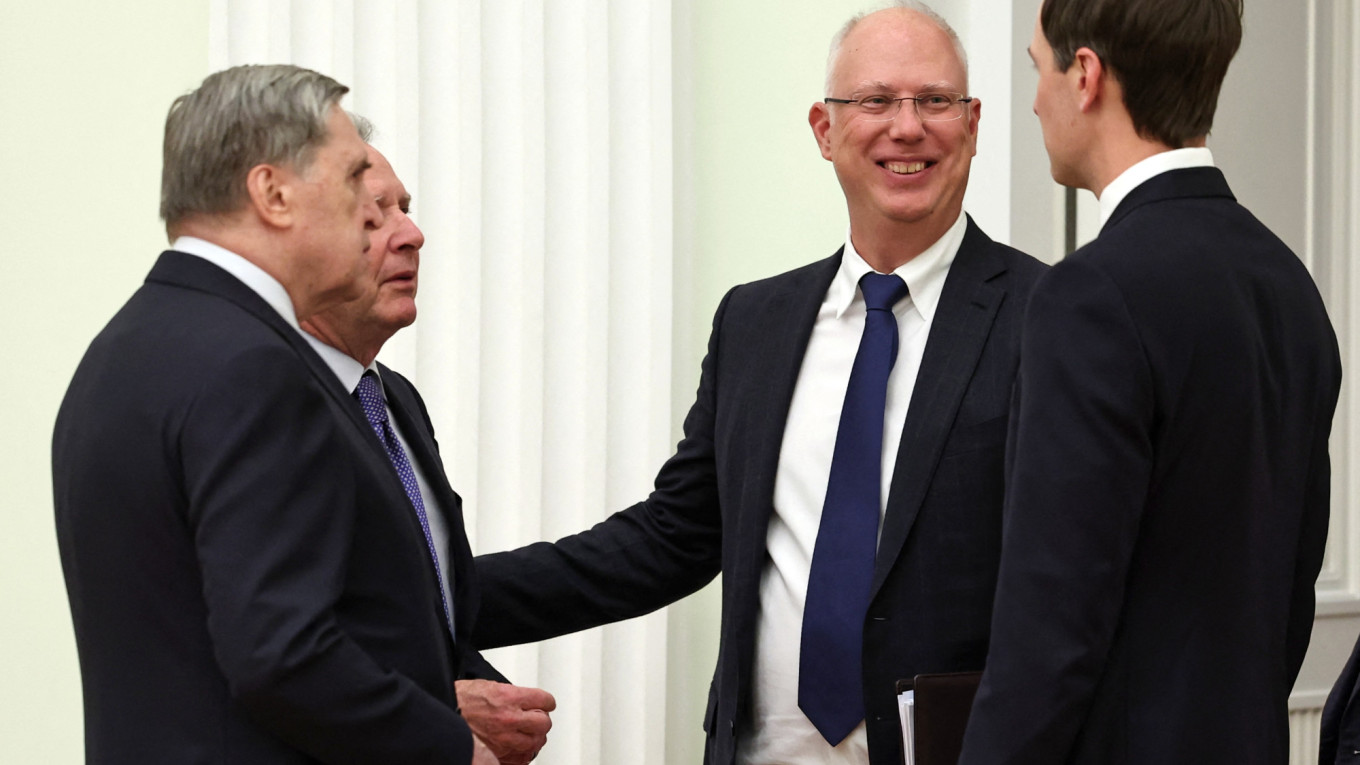
U.S. special representatives Steve Witkoff and Jared Kushner landed in Moscow on Saturday for talks on how to end the war in Ukraine, where they were met by Russian presidential envoy Kirill Dmitriev.
A motorcade, carrying Witkoff, Kushner and Dmitriev, left Moscow's governmental airport and headed towards the city, a Reuters witness said. Russian spokesman Dmitry Peskov told the state-run TASS news agency that President Vladimir Putin would meet Witkoff and Kushner in the Kremlin later on Saturday.
U.S. President Donald Trump suggested on Friday the U.S. had a fresh concrete proposal aimed at ending the war, which is now in its fifth year. He did not, however, elaborate on what that proposal would be.
Dmitriev, who told Reuters in June that he had remained in contact with the U.S. negotiators during a pause in their visits to Russia, took part in all their previous meetings with Putin alongside Putin's foreign policy aide Yuri Ushakov.
He also played a role in negotiating U.S. sanction waivers for Russian oil this year.
Ukrainian President Volodymyr Zelensky said on Friday the two men would fly to Ukraine on Sunday after visiting Moscow. In an X post on Saturday, Zelensky said Russia hit two Ukrainian airports ahead of U.S. envoys' visit to Kyiv.
Peskov said in a statement posted on the Kremlin's channel in the Max messaging app that Putin had ordered the military not to strike Kyiv for three days, starting at midnight on Saturday, in connection with Witkoff and Kushner's visit to the Ukrainian capital.
A vast gulf in positions
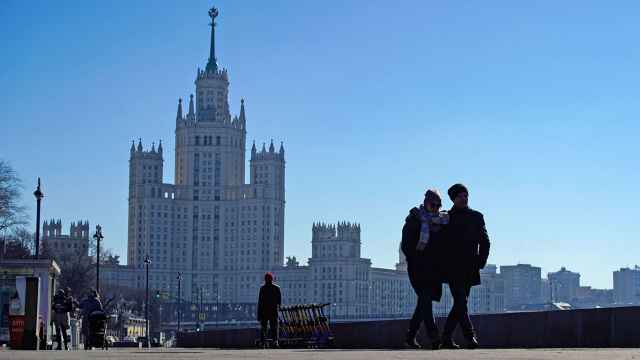
The Russian Defense Ministry reported 53 Ukrainian drones in Russian airspace on Saturday, significantly fewer than the average seen in recent months. Moscow is celebrating its City Day on Saturday, with hundreds of thousands of people taking part in open-air festivities across the city.
A vast gulf remains between Russia and Ukraine on how to end the 4-1/2-year-old war, which is the deadliest in Europe since World War II.
A source close to the Kremlin, speaking before reports emerged of a possible trip by President Trump's envoys, said Putin was still intent on capturing more territory.
“There is no chance of reaching an agreement regarding the front line until Putin finishes securing the remaining part of the Donetsk region,” the source told Reuters, adding that the Kremlin leader was confident — based on reports from his commanders — that this would happen by the end of the year.
Kremlin’s position remains ‘unshakeable’
Western military analysts see such a possibility as remote, given Moscow's slow rate of progress. Ukraine refuses to surrender land that it has successfully defended at huge cost, and rejects such terms as tantamount to surrender.
The Kremlin said on Friday the position that Putin set out in a speech two years ago — that Ukraine should cede the entire territory of four regions claimed by Russia and abandon its plan to join NATO — was “unshakeable.”
Since the last peace talks in February, each side has intensified long-range air attacks deep inside the other's territory, while the war at sea has also escalated.
On the ground, the front lines have remained largely static, with Russia making only gradual gains in its attempt to take the whole of Ukraine's Donbas region.
Ukraine's drone strikes on Russian oil refineries have led to a summer of fuel shortages and rising prices for Russian motorists, while some 30 attacks on warehouses belonging mostly to Wildberries and Ozon, the country's largest online retailers, have affected the consumer economy.
A Russian drone attack hit the headquarters of Ukraine's SBU security service in Kyiv on Friday — the 10th consecutive day of heavy attacks on the capital. Zelensky vowed to retaliate.
A Message from The Moscow Times:
Dear readers,
We are facing unprecedented challenges. Russia's Prosecutor General's Office has designated The Moscow Times as an "undesirable" organization, criminalizing our work and putting our staff at risk of prosecution. This follows our earlier unjust labeling as a "foreign agent."
These actions are direct attempts to silence independent journalism in Russia. The authorities claim our work "discredits the decisions of the Russian leadership." We see things differently: we strive to provide accurate, unbiased reporting on Russia.
We, the journalists of The Moscow Times, refuse to be silenced. But to continue our work, we need your help.
Your support, no matter how small, makes a world of difference. If you can, please support us monthly starting from just $2. It's quick to set up, and every contribution makes a significant impact.
By supporting The Moscow Times, you're defending open, independent journalism in the face of repression. Thank you for standing with us.

Remind me later.