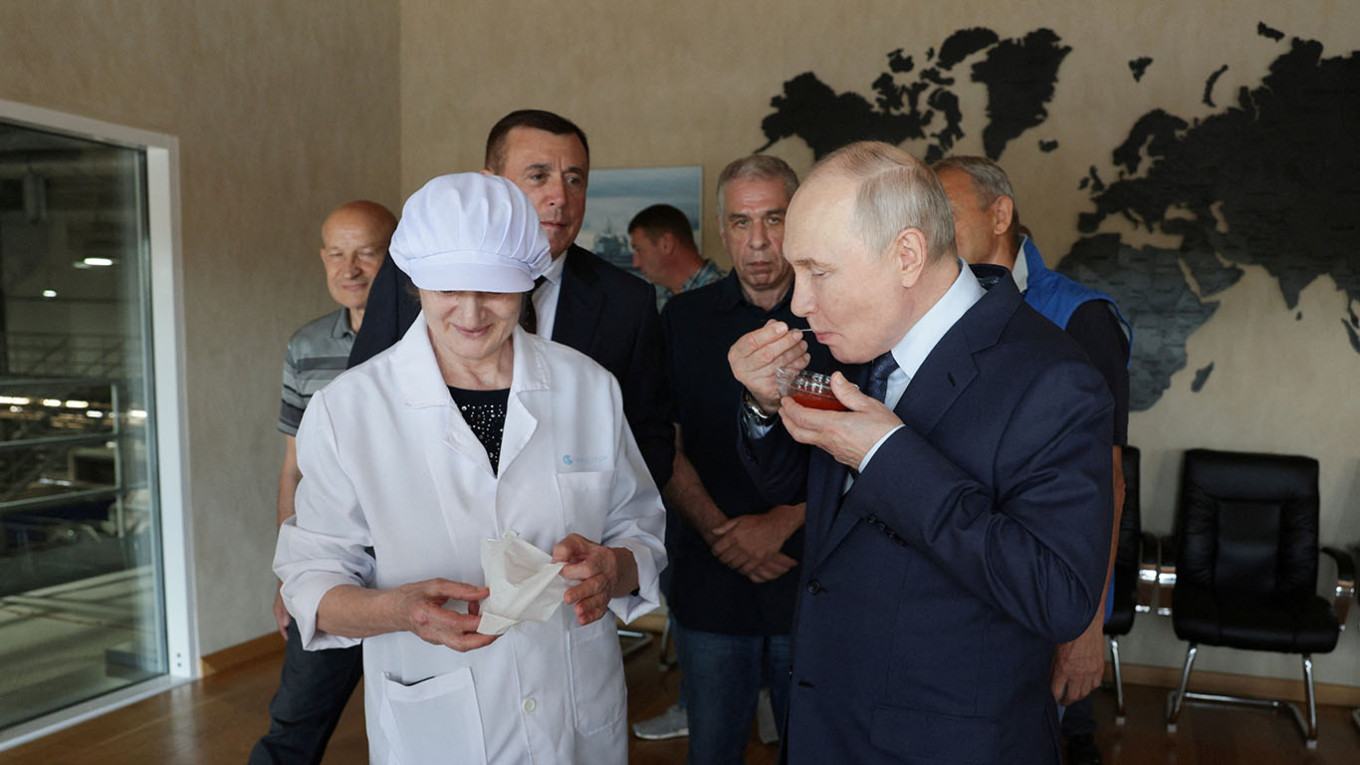
President Vladimir Putin’s visit to the island of Iturup on Aug. 13 was routine in some respects. As with his brief appearances in other Russian regions, it featured a bored-looking Putin inspecting a local business, a stage-managed meeting at which Putin glowered at a regional official and a meet-and-greet with handpicked locals.
Yet, this visit was different because Iturup (or "Etorofu" in Japanese) is one of the four Russian-held islands claimed by Japan as its Northern Territories. These islands were historically part of Japan, but, following the Soviet Union’s declaration of war on Aug. 8, 1945, Soviet forces occupied the islands and subsequently expelled the Japanese population.
Moscow’s declaration of war was a violation of the Soviet-Japanese Neutrality Pact of 1941. Another contentious point is that the Soviet advance continued after Japan’s announcement of surrender on Aug. 15, with the occupation of the islands not completed until September.
Eight decades later, this remains an important political issue in Japan. A peace treaty with Russia has yet to be signed because Japan insists that the territorial issue be settled first.
It is therefore no surprise that Putin’s visit provoked outrage in Tokyo. Russian ambassador Nikolai Nozdrev was summoned to the Foreign Ministry and issued with a strong protest. Russian state media also reported protests near the Russian embassy in Tokyo.
Other Russian officials have visited the disputed islands, but, throughout his quarter-century in power, Putin had always stayed away. What has changed?
The first factor is the parliamentary election on Sept. 18-20. The outcome will, of course, be fixed, but the Kremlin would like to limit the amount of cheating required. This is a challenge given Putin’s falling approval ratings and growing war fatigue.
The Russian Far East is a particular concern given its history of anti-regime protest, including in 2020-21 when thousands in Khabarovsk demonstrated against the removal of a popular governor. The Kremlin likely judged that a pre-election visit to the Kurils would helpfully generate patriotic support for Putin because the majority of Russians, irrespective of political stripe, strongly favor Russia’s retention of the islands.
The second factor is the Kremlin’s desire to punish Japan. After Russia’s full-scale invasion of Ukraine in February 2022, Japan’s government surprised Moscow with the robustness of its response. Under Kishida Fumio, who served as prime minister from 2021 to 2024, Japan imposed wide-ranging sanctions against Russia, including against Putin himself.
Japan has also been generous in its support for Ukraine, pledging financial assistance worth $20 billion. The sides signed a cooperation agreement in June 2024 that commits Japan to provide security assistance to Ukraine over a 10-year period.
Much to the frustration of Moscow, Japan has also deepened cooperation with NATO. This includes joining the Prioritized Ukraine Requirements List (PURL), a NATO mechanism to fund the purchase of United States-made military equipment for Ukraine.
With Putin setting foot on what Japan considers its sovereign territory, the Kremlin intends to send the message that if Japan continues to take actions that Moscow regards as unfriendly, Russia will retaliate in ways that harm Japan’s national interests.
The Kremlin’s hope is that the Japanese government, suitably chastened, will shy away from future confrontation. Instead, this crude maneuver will likely achieve the opposite.
For most of his tenure, Putin employed a more subtle strategy towards Japan. This entailed playing up his judo expertise and knowledge of Japanese culture to present himself as someone with a soft spot for Japan. Many Japanese were charmed when Putin participated in a judo display at Tokyo’s Kodokan hall in September 2000 and permitted himself to be thrown by a 10-year-old schoolgirl.
The strategy developed after Dmitry Medvedev took the role of president in 2008 and Putin shifted to prime minister. This gave the Kremlin the opportunity for a good cop, bad cop routine. While Medvedev visited the disputed islands in November 2010, Putin politely refrained from doing so. Furthermore, in March 2012, Putin suggested that the territorial dispute could be settled as a “hikiwake,” the Japanese term for a draw in a competition. The Kremlin’s goal was to kindle false hope in Japan that, after Putin’s return to the presidency, which occurred a few days after the “hikiwake” comments, a deal could be reached that could see the return of two of the four disputed islands. In this way, the Russian leadership proposed to entice Japanese engagement without really intending territorial concessions.
The strategy proved successful because Abe Shinzo, who became prime minister in December 2012, took the bait. Convinced by Putin’s charade of friendship, Abe made improving relations with Russia a leading priority. He met Putin 27 times and hosted the Russian leader in his home prefecture of Yamaguchi. Abe also unveiled an eight-point economic cooperation plan with Russia and cajoled a Japanese consortium to purchase 10% of Russia’s Arctic LNG-2 project.
Worryingly for Japan’s European partners, Abe’s government avoided imposing meaningful sanctions on Russia after the annexation of Crimea in 2014. Japan was also the only G7 country not to join Britain in expelling Russian intelligence officers after the attempted assassination of Sergei Skripal in Salisbury in 2018.
Putin’s manipulation of Abe came to an end when Abe resigned in September 2020. The full-scale invasion of Ukraine two years later then soured bilateral relations.
And yet, within the last few months, there have been signs of tentative reengagement by Japan. Takaichi Sanae, who became prime minister in October, is a protégé of Abe, who was assassinated in 2022. Several figures who were close to Abe have returned to influence. Undiscouraged by the eight years of failed engagement, these individuals, who include member of parliament Suzuki Muneo, have been pressing for a return to Abe’s Russia policy.
In May, Japan’s Ministry of Economy, Trade and Industry led a business delegation to Moscow. Foreign Minister Motegi Toshimitsu also spoke with Russian counterpart Sergei Lavrov at an ASEAN-related summit in July, describing the Russian foreign minister as an “old acquaintance.” The same month, Japan’s Ministry of Foreign Affairs announced the resumption of a scheme to send Japanese students to Russia.
There have also been suggestions that Japan’s government was distancing itself from Ukraine. Most notably, Takaichi has still not held a face-to-face meeting with Ukrainian president Volodymyr Zelensky, despite both attending the G7 summit in France in June.
A wiser Kremlin would have encouraged reengagement with Tokyo with concessions of their own, such as by permitting former Japanese residents to visit ancestral graves on the disputed islands. These once-annual trips have been suspended since 2019. Instead, Putin doubled down on pressure, believing that Japan can be bullied into further concessions.
Takaichi herself did not hide her frustration, telling the media that “Japan had made every possible effort” with Russia. She added that Putin’s “visit has further hardened anti-Russian sentiment within Japan and made the restoration of relations in the medium to long-term more difficult.” Japan’s government is now considering additional sanctions.
Putin once handled Japan with ruthless guile. By contrast, his visit to Iturup/Etorofu is a strategic blunder that throws away an opportunity for Russia and spares Japan from more fruitless engagement. The smiling face Putin once showed to Japan has been revealed to be a mask.
A Message from The Moscow Times:
Dear readers,
We are facing unprecedented challenges. Russia's Prosecutor General's Office has designated The Moscow Times as an "undesirable" organization, criminalizing our work and putting our staff at risk of prosecution. This follows our earlier unjust labeling as a "foreign agent."
These actions are direct attempts to silence independent journalism in Russia. The authorities claim our work "discredits the decisions of the Russian leadership." We see things differently: we strive to provide accurate, unbiased reporting on Russia.
We, the journalists of The Moscow Times, refuse to be silenced. But to continue our work, we need your help.
Your support, no matter how small, makes a world of difference. If you can, please support us monthly starting from just $2. It's quick to set up, and every contribution makes a significant impact.
By supporting The Moscow Times, you're defending open, independent journalism in the face of repression. Thank you for standing with us.

Remind me later.