
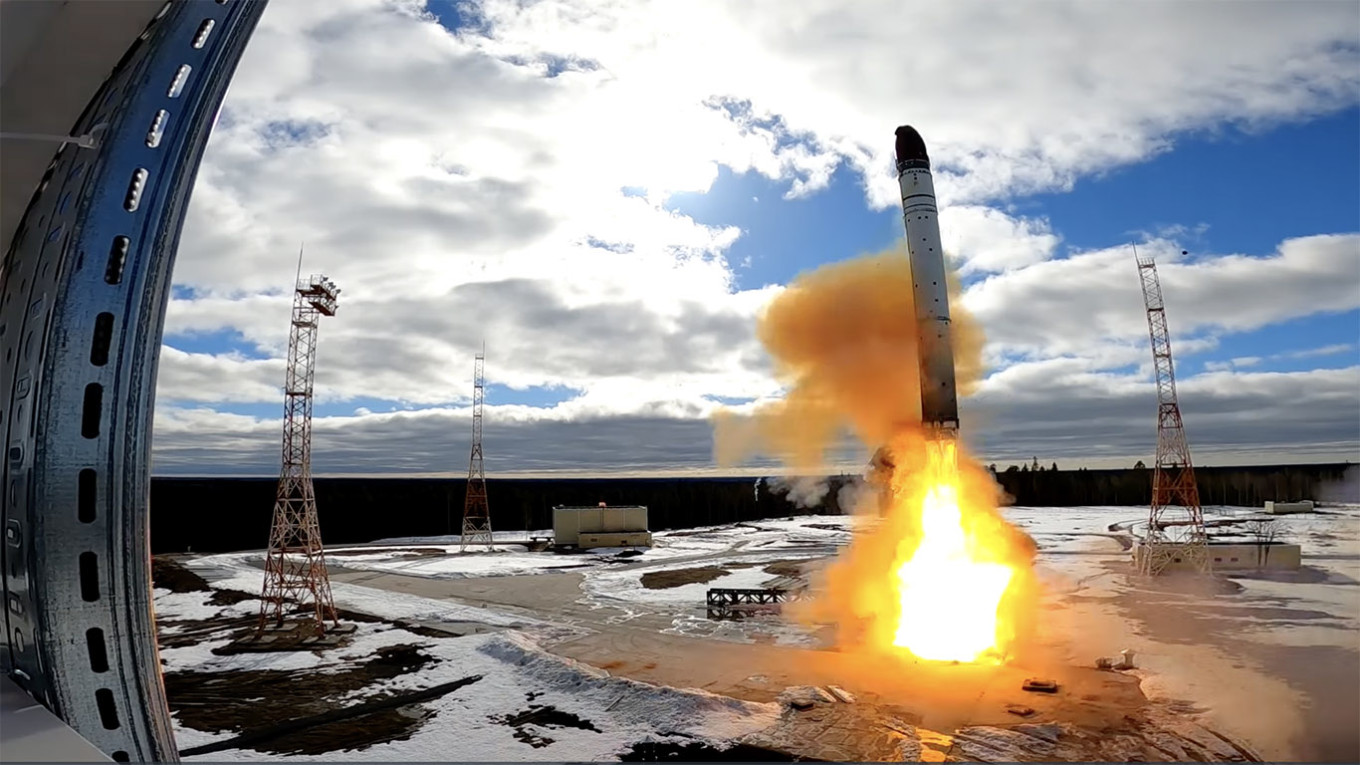
On May 12, Moscow announced that its flagship RS-28 Sarmat intercontinental ballistic missile would be put on combat duty by the end of the year. It had already been declared ready for combat duty once before — in September 2023. And before that, President Vladimir Putin said it would be ready by the end of 2022.
Since it was unveiled in 2018, the Sarmat has been beset with successive failures to meet official deadlines. This has not stopped the Kremlin from talking up the imminent operationality of the “invincible” missile that’s capable of carrying up to 16 warheads, including thermonuclear payloads, amid its invasion of Ukraine.
Leaked internal documents released Monday by the Dallas Analytics firm lift the lid on years of behind-the-scenes discussions, showing how Russian defense manufacturers and agencies cut corners to try to deliver the missiles by the Kremlin’s deadlines which appear to be focused more on nuclear signalling than genuine industrial capacity.
These documents matter because detailed information about Russia’s strategic weapons programs is rarely available to outsiders. This ambiguity helps Moscow by hiding its weaknesses, but also by creating uncertainty about whether it could deploy a new nuclear or conventional weapon in order to deter its opponents.
Leaked letters dated in October 2022 show preparations codenamed “Theme 001” to transfer missile components to the 62nd missile division in Uzhur in the Krasnoyarsk region, following Putin’s April 2022 announcement that Sarmat would enter combat duty by the end of that year.
Satellite imagery from 2022 and 2023 shows that several silos at the Uzhur site were being upgraded to host Sarmat. The head of state space agency Roscosmos claimed on Sept. 1, 2023, that the missile had entered combat duty — months after Putin’s declared deadline of the end of 2022.
The leaked documents give an insight into why that deadline was missed. A shortage of wagons meant the Strategic Rocket Forces was only able to send one rail transporter instead of the two requested, delaying the shipment of two of the first three C286 components believed to be payload fairings — the nose cones that protect a missile's payload.
Furthermore, the first of these components was shipped without its formulyar — an official technical logbook that confirms the missile’s condition, operational lifespan and information that allows it to be tracked.
The absence of this paperwork suggests that standard procurement procedures were not followed, possibly in a futile effort to meet the Kremlin’s deployment deadlines.
But there was another problem. Documents from late 2022 show that the missile components were shipped before a fixed price had been agreed. The letter is addressed to Vladimir Verteletsky, a Defense Ministry official later arrested for allegedly signing off on research and development work despite it being incomplete.
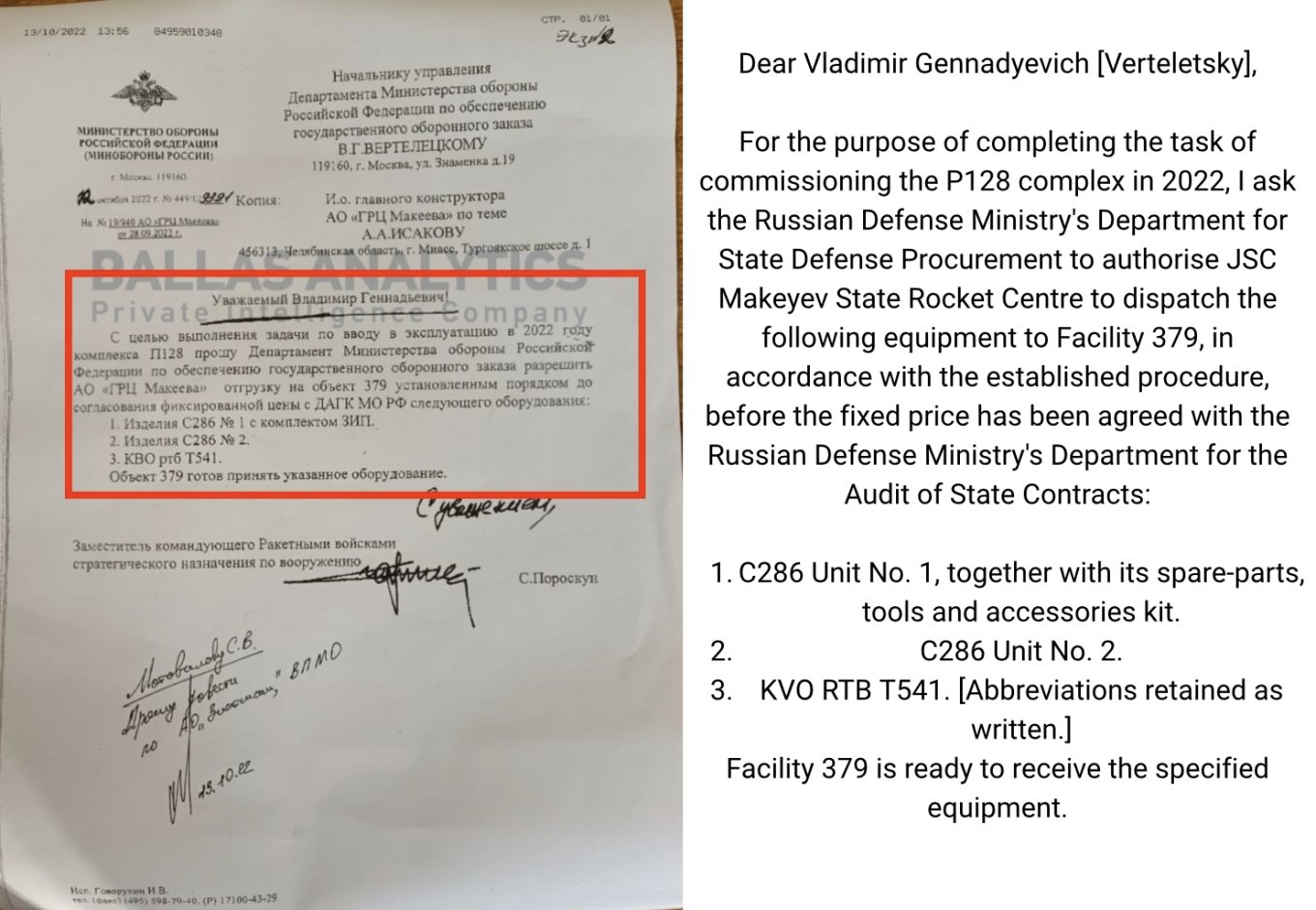
This problem was not resolved quickly. Later correspondence from Roscosmos in 2025 suggests that the price for "Theme 002" hardware was still being negotiated and had not yet been registered with the Federal Antimonopoly Service nearly three years after the first units were shipped.
Why would Russia allow components of a flagship weapon to remain without a finalized price after three years?
Experts told The Moscow Times that Sarmat is intended primarily as a strategic nuclear deterrent rather than a battlefield weapon, and it is therefore unlikely that Russia is producing it in large numbers.
A former Russian defense engineer told The Moscow Times in 2024 that new missile systems typically require years of testing before sufficient data has been gathered to justify mass production.
Blythe Crawford, director of the GRAIL defense supply chain project at Tiberius Aerospace, told The Moscow Times that Russian manufacturers often push through new equipment without scaling up their production capacity. He said procurement agencies were likely waiting to see whether the Kremlin’s bellicose messaging around Sarmat convinced the West to reduce its support to Ukraine, leaving manufacturers to figure out how to reach the deadline.
“It's flipping huge as well as a massive, massive weapon, and it is going to cost them an absolute fortune. So of course they're not going to spend money on it unless they really, really have to,” he told The Moscow Times.
The gap between Moscow’s nuclear posturing and what it can actually deliver has become harder to assess. When Russia suspended its participation in the NEW START treaty in February 2023, even before the agreement expired in 2026, international observers lost their means of verifying Moscow’s participation with nuclear arms control protocols from inside the country.
A missile test is hard to hide. Their launches produce heat signatures and accidents leave behind craters, both of which can be detected by satellites, and pilots are often warned to avoid the area around suspected test sites ahead of a launch.
In September 2024, Western analysts deduced from this evidence that a Sarmat test at the Plesetsk Cosmodrome in the Arkhangelsk region suffered a “catastrophic” failure.
A Message from The Moscow Times:
Dear readers,
We are facing unprecedented challenges. Russia's Prosecutor General's Office has designated The Moscow Times as an "undesirable" organization, criminalizing our work and putting our staff at risk of prosecution. This follows our earlier unjust labeling as a "foreign agent."
These actions are direct attempts to silence independent journalism in Russia. The authorities claim our work "discredits the decisions of the Russian leadership." We see things differently: we strive to provide accurate, unbiased reporting on Russia.
We, the journalists of The Moscow Times, refuse to be silenced. But to continue our work, we need your help.
Your support, no matter how small, makes a world of difference. If you can, please support us monthly starting from just $2. It's quick to set up, and every contribution makes a significant impact.
By supporting The Moscow Times, you're defending open, independent journalism in the face of repression. Thank you for standing with us.

Remind me later.