

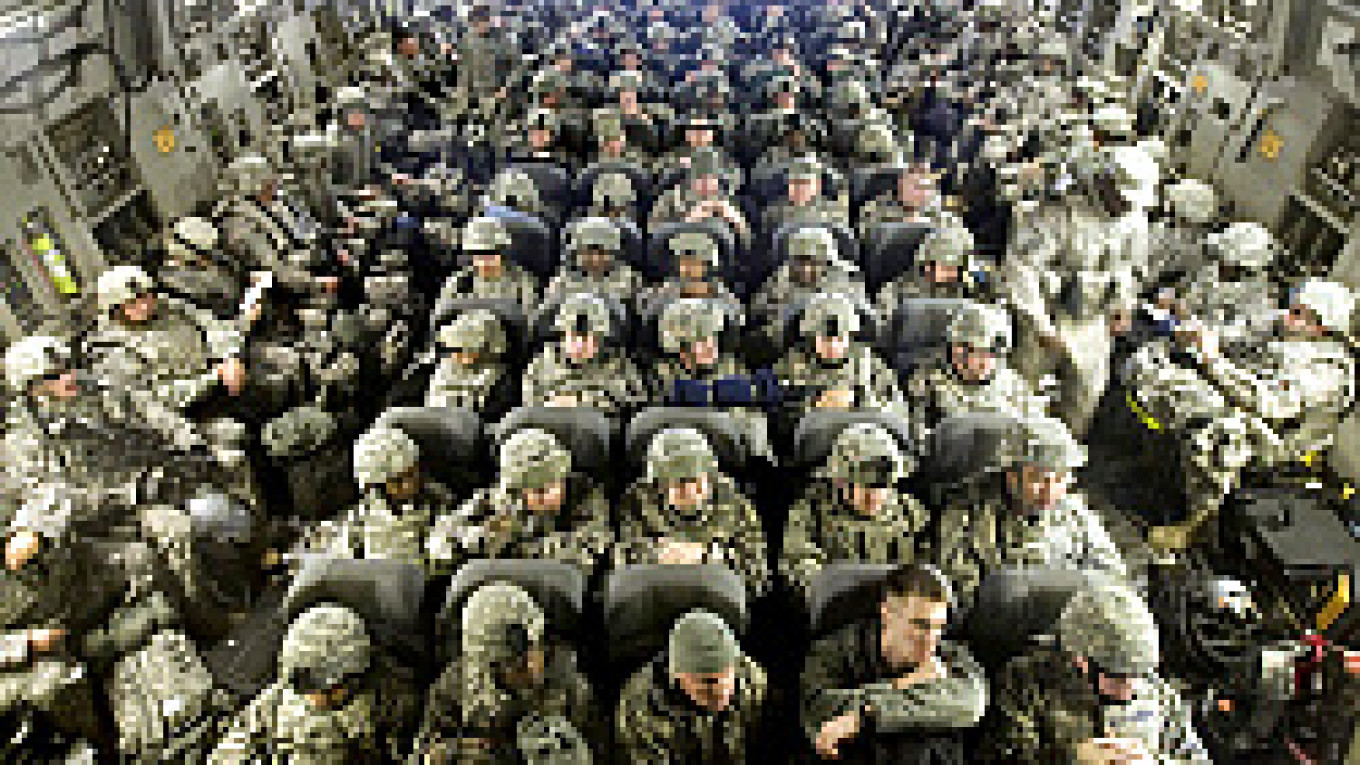
President Barack Obama's call for an increased military focus on Afghanistan could be hampered both by the potential closure of the Manas air base in Kyrgyzstan and increased attacks on the main land route for supplies through Pakistan.
Kyrgyz President Kurmanbek Bakiyev unexpectedly called this month for the closure of the Manas base, a transit point for 15,000 troops and 500 tons of cargo each month to and from Afghanistan. It also is a base for military refueling planes.
The decision is expected to easily pass parliament, which is dominated by the president's party.
A vote had not been expected until March, which would have given Washington more time to try to change Bakiyev's mind. But the parliamentary Foreign Affairs Committee on Tuesday approved the order and set a Thursday vote for the lower house.
"The committee has endorsed the bill and will present the resolution to parliament this coming Thursday," committee chairman Erik Arsaliyev said.
If the bill is approved, the United States would have to leave the base within 180 days.
President Bakiyev has complained that the United States is not paying enough rent for the Manas base. His announcement on the base closure was made in Moscow, shortly after Russia offered his impoverished country $2.15 billion in aid and loans. Analysts say the closure and the aid appeared to be linked, although officials deny any connection.
But Kyrgyz Deputy Murat Jurayev, a member of the pro-government party that dominates parliament, said the government's action could help to bolster ties with Russia.
"Closing the American air base is beneficial to the friendship between Russia and Kyrgyzstan -- that is why the committee took the decision," Jurayev said Tuesday.
The United States began using the Manas base shortly after it launched operations against Afghanistan following the Sept. 11, 2001, terrorist attacks.
In Uzbekistan, U.S. regional military chief General David Petraeus was discussing strengthening U.S. supply lines for troops in Afghanistan on Tuesday, the U.S. Embassy said.
As part of his visit, Petraeus met President Islam Karimov and other senior Uzbek officials to discuss Afghanistan, the U.S. Embassy in Tashkent said.
"He is here in Tashkent to listen to Uzbekistan's perspective ... on the situation in Afghanistan," an embassy spokeswoman said.
She declined to say whether a supply agreement might be signed during the visit.
A Western diplomat said this month that Washington was close to signing a deal with Uzbekistan that would allow U.S. nonmilitary rail cargo to transit through Uzbekistan on its way to Afghanistan.
RIA-Novosti cited an Uzbek government source as saying Petraeus would specifically raise the issue of alternative supply routes with Uzbek officials. Nonmilitary cargo includes building materials, food, medicine and water.
(AP, Reuters)
A Message from The Moscow Times:
Dear readers,
We are facing unprecedented challenges. Russia's Prosecutor General's Office has designated The Moscow Times as an "undesirable" organization, criminalizing our work and putting our staff at risk of prosecution. This follows our earlier unjust labeling as a "foreign agent."
These actions are direct attempts to silence independent journalism in Russia. The authorities claim our work "discredits the decisions of the Russian leadership." We see things differently: we strive to provide accurate, unbiased reporting on Russia.
We, the journalists of The Moscow Times, refuse to be silenced. But to continue our work, we need your help.
Your support, no matter how small, makes a world of difference. If you can, please support us monthly starting from just $2. It's quick to set up, and every contribution makes a significant impact.
By supporting The Moscow Times, you're defending open, independent journalism in the face of repression. Thank you for standing with us.

Remind me later.