

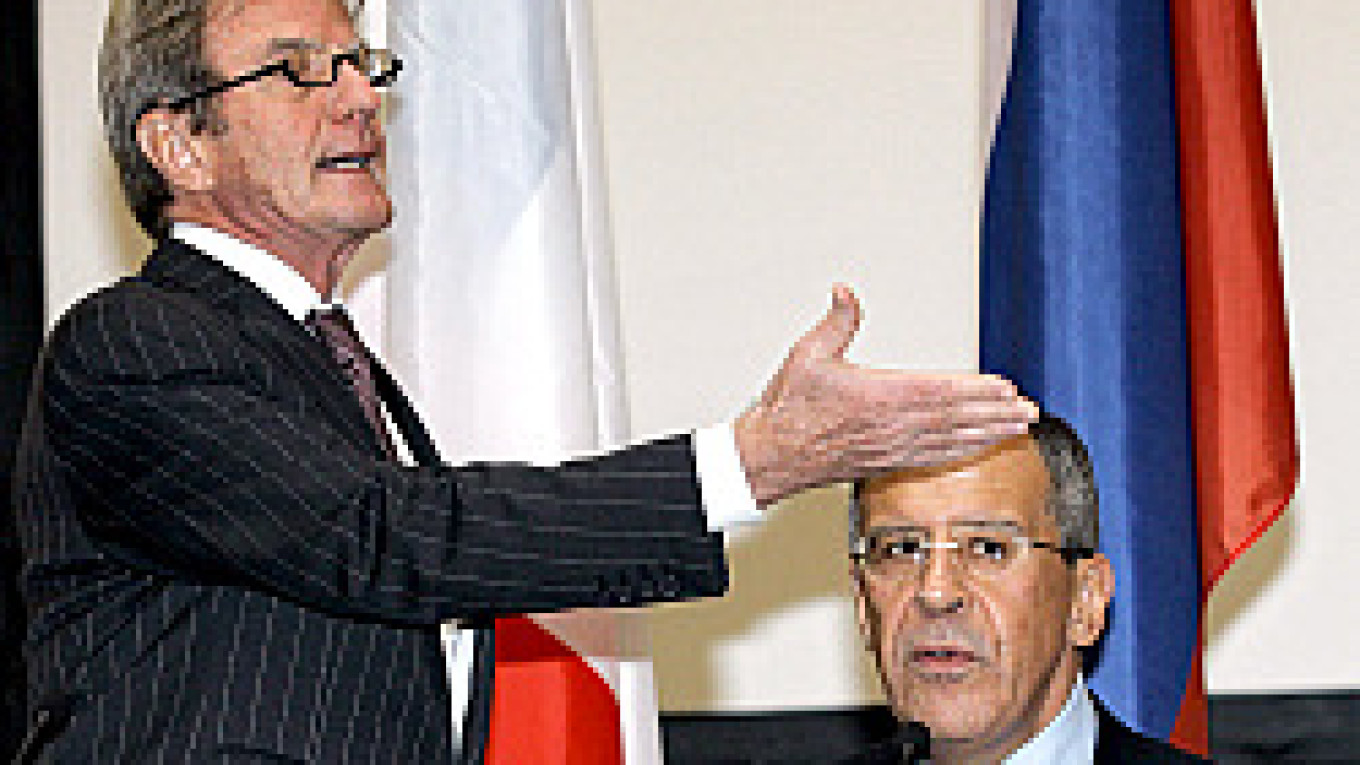
Russia's military thrust into Georgia in August overshadowed the talks between Foreign Minister Sergei Lavrov and an EU delegation headed by French Foreign Minister Bernard Kouchner, whose country holds the rotating EU presidency.
One senior diplomat described the mood of the meeting as "pretty prickly."
But Kouchner told a joint news conference that EU and Russian leaders would meet in the French city of Nice on Nov. 13 and 14 to resume talks on a planned partnership agreement.
"They will fix a schedule at that date for advancing the partnership agreement," Kouchner said.
Plans for a broad agreement, a blueprint for long-term relations between Moscow and Brussels, were put on hold because of Russia's armed intervention into Georgia to force Georgian troops out of South Ossetia, a pro-Russian enclave.
Kouchner, joined in St. Petersburg by EU foreign policy chief Javier Solana, said the Nice summit was expected to have a positive outcome.
Russia supplies a quarter of Europe's gas, while the EU is Russia's biggest trading partner.
Russia's five-day war in Georgia, its brief occupation of parts of Georgian territory and prompt recognition of South Ossetia and another rebel region, Abkhazia, as independent states have drawn harsh criticism from the West.
Despite efforts to project a light-hearted mood at the news conference, one official said there had been little movement on other topics discussed, apart from the partnership talks.
These included Russia's plan for a new security architecture on the continent to replace umbrella treaties covering European security. Lavrov raised the Russian plan again at the news conference.
Lavrov also stood by Russia's position that under Moscow's interpretation of a cease-fire agreement, EU monitors were entitled only to operate in Georgian territory adjacent to South Ossetia but not inside the breakaway region itself, as the EU had requested.
"The security in South Ossetia and Abkhazia after Russia's recognition is secured by the presence on their territory of Russian military contingents in response to requests from the leaderships of South Ossetia and Abkhazia," Lavrov said.
Western states condemned Russia's action in Georgia in August as disproportionate. Russia said it had been obliged to act to prevent a genocide of separatists in South Ossetia by Georgia.
Before the French presidency of the EU can initiate moves to restart the partnership talks, it has to get the go-ahead from EU foreign ministers, who will meet on Nov. 10.
Member states disagree over whether Russia has done enough to merit restarting the talks.
But some EU diplomats traveling with the delegation to St. Petersburg said they were hopeful that no country would try to block the resumption of negotiations.
A Message from The Moscow Times:
Dear readers,
We are facing unprecedented challenges. Russia's Prosecutor General's Office has designated The Moscow Times as an "undesirable" organization, criminalizing our work and putting our staff at risk of prosecution. This follows our earlier unjust labeling as a "foreign agent."
These actions are direct attempts to silence independent journalism in Russia. The authorities claim our work "discredits the decisions of the Russian leadership." We see things differently: we strive to provide accurate, unbiased reporting on Russia.
We, the journalists of The Moscow Times, refuse to be silenced. But to continue our work, we need your help.
Your support, no matter how small, makes a world of difference. If you can, please support us monthly starting from just $2. It's quick to set up, and every contribution makes a significant impact.
By supporting The Moscow Times, you're defending open, independent journalism in the face of repression. Thank you for standing with us.

Remind me later.