

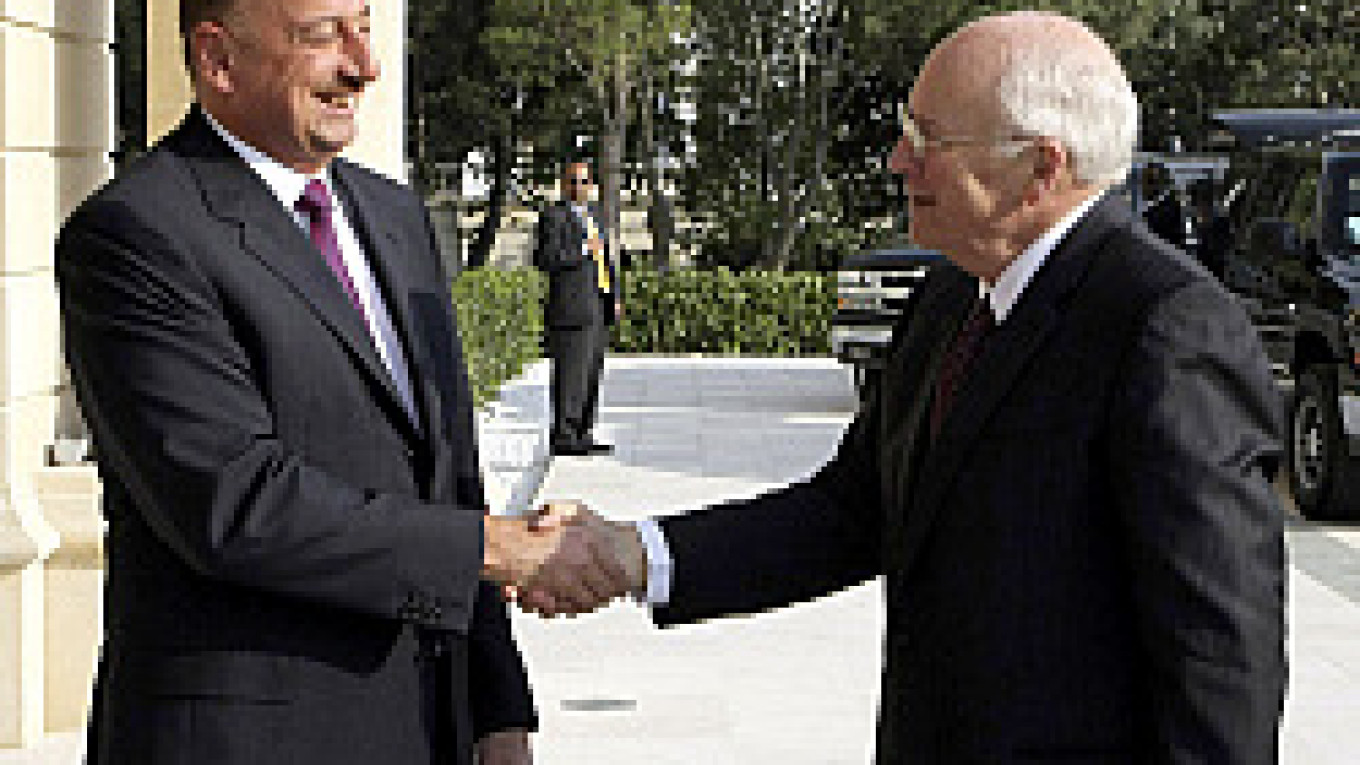
"We both seek greater stability and security and cooperation in this vital region of the world," Cheney told reporters in Baku after a meeting with President Ilham Aliyev at the presidential summer palace.
Cheney was in Baku on the first leg of a tour that will include Georgia and Ukraine. Azerbaijan and Georgia are links in the chain of a Western-backed energy corridor bypassing Russia that the West fears could be in jeopardy after the Kremlin sent its troops deep into Georgia during the brief war last month.
Cheney also met representatives of BP and Chevron, two oil majors involved in a pipeline that pumps up to 1 million barrels of crude a day -- or about 1 percent of world output -- to world markets from Azerbaijan and through Georgia.
The oil company executives "gave their assessments of the energy situation in Azerbaijan and the broader Caspian region -- especially in light of Russia's recent military actions in Georgia," said Megan Mitchell, a spokeswoman for Cheney.
At the presidential palace, Cheney said the United States had a deep interest in the well-being of its allies in the region. "We've met this evening in the shadow of the recent Russian invasion of Georgia," he said. "President Bush has sent me here with a clear and simple message for the people of Azerbaijan and the entire region: The United States has a deep and abiding interest in your well-being and security."
In Moscow, the Foreign Ministry said it was reserving comment on Cheney's trip until it saw what he did in Georgia.
"We need to wait until Mr. Cheney is actually in Georgia to see how he assesses the situation," ministry spokesman Andrei Nesterenko said at a news briefing.
The United States has condemned Russia for sending troops and tanks into Georgia, but Moscow has countered by saying Washington helped spark the conflict by failing to rein in its ally Georgia.
(Reuters, Bloomberg)
A Message from The Moscow Times:
Dear readers,
We are facing unprecedented challenges. Russia's Prosecutor General's Office has designated The Moscow Times as an "undesirable" organization, criminalizing our work and putting our staff at risk of prosecution. This follows our earlier unjust labeling as a "foreign agent."
These actions are direct attempts to silence independent journalism in Russia. The authorities claim our work "discredits the decisions of the Russian leadership." We see things differently: we strive to provide accurate, unbiased reporting on Russia.
We, the journalists of The Moscow Times, refuse to be silenced. But to continue our work, we need your help.
Your support, no matter how small, makes a world of difference. If you can, please support us monthly starting from just $2. It's quick to set up, and every contribution makes a significant impact.
By supporting The Moscow Times, you're defending open, independent journalism in the face of repression. Thank you for standing with us.

Remind me later.