

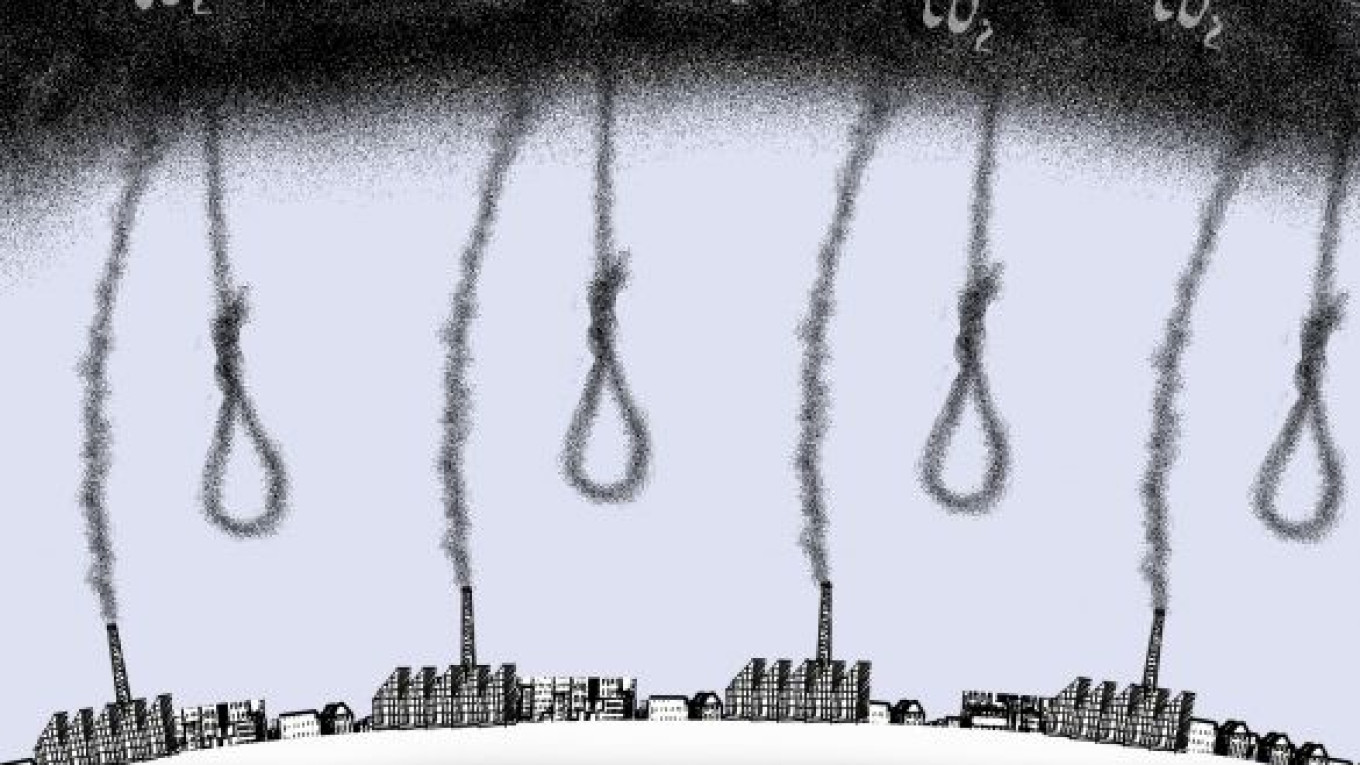
This summer has been one of weather-related extremes in Russia, Pakistan, China, Europe, the Arctic — you name it. But does this have anything to do with global warming, and are human emissions to blame?
While it cannot be scientifically proven — or disproven, for that matter — that global warming caused any particular extreme event, we can say that global warming very likely makes many kinds of extreme weather both more frequent and more severe.
For weeks in late July and early August, central Russia suffered its worst-ever heat wave. As a result of drought and heat, more than 500 wildfires raged out of control.
Meanwhile, Pakistan is still struggling with unprecedented flooding that has killed more than 1,600 people and affected millions more. In China, flash floods have so far killed more than 1,000 people and destroyed more than a million homes. On a smaller scale, European countries like Germany, Poland and the Czech Republic have also suffered serious flooding.
Meanwhile, global temperatures in recent months have been at their highest levels in records that go back 130 years. Arctic Sea ice cover reached its lowest recorded average level for the month of June ever. In Greenland, two huge chunks of ice broke off in July and August.
Are these events connected?
Looking only at individual extreme events will not reveal their cause, just like watching a few scenes from a movie does not reveal the plot. But viewed in a broader context and using the logic of physics, important parts of the plot can be understood.
This decade has been marked by a number of stunning extremes. In 2003, the most severe heat wave in living memory broke previous temperature records by a large margin and caused 70,000 deaths in Europe. In 2005, the most severe hurricane season ever witnessed in the Atlantic devastated New Orleans and broke records in terms of the number and intensity of storms.
In 2007, unprecedented wildfires raged across Greece, nearly destroying the ancient site of Olympia. And the Northwest Passage in the Arctic became ice-free for the first time in living memory. Last year, more than 100 people were killed in bush fires in Australia, following drought and record-breaking heat.
This cluster of record-breaking events could be merely an astonishing streak of bad luck. But that is extremely unlikely. This is far more likely to be the result of a warming climate — a consequence of this decade being the hottest worldwide for 1,000 years.
All weather is driven by energy, and the sun ultimately provides this energy. But the biggest change in Earth’s energy budget by far over the past 100 years is because of the accumulation in our atmosphere of greenhouse gases, which limit the exit of heat into space. Owing to fossil-fuel emissions, there is now one-third more carbon dioxide in the atmosphere than at any time in at least a million years, as the latest ice drilling in Antarctica has revealed.
The changes in the planet’s energy budget caused by solar variations are at least 10 times smaller in comparison. And they go in the wrong direction. In recent years, the sun has been at its dimmest since satellite measurements began in the 1970s. So when unprecedented extreme weather events occur, the prime suspect is naturally the biggest atmospheric change that has happened over the past 100 years — one that has been caused by human emissions.
The fact that heat waves like the one in Russia become more frequent and extreme in a warmer world is easy to understand. Extreme rainfall events will also become more frequent and intense in a warmer climate, owing to another simple fact of physics: Warm air can hold more moisture. For each degree Celsius of warming, 7 percent more water is available to rain down from saturated air masses. Drought risk also increases with warming. Even where rainfall does not decline, increased evaporation dries out the soils.
The events of this summer show how vulnerable our societies are to weather-related extremes. But what we see now is happening after only 0.8 C of global warming. With swift and decisive action, we can still limit global warming to a total of 2 C or a bit less. Even that much warming would require a massive effort to adapt to weather extremes and rising sea levels, which needs to start now.
With weak action, like that promised by governments in Copenhagen in December, we will be on course for a global warming of 3 or 4 C. This is bound to outstrip the ability of many societies and ecosystems to adapt. With no action at all, the planet could even heat up by 5 to 7 C by the end of this century — and more thereafter. Knowingly marching down that road would be insane.
We must face the facts. Our emissions of greenhouse gases probably are at least partly to blame for this summer of extremes. Clinging to the hope that it is all chance and all natural seems naive. Let us hope that this summer of extremes is a last-minute wake-up call to policymakers, the corporate world and citizens alike.
Stefan Rahmstorf, a professor of physics at Potsdam University and a member of the German Advisory Council on Global Change, is author of “The Climate Crisis.” © Project Syndicate
A Message from The Moscow Times:
Dear readers,
We are facing unprecedented challenges. Russia's Prosecutor General's Office has designated The Moscow Times as an "undesirable" organization, criminalizing our work and putting our staff at risk of prosecution. This follows our earlier unjust labeling as a "foreign agent."
These actions are direct attempts to silence independent journalism in Russia. The authorities claim our work "discredits the decisions of the Russian leadership." We see things differently: we strive to provide accurate, unbiased reporting on Russia.
We, the journalists of The Moscow Times, refuse to be silenced. But to continue our work, we need your help.
Your support, no matter how small, makes a world of difference. If you can, please support us monthly starting from just $2. It's quick to set up, and every contribution makes a significant impact.
By supporting The Moscow Times, you're defending open, independent journalism in the face of repression. Thank you for standing with us.

Remind me later.