

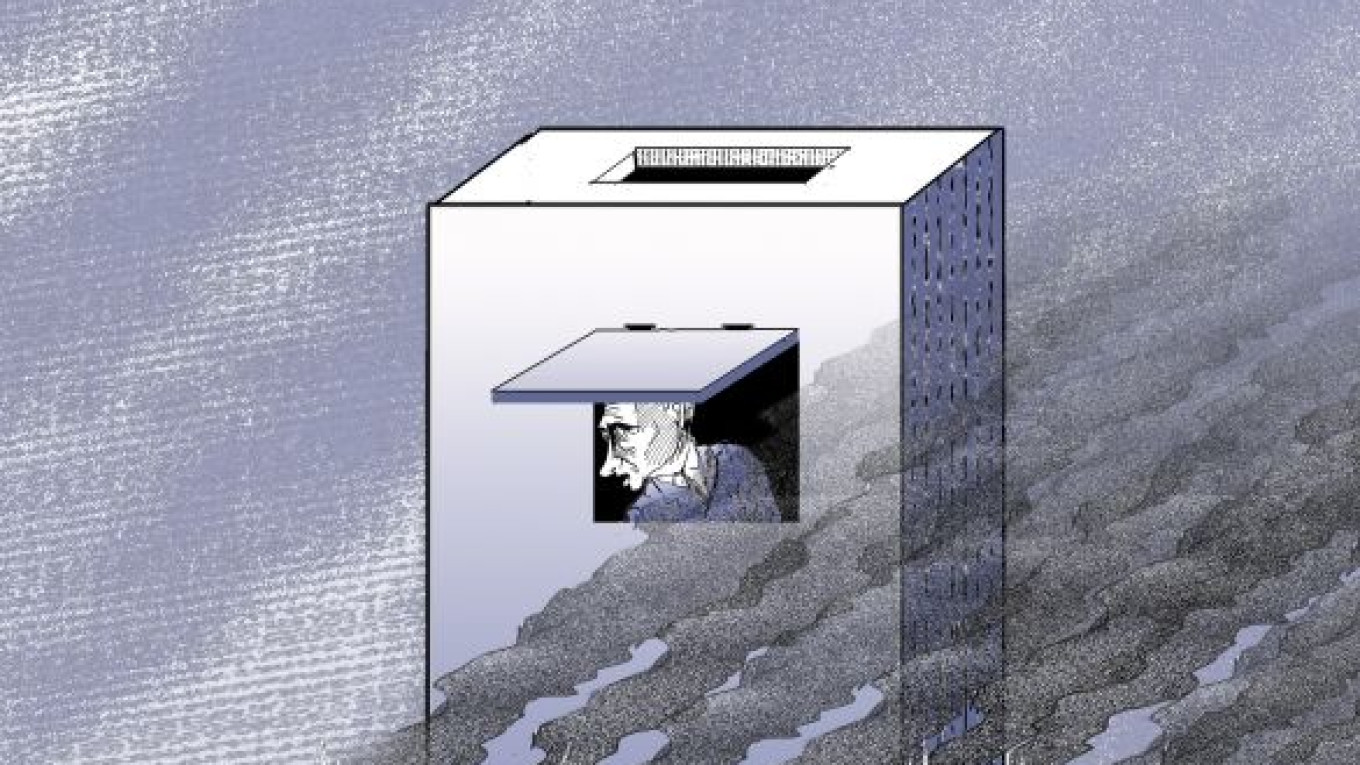
For Russia’s liberals, 2011 has become the Year of Dashed Hopes. These mostly young professionals grew up after the dissolution of the Soviet Union and are avid Internet users. They also understood very well that “freedom is better than no freedom” long before President Dmitry Medvedev told them so. Many of them felt cautious optimism. They hoped that the upcoming elections would give them a chance to express their position and elect politicians who reflect their interests into the State Duma.
Political reality hit the optimists hard. In the spring, the liberal opposition Parnas party was refused registration. After that, the optimists warmly welcomed Mikhail Prokhorov and began to pin their hopes on the party he headed, Right Cause. But then Prokhorov achieved a world record for the shortest political career, disappearing from the political scene after only three months. And then came the United Russia convention and the inevitable return of Prime Minister Vladimir Putin to the Kremlin. Instead of hope, optimists faced living the next 12 years in the same kind of stagnating society that their parents lived in under Soviet leader Leonid Brezhnev.
“Get out of the country” has become a popular slogan that functions on the Internet as a kind of community for discussing various countries for emigration. There’s no question that this is a political issue for most people. A St. Petersburg IT specialist going by the name of Tebedam? wrote: “The only way to change your life for the better is to vote — for another place to live, if you have the opportunity. Of course, it would be wonderful to change Russia for the better, and many have already tried, but those attempts have ended badly. A week ago, I already made a decision. And if there is no bureaucratic red tape, by New Year’s I’ll be living on the West Coast of the United States.”
But Russians who can’t count on a Silicon Valley cubicle have to decide what to do in the December elections. Under Josef Stalin, depriving someone of his or her right to vote was a form of legal punishment. Today, once again millions of people are being deprived of their right to vote — this time because none of their candidates are allowed to run. This issue was discussed outside Moscow from Sept. 30 to Oct. 2 at a political forum held with the poetic name of “The Last Autumn,” the name of a hit song by the rock group DDT that was popular among political activists in the perestroika years. Three possible courses of action were proposed.
Chess champion and former presidential candidate Garry Kasparov suggested boycotting the elections altogether. Opposition leader Boris Nemtsov disagreed, saying this would only make it easier for the authorities to falsify results. He suggested that people go to voting stations and mark up the ballots so that they are invalid. The popular blogger and anti-corruption activist Alexei Navalny on his LiveJournal blog? proposed? voting for any party but United Russia. “This strategy will create the greatest number of practical problems for the crooks in the Kremlin and will make allies out of activists in other political parties,” he said.
The majority at the forum supported Navalny’s proposal. But they were perhaps less concerned with the elections and concentrated more on finding new forms of civil protest. As Solidarity activist Denis Bilunov? wrote? on his LiveJournal blog: “We more or less know what to do after the ‘Arab Spring’ when Internet usage is constantly growing and people are more tired of Putin’s stagnation. We need to elevate communication among the discontented to another level.”
This work is difficult to carry out when civil society is weak. But when society has no means to influence decision making at the top, the only alternative is violence. The Arab Spring showed this clearly. Coincidentally — or not — since the beginning of October, Moscow has been plagued by a series of car burnings, mostly expensive foreign makes. The most likely culprits are anarchists or nationalists. On Oct. 8 and 9, 11 cars were burned — in addition to the five burned in the previous days.
To understand the connection between the lack of political freedoms and violence, you don’t have to go back in history. Today in the North Caucasus republics, the party of power gets a very Soviet-esque 90 percent of the vote, while a civil war simmers in the background, bursting into terrorist acts virtually every week.
We can only hope that the authorities will wake up before this cancer of the North Caucasus metastasizes throughout the country.
Victor Davidoff is a Moscow-based writer and journalist whose blog is
A Message from The Moscow Times:
Dear readers,
We are facing unprecedented challenges. Russia's Prosecutor General's Office has designated The Moscow Times as an "undesirable" organization, criminalizing our work and putting our staff at risk of prosecution. This follows our earlier unjust labeling as a "foreign agent."
These actions are direct attempts to silence independent journalism in Russia. The authorities claim our work "discredits the decisions of the Russian leadership." We see things differently: we strive to provide accurate, unbiased reporting on Russia.
We, the journalists of The Moscow Times, refuse to be silenced. But to continue our work, we need your help.
Your support, no matter how small, makes a world of difference. If you can, please support us monthly starting from just $2. It's quick to set up, and every contribution makes a significant impact.
By supporting The Moscow Times, you're defending open, independent journalism in the face of repression. Thank you for standing with us.

Remind me later.