

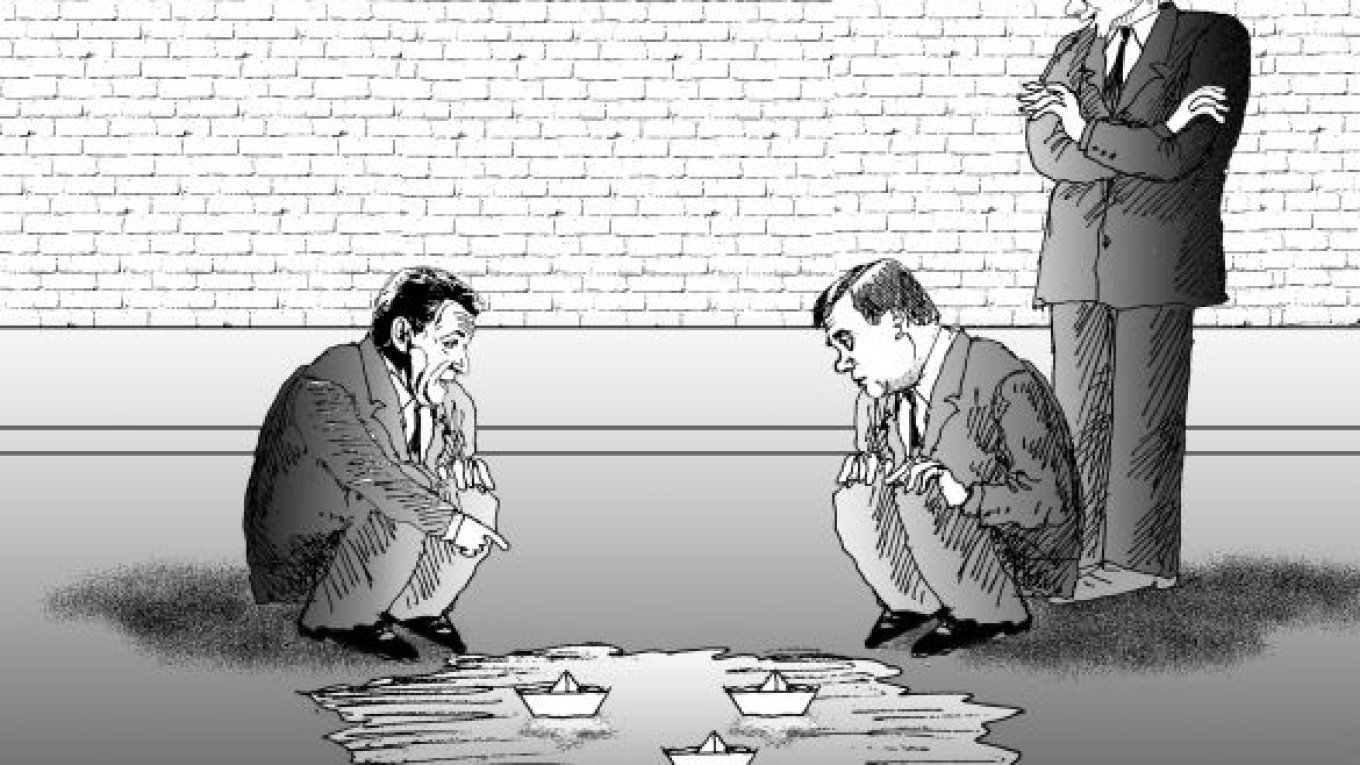
It is sometimes said that Germany has become a “second France” in its “selfish” approach to the European Union, but is France really on its way to becoming a “second Germany”? If Germany is Russia’s main economic partner, perhaps France should be its principal strategic partner.
France does not share Germany’s natural closeness to Russia — a relationship based on both geography and history. But France does have a long tradition of a special bilateral relationship with Russia — marked by a deep cultural dimension — that somehow transcended the Cold War.
General Charles de Gaulle once described himself as a “bad-weather friend” of the United States, which implied that in “better weather” he could go his own way, leave NATO’s integrated military command and behave as some kind of bridge between East and West. De Gaulle’s policy of detente towards the Soviet Union, which he started years before former U.S. President Richard Nixon and former U.S. Secretary of State Henry Kissinger tried it, personified France’s desire to exist diplomatically on its own and to maximize its room for maneuver with the United States.
Times have changed. French President Nicolas Sarkozy is not de Gaulle, and Russia is not the Soviet Union. Yet there is an undeniable whiff of nostalgia in the current rapprochement between two powers that are both conscious of their relative decline in the world. Both intend to reinforce their respective status — diplomatic in the case of France, strategic in the case of Russia. Yet the reality is more prosaic for both.
The high point of President Dmitry Medvedev’s visit to Paris several weeks ago, during which the Mistral-class helicopter carrier deal was discussed, was the two countries’ agreement not so much on long-term strategic visions, but on pragmatic considerations. For France, above all, “it’s the economy, stupid.”
France is keen to maintain its independent arms industry and to keep open its naval arsenal, based in Saint-Nazaire on the country’s west coast. This legitimate mercantile concern has supposedly been reciprocated by small steps by Russia in the direction of a policy of sanctions against Iran. It will be interesting to see in a few weeks or a few months whether the Kremlin will really deliver.
In reality, as was the case in August 2008, when Sarkozy successfully negotiated a cease-fire and then a peace deal between Georgia and Russia, largely on Russian terms, the French president’s actions are music to Russian ears. And “Sarkozy the American,” as he was once known in France, no longer thinks that he has to prove anything to the United States. France symbolically returned to NATO’s military command in April 2009. Even if some U.S. officials are irritated by French sales of sophisticated military equipment to Russia, no one has dared to complain openly.
With China looming on the horizon as a much more confident and defiant force than Russia, including as a key player in the Group of 20, Russia is being courted by all the world’s powers. And everybody seems to be making the same calculus, hoping to alter the balance of power within Russia to reinforce Medvedev’s position vis-a-vis Prime Minister Vladimir Putin.
But does such a calculus make sense, or is it simply wishful thinking, a reassuring and comfortable illusion designed to make French leaders feel good, when in fact they are dealing with Russia on purely commercial grounds?
As a Russian friend told me recently, “Putin wants to live like Roman Abramovich and to rule like Stalin.” He is the man in charge. The idea that you can play a Medvedev card to balance Putin is a dangerous illusion. There is no division of power between the two men. The first one is paving the way for the second to return to the Kremlin in 2012. In Russia, power is money and money is power. The stakes are simply too high.
France should not delude itself. There is nothing inherently wrong in selling weapons to Russia, but by doing so one merely plays into the hands of Putin’s effort to reinforce his policy of domination over Russia’s “near abroad.” The sale of such warships will not positively affect the balance of power within Russia, but it will affect the regional balance of power — in favor of Russia.
What is clear is that any ambition to define a common European energy and security policy toward Russia is slowly disappearing. From Berlin to Paris and from Paris to Rome, European leaders may ultimately be doing the same thing, but they are all doing it separately as competitors vying for Russian favor rather than as partners within a supposedly tight-knit union.
Dominique Moisi is a visiting professor at Harvard University and the author of “The Geopolitics of Emotion.” © Project Syndicate
A Message from The Moscow Times:
Dear readers,
We are facing unprecedented challenges. Russia's Prosecutor General's Office has designated The Moscow Times as an "undesirable" organization, criminalizing our work and putting our staff at risk of prosecution. This follows our earlier unjust labeling as a "foreign agent."
These actions are direct attempts to silence independent journalism in Russia. The authorities claim our work "discredits the decisions of the Russian leadership." We see things differently: we strive to provide accurate, unbiased reporting on Russia.
We, the journalists of The Moscow Times, refuse to be silenced. But to continue our work, we need your help.
Your support, no matter how small, makes a world of difference. If you can, please support us monthly starting from just $2. It's quick to set up, and every contribution makes a significant impact.
By supporting The Moscow Times, you're defending open, independent journalism in the face of repression. Thank you for standing with us.

Remind me later.