

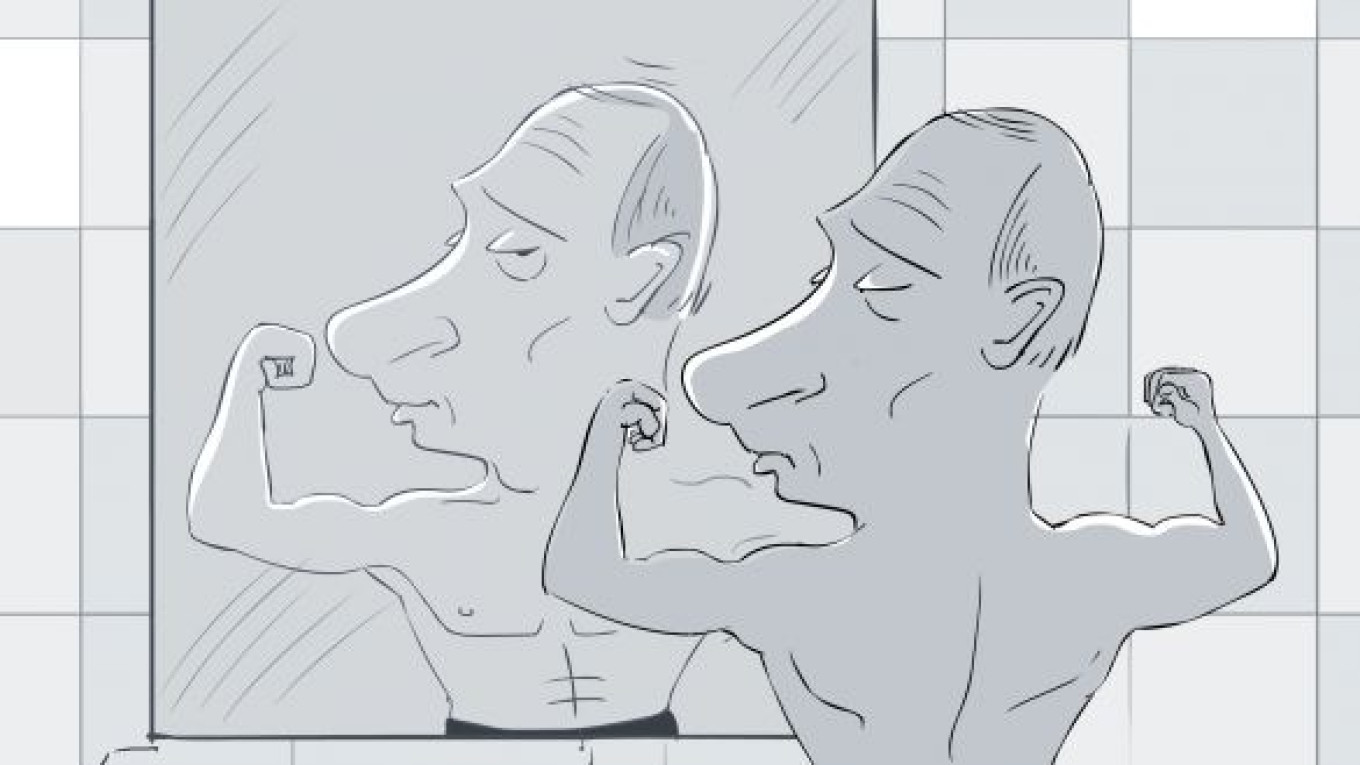
Over the past decade, Russia has made repeated attempts to demonstrate its growing power to the world. There are two main objectives behind these attempts: to obtain international recognition as a superpower and to coerce other states into partnership. Both goals are based on the political elite’s belief that Russia should be included on that list a priori by virtue of its huge territory, nuclear arsenal and economic potential.
In this respect, Russia’s policy toward the West places a strong emphasis on its sovereignty and on the assertion that it deserves equal standing with the other great powers.
But Moscow’s strategy toward other former Soviet republics is another matter entirely. Here, Russia is essentially attempting to coerce its neighbors into partnerships. Moscow takes this approach because it wants to have pro-Russian coalitions in its backyard. In practice, Russian foreign policy in its near abroad looks like a series of random fits and starts. Initiatives to create multilateral alliances, such as the Collective Security Treaty Organization and the Shanghai Cooperation Organization, have been unsuccessful. Russia’s attempts at strong-arm diplomacy and the use of its natural resources as a bargaining chip have also failed.
The divide between Russia’s efforts to regain its superpower status and the extremely modest results it has achieved stems from the fact that Prime Minister Vladimir Putin’s vertical power structure is a clumsy hybrid of authoritarianism and some elements of democracy. Clearly, liberal democratic governments — and in some ways, strangely enough, even 100 percent authoritarian regimes — are more effective than hybrid regimes.
Internal political considerations often force the leaders of hybrid regimes into reckless foreign policy pursuits in an attempt to boost approval ratings. But even if an aggressive foreign policy plays well with voters, it usually undermines the regime’s credibility in the eyes of its potential foreign partners. This results in a self-fulfilling vicious cycle: The less attractive the regime is to potential partners, the more limited its ability to build a long-term coalition strategy with other states — and the greater the temptation politicians face to opt for provocative foreign policy moves.
The hybrid nature of Russia’s political regime makes it harder for the country to project itself as a superpower. For Russia to increase its real influence in the world, it must achieve not only economic growth and technological progress, but must also modernize its decrepit and highly ineffective political institutions. Above all, it must adopt measures giving the political system greater predictability and stability, including the ability to change leadership peacefully and democratically.
Today, the United States and other leading global powers are forced to compete for potential partners for international alliances. For Russia to increase its global position, it must become a more attractive partner to its neighbors, and it must gain their trust. Treating them as “younger brothers” who should be dominated in one way or another achieves the opposite results and pushes them toward alliances with the West.
Russia is too unpredictable a country for the leaders of other former Soviet republics to be certain that its leadership will not try to use a partnership agreement to apply additional pressure on them. What’s more, they are justifiably concerned that Russia could use its growing power to exact further concessions from them. Naturally in such a situation, participants will block even effective forms of cooperation because they could end up weakening their own positions.
To become an attractive partner, Russia must formulate predictable and consistent domestic and foreign policies. It must have properly functioning democratic institutions and restrain its imperial ambitions. In the absence of such institutions, it is impossible to predict Russian policy. It is no coincidence that the European Union consists of democratic states only; democratic institutions are a necessary prerequisite for membership. Attempts to build unions after the EU model among non-democratic states in Africa and Asia have achieved only limited success.
Without a full-fledged democracy, it would be unrealistic to expect Russia’s potential allies to trust the Kremlin’s intentions. Even non-democratic and semi-democratic states — including CIS members — will continue distrusting Moscow. Using carrot-and-stick diplomacy — particularly using its enormous energy resources — Russia can compel these states from time to time to repeatedly voice support for Moscow’s position and to sign various agreements. But in the long term, such alliances are ineffective.
By maintaining a hybrid regime that combines elements of authoritarianism and electoral democracy, Russia effectively dooms itself to isolation in one form or another and loss of influence in the global arena.
Irina Busygina is a professor of political science and director of the Center for Regional Political Studies at Moscow State University for International Relations. Mikhail Filippov is a professor of political science at Binghamton University in New York. This comment appeared in Vedomosti.
A Message from The Moscow Times:
Dear readers,
We are facing unprecedented challenges. Russia's Prosecutor General's Office has designated The Moscow Times as an "undesirable" organization, criminalizing our work and putting our staff at risk of prosecution. This follows our earlier unjust labeling as a "foreign agent."
These actions are direct attempts to silence independent journalism in Russia. The authorities claim our work "discredits the decisions of the Russian leadership." We see things differently: we strive to provide accurate, unbiased reporting on Russia.
We, the journalists of The Moscow Times, refuse to be silenced. But to continue our work, we need your help.
Your support, no matter how small, makes a world of difference. If you can, please support us monthly starting from just $2. It's quick to set up, and every contribution makes a significant impact.
By supporting The Moscow Times, you're defending open, independent journalism in the face of repression. Thank you for standing with us.

Remind me later.