

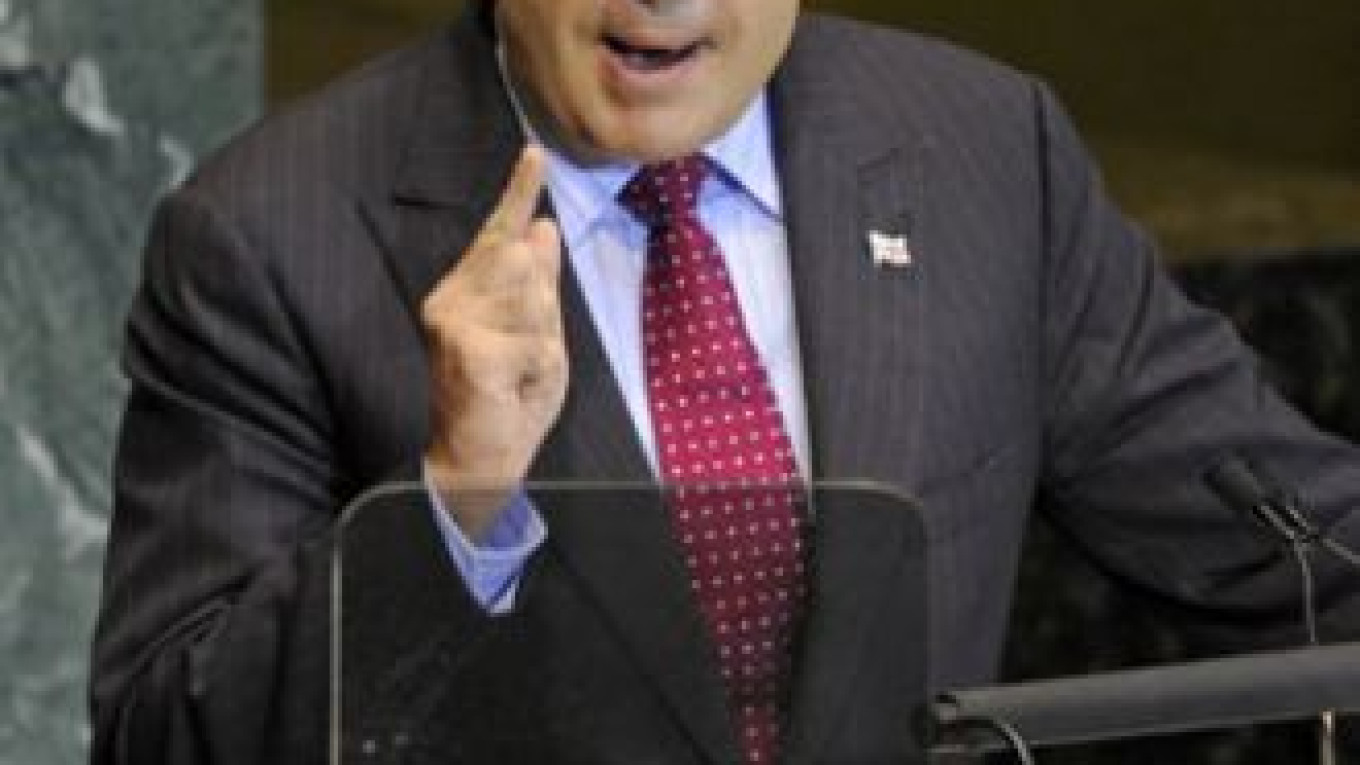
I will enjoy art, life and new architecture. And I will not care if people don’t remember President Saakashvili.”
That’s what the Georgian president said last week when speculation resurfaced about what he would do when his time in office ends. But while his opponents might relish the image of a happily retired Saakashvili chilling out in the galleries and cafes of Tbilisi, most of them don’t see it happening any time soon.
During the summer, lawmakers have been discussing constitutional reforms that could transform Georgia’s political system, reducing the powers of the president and making parliament and the prime minister stronger. In recent years, some opposition parties have argued for a less dominant presidency and enhanced parliamentary authority. But now they’re also unhappy about the proposed reforms. This is partially because they’re worried that the future, turbo-charged prime minister could turn out to be none other than Saakashvili.
Saakashvili is supposed to step down as president in 2013 after completing the maximum two terms. Many Georgians believe, however, that he won’t quit politics altogether. Despite the ruinous war with Russia and the allegations that he’s effectively made himself omnipotent in Georgia, he is still the single most popular politician in the country. Some of his supporters argue that a character with such vigor and imagination should not be carelessly discarded.
So will he imitate his enemy, Vladimir Putin, and become prime minister while one of his allies takes on the emasculated presidential role? So far, Saakashvili isn’t saying yes. But he isn’t saying no either, although he has denied that the constitutional changes are aimed at extending his reign.
He is clear, though, that he wants his cohorts to keep on ruling. “No one should be surprised that I will spare no efforts for the ideology and the reform team which I represent to remain in power after 2013,” he said recently.
Although former British Prime Minister Margaret Thatcher once famously declared she would go “on and on and on,” that didn’t happen, of course. She was eventually ousted by her own ministers. But unlike with Thatcher, there seems little chance that Saakashvili will become the victim of a “palace coup.” Therefore, despite the potentially uncomfortable comparisons with Putin, the choice about whether to take another tilt at power is likely to remain his alone.
Matthew Collin is a journalist based in Tbilisi.
A Message from The Moscow Times:
Dear readers,
We are facing unprecedented challenges. Russia's Prosecutor General's Office has designated The Moscow Times as an "undesirable" organization, criminalizing our work and putting our staff at risk of prosecution. This follows our earlier unjust labeling as a "foreign agent."
These actions are direct attempts to silence independent journalism in Russia. The authorities claim our work "discredits the decisions of the Russian leadership." We see things differently: we strive to provide accurate, unbiased reporting on Russia.
We, the journalists of The Moscow Times, refuse to be silenced. But to continue our work, we need your help.
Your support, no matter how small, makes a world of difference. If you can, please support us monthly starting from just $2. It's quick to set up, and every contribution makes a significant impact.
By supporting The Moscow Times, you're defending open, independent journalism in the face of repression. Thank you for standing with us.

Remind me later.