

 | To Our Readers |
The Moscow Times welcomes letters to the editor. Letters for publication should be signed and bear the signatory's address and telephone number. |
For most countries of the world, the global crisis is strictly economic. But Russia is experiencing two crises simultaneously -- economic and political.
Economic downturns, including the current one, come and go, but Russia's political crisis will never go away. This is because Russia's political model has always been deeply grounded in the myth of monism: one monolithic state, one party, one ideology, one national leader and one people. Those who lived during the Soviet period remember the ubiquitous overblown slogans of "the unity of all Soviet nationalities" or "the unified Soviet nation."
Russia under Vladimir Putin's leadership is doomed by historical inertia and tradition to continue the Soviet monistic model. United Russia is Putin's modern version of the Soviet Union's "United U.S.S.R." -- that is, the Communist Party. Nonetheless, United Russia is not as unified as Putin would like. There is the United Russia faction loyal to State Duma Speaker Boris Gryzlov, and there is the one loyal to Mayor Yury Luzhkov. Luzhkov rigidly controls the party's membership in Moscow and won't let any federal functionaries get within a mile of holding power.
Of course, you don't have to look very hard to see how empty the concept of a "unified people" really is. A large percentage of the Russian population don't hide their opposition to being "unified" or placed on the same level as the people from the Caucasus. This leads to the country's social schizophrenia. On one hand, Russians passionately supported the Russia-Georgia war to protect their "fellow citizens" in South Ossetia, in accordance with myths of a unified, monolithic superpower. But on the other hand, if they happen to meet one of their repatriated fellow citizens at any one of Moscow's street markets, they are quick to complain that the capital is being invaded by the "dark-skinned scum" from the Caucasus.
In mature democracies, whenever a failed president's term ends, power is peacefully passed on to a new administration. The new president receives a mandate from the people to remake and repair his predecessor's political failures. Putin's power vertical, however, remains a sacrosanct institution for roughly 80 percent of the population, regardless of the small cracks in the foundation that have revealed themselves as the crisis unfolds. Putin's political system is considered so sacred that the mere thought of its dissolution would be seen as a catastrophe. What model would replace his power vertical? Who would lead it? In Putin's power vertical, everything is decided by and dependent on one person only. If that person is removed, the entire political system collapses. A monistic system is by definition monopolistic; there are no alternatives.
Of course, Putin is not immortal. At some point -- perhaps when he completes two more presidential terms at the age of 72 -- there will be a change of power. Just like Yeltsin anointed Putin and Putin anointed Medvedev, Putin in his 70s could anoint a successor. But it is never that simple. In all likelihood, it will not be Putin himself but the most powerful clique within Putin's elite -- those who control the most resources in the country -- who get the final say in who becomes president after Putin. And as Putin gets older and weaker, this could be a messy affair, as feuding clans within the elite battle with one another to fill the imminent vacuum. This behind-the-scenes fight for power is a time-honored tradition passed on by the Communist Party's Central Committee. In this sense, Russia's politics will continue to be as secret and nontransparent as they always were. Despite the superficial semblances of democracy and popular vote, the people will have little if any say in the change of power.
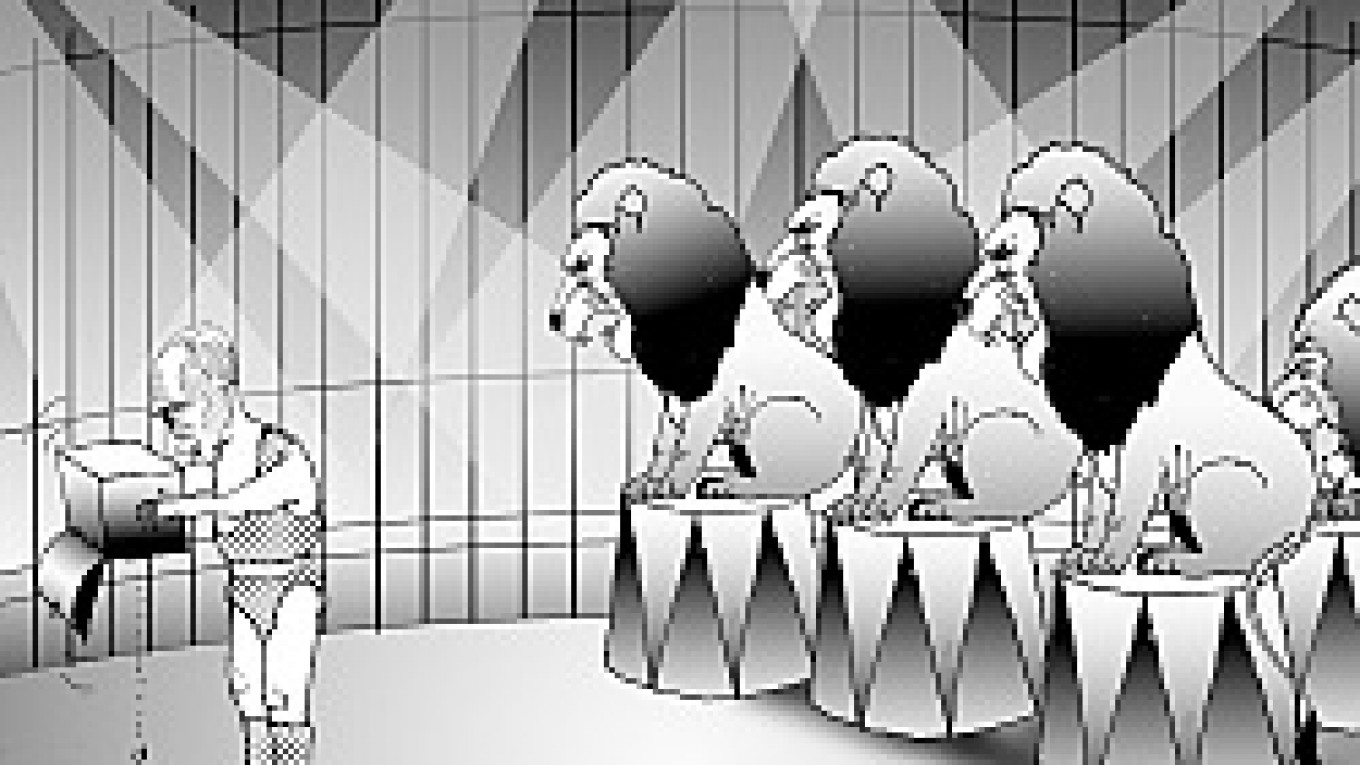
Putin could have continued propping up his Potemkin power vertical and his Potemkin democracy for many more years if the petrodollars kept pouring in. That money was crucial to keep Putin's "circus lions" -- that is, the various elite surrounding him -- well-fed and docile. But now the money is running out, and it is frightening to consider the consequences. It is well-known that even the best-trained circus lions have been known to turn on their trainers unexpectedly, even when they are well-fed. Just think of what could happen if those lions are hungry -- and angry. We have already heard the first menacing roars from Putin's lions. They are gritting their teeth and salivating at the mouth. I am sure that Putin sees and hears all of this.
Putin's Potemkin village is about to fall apart at the seams, but this is nothing to rejoice over. The only pluralism we will see as the result of this collapse will be "armed pluralism" -- that is, widespread protests and violence on the streets. The government will respond by further strengthening its autocratic rule.
There is an outside chance that the collapse of Putin's model might end with a whimper, but it all likelihood it will end with a huge explosion -- like the lid blowing off an overheated pressure cooker.
Dmitry Oreshkin is a Moscow-based political analyst.
A Message from The Moscow Times:
Dear readers,
We are facing unprecedented challenges. Russia's Prosecutor General's Office has designated The Moscow Times as an "undesirable" organization, criminalizing our work and putting our staff at risk of prosecution. This follows our earlier unjust labeling as a "foreign agent."
These actions are direct attempts to silence independent journalism in Russia. The authorities claim our work "discredits the decisions of the Russian leadership." We see things differently: we strive to provide accurate, unbiased reporting on Russia.
We, the journalists of The Moscow Times, refuse to be silenced. But to continue our work, we need your help.
Your support, no matter how small, makes a world of difference. If you can, please support us monthly starting from just $2. It's quick to set up, and every contribution makes a significant impact.
By supporting The Moscow Times, you're defending open, independent journalism in the face of repression. Thank you for standing with us.

Remind me later.