

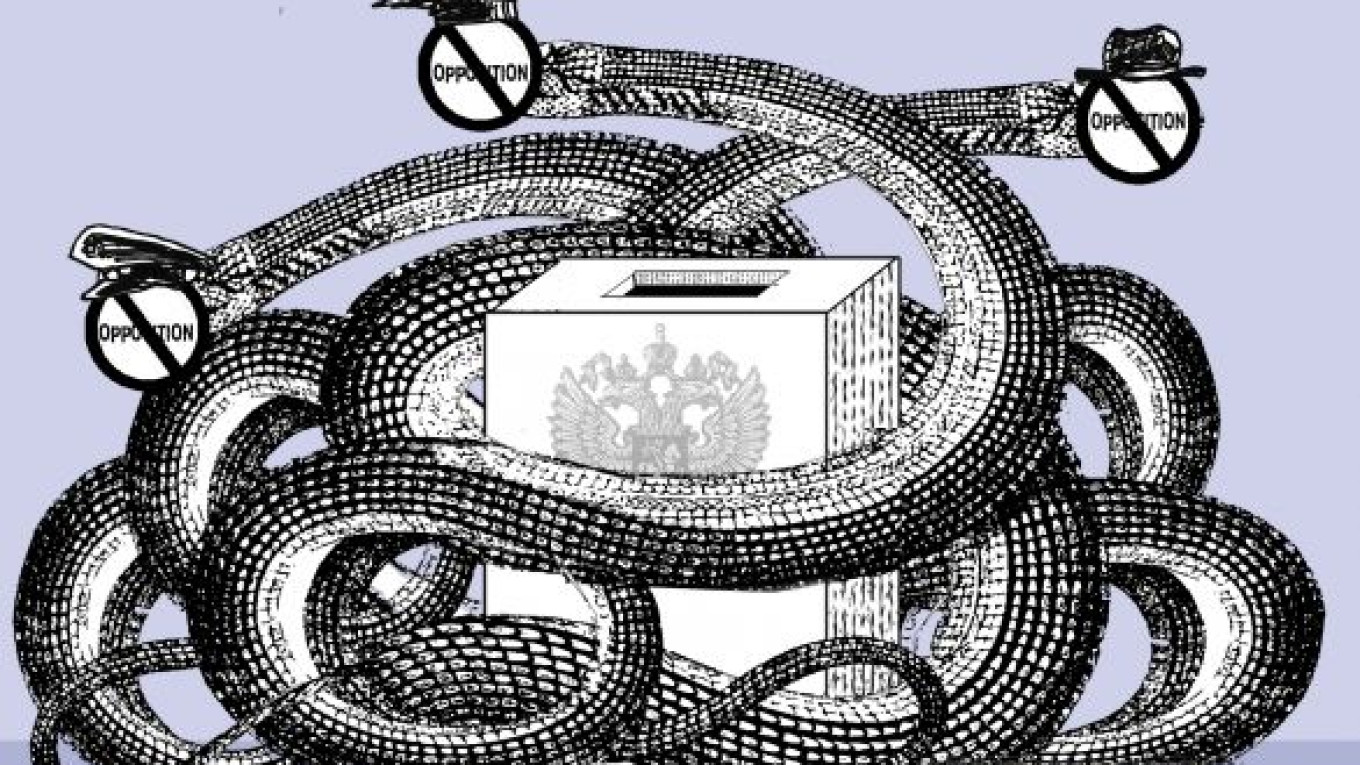
On Friday, the Party of People’s Freedom, or Parnas, filed a lawsuit in Moscow’s Zamoskvoretsky District Court challenging the Justice Ministry decision on June 22 to not register the party.
Unfortunately, the outcome of our appeal is a foregone conclusion. During the past decade under Vladimir Putin, not a single citizen or political opposition member has won a court case against the government or a senior official. Using administrative resources and the Kremlin-subservient Justice Ministry, Putin was determined to destroy Parnas any way possible. This became clear in December, when, during his yearly call-in show, he made libelous accusations against Parnas leaders, claiming they stole billions of dollars in the 1990s.
In its appeal on Friday, Parnas lawyers showed the utter absurdity of the claims made by the Justice Ministry.
First, the ministry based its refusal on inaccuracies in the data for 79 individual party members, even though more than 46,000 adult citizens — more than 1,000 more than the required minimum — signed the petition to become members.
Second, lawyers showed that the Parnas charter does have a mechanism for rotating the governing bodies of the organization, directly refuting Justice Ministry claims to the contrary.
Third, lawyers proved that the Justice Ministry’s allegation that Parnas has an improper process for appointing its executive directors and the executive directors of its regional branches is completely groundless. Parnas’ provisions for appointing members to these posts, stipulated in the party’s charter, corresponds word-for-word to the charters of United Russia and the Kremlin-sanctioned Right Cause party.
Fourth, the Justice Ministry in its official explanation why Parnas registration was disqualified mistakenly cites the law concerning nongovernmental organizations rather than the law regulating political parties. This flub proves not only the incompetence of the ministry, but underscores the complete arbitrary nature of the campaign against the party.
Thus, all four of the claims the Justice Ministry cites in its refusal to register Parnas are legally untenable according to Russian law, much less according to standards set by the European Court of Human Rights. Interestingly, the Justice Ministry was either unwilling or unable to back up its claims with any legal justification indicating why alleged violations served as the basis for refusing registration.
Russia’s leaders who are behind the campaign to destroy independent opposition parties try to deflect the West’s attention away from their manipulations and abuse of power by using the old, worn-out standard phrase that goes back to the Soviet period: “You have no right to interfere with our internal laws and regulations.”
But Russia’s abuse of power is not a purely “internal affair” for the simple reason that by violating the constitutional rights of political parties and rights of voters to select their representatives in parliament, Russia is violating international law and international conventions. Above all, it has violated the European Convention on Human Rights, which Russia ratified in March 1998 — particularly its provisions on freedom of assembly and association.
In addition, Russia has violated its own Constitution. Article 15, Point 4? of the Constitution states that both “commonly recognized principles and norms of international law” and the international treaties that Russia has signed are automatically accepted as a part of Russia’s legal codes. Furthermore, in those cases when provisions in these treaties contradict or otherwise conflict with Russian law, the treaties take precedence.
Starting in 2006, the Kremlin has failed to register nine political parties, including Parnas, on trumped-up charges. This violates Article 11 of the European Convention for the Protection of Human Rights and Fundamental Freedoms. That clause was cited in an European Court of Human Rights ruling made on April 12 in response to a lawsuit filed by the Republican Party that was liquidated in accordance with a new law on political parties adopted in 2006. That ruling clearly states that restrictions on the registration or activities of political parties can be made only when it is “necessary in a democratic society in the interests of national security or public safety, for the prevention of disorder or crime, for the protection of health or morals or for the protection of the rights and freedoms of others.”
None of these reasons are cited in the Justice Ministry’s refusal to register Parnas. Instead, the decision is based on fabricated violations. Missed commas and an arbitrary interpretation of the law are given greater weight than the constitutional rights of citizens.
Parnas has little hope it can win its case in a court system that is so servile to the Kremlin. It would also be pointless to wait for the European Court of Human Rights to make a new ruling when Putin and his inner circle have refused to honor the decisions that court has already handed down and continue to violate international law on human rights.
Thus, in the near term Parnas will focus instead on delegitimizing the current regime and paving the way for future democratic change in the country.
Vladimir Ryzhkov, a State Duma deputy from 1993 to 2007, hosts a political talk show on Ekho Moskvy radio and is a co-founder of the opposition Party of People’s Freedom.
A Message from The Moscow Times:
Dear readers,
We are facing unprecedented challenges. Russia's Prosecutor General's Office has designated The Moscow Times as an "undesirable" organization, criminalizing our work and putting our staff at risk of prosecution. This follows our earlier unjust labeling as a "foreign agent."
These actions are direct attempts to silence independent journalism in Russia. The authorities claim our work "discredits the decisions of the Russian leadership." We see things differently: we strive to provide accurate, unbiased reporting on Russia.
We, the journalists of The Moscow Times, refuse to be silenced. But to continue our work, we need your help.
Your support, no matter how small, makes a world of difference. If you can, please support us monthly starting from just $2. It's quick to set up, and every contribution makes a significant impact.
By supporting The Moscow Times, you're defending open, independent journalism in the face of repression. Thank you for standing with us.

Remind me later.