

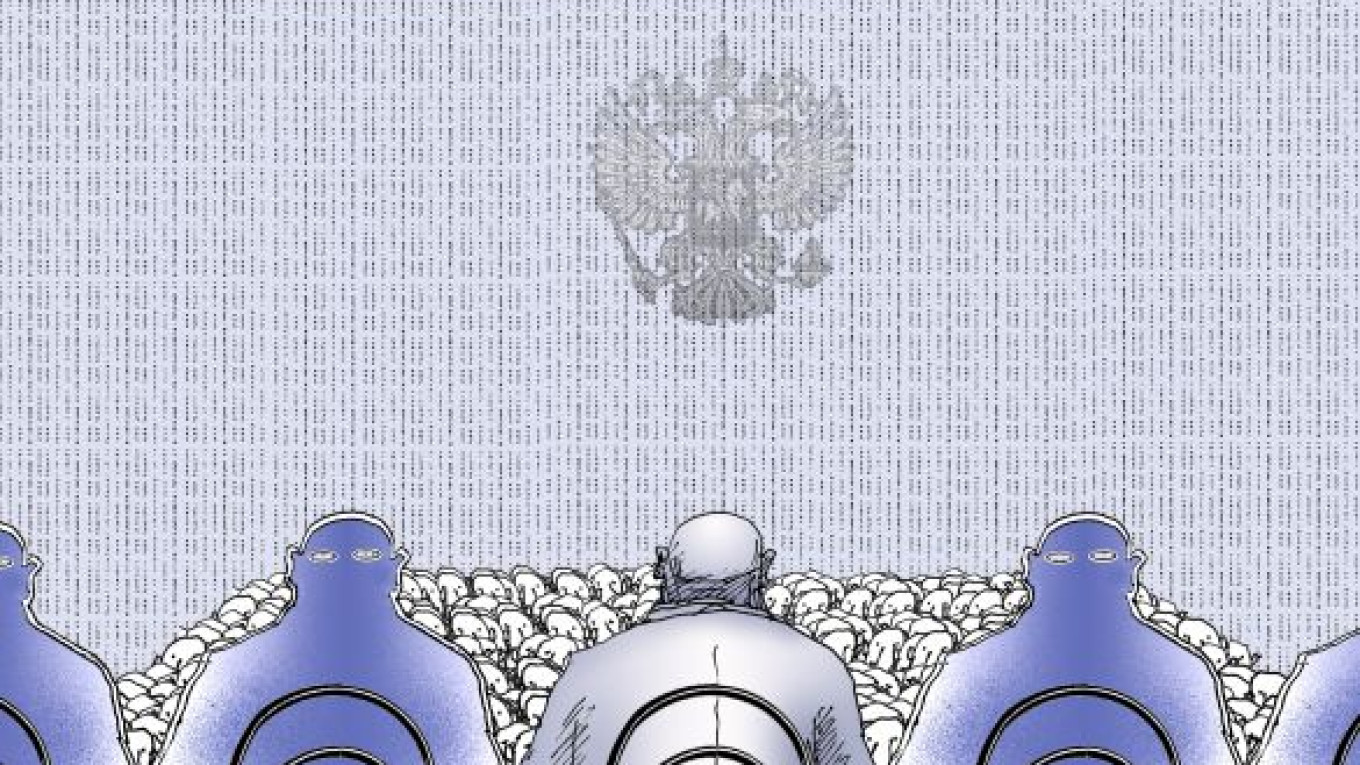
The scandal about how Mikhail Prokhorov was first recruited and then cast out of the Right Cause party calls into question whether there is a place for political parties in an authoritarian political system. If there is, can those parties be the initiators and leaders of peaceful or revolutionary democratic change? Does it make sense to vote for Kremlin-approved parties in the December State Duma elections in the hope that they will loosen the power of the current authoritarian regime? ?
Paradoxically, authoritarian regimes are often multiparty systems, although that pluralism is only nominal.
China is a good example of a nominally multiparty system. Aside from the Communist Party that holds a monopoly on power, there are eight political parties that were created before the People’s Republic of China was founded in 1949 and implicitly accept the commanding role of the Communist Party. All the parties are combined into a common front headed by the Communist Party and play a purely consultative role as part of a special institution called the Chinese People’s Political Consultative Conference.
Another example was East Germany since it had a nominally multiparty system under a Communist dictatorship. As in China, East Germany inherited its multiparty system from the country’s democratic period before the war. The Communist Party of Germany ruled the country with assistance from the Soviet Union right up until the fall of the Berlin Wall. The Social Democratic Party of Germany was re-established in East Germany immediately after the war’s end. In fact, by late 1945 the Social Democratic Party was the largest political party in the Soviet occupation zone. In addition, East Germany had the Christian Democratic Union and the Liberal Democratic Party.
There techniques enable a ruling party to turn formerly independent political parties with their own traditions into satellites or subordinates of the dominant party. Many of those same tricks are employed in today’s Russia.
As early as July 1945, four parties inside the Soviet occupation zone in East Germany formed an “anti-fascist democratic bloc” with the aim of working together to rebuild their country. As with Prime Minister Vladimir Putin’s All-Russia People’s Front, that bloc enlisted a variety of civil organizations such as women’s and cultural groups. The bloc’s leader, Walter Ulbricht, once said, “Everything has to look democratic, but it should be under our control.” You cannot help but think about Russia when reading this quote.
The system of “co-participant parties” in East Germany did not become the engine moving the country toward democracy and the fall of the Communist dictatorship in 1990. Instead, these parties moved in the wake of revolutionary events. The turning point was the elections held on May 7, 1989, when 10 percent to 20 percent of people voted against the unified list of the “anti-fascist bloc,” although official statistics claim that 98.89 percent of the population voted for it. Also that year, 120,000 East German citizens applied for emigration. Dissidents operating underground became leaders of the revolution and the masses rallied around them. In the end, the authorities were forced to sit down at the negotiating table with them.
As a second step, the smaller Communist Party of Germany forced the larger Social Democratic Party into a merger that essentially swallowed the latter. By April 1946, the two had combined into a single party — the Socialist Unity Party of Germany — that immediately held hegemony over the political system of the country.
In similar fashion, the Unity party swallowed up the Fatherland-All Russia party headed by then-Mayor Yury Luzhkov to form United Russia. Later, United Russia swallowed up a number of other minor parties as well, including the Agrarian Party. Similarly, in 2006 the pro-Kremlin Life Party headed by Sergei Mironov absorbed the Rodina party and Pensioners’ Party through mergers. Forcing independent parties to merge with larger pro-government parties helps the Kremlin monopolize political power.
The techniques of replacing disloyal leaders with loyal ones and creating artificial puppet parties are widely practiced in Russia today. It is interesting that in East Germany, Social Unity Party officers would handpick the entire leadership of the new parties they created — strikingly similar to what happened with Right Cause and its short-lived chairman, Prokhorov.
History demonstrates that satellite or subordinate parties in an authoritarian system cannot be the initiators of change. On the contrary, they either disappear or change completely with the collapse of the ruling regime. Real change is brought on by society itself. The leaders of that transition are individuals who enjoy the public’s confidence and not those who are responsible for the crimes committed by the failed regime.
Vladimir Ryzhkov, a State Duma deputy from 1993 to 2007, hosts a political talk show on Ekho Moskvy radio and is co-founder of the opposition Party of People’s Freedom.
A Message from The Moscow Times:
Dear readers,
We are facing unprecedented challenges. Russia's Prosecutor General's Office has designated The Moscow Times as an "undesirable" organization, criminalizing our work and putting our staff at risk of prosecution. This follows our earlier unjust labeling as a "foreign agent."
These actions are direct attempts to silence independent journalism in Russia. The authorities claim our work "discredits the decisions of the Russian leadership." We see things differently: we strive to provide accurate, unbiased reporting on Russia.
We, the journalists of The Moscow Times, refuse to be silenced. But to continue our work, we need your help.
Your support, no matter how small, makes a world of difference. If you can, please support us monthly starting from just $2. It's quick to set up, and every contribution makes a significant impact.
By supporting The Moscow Times, you're defending open, independent journalism in the face of repression. Thank you for standing with us.

Remind me later.