

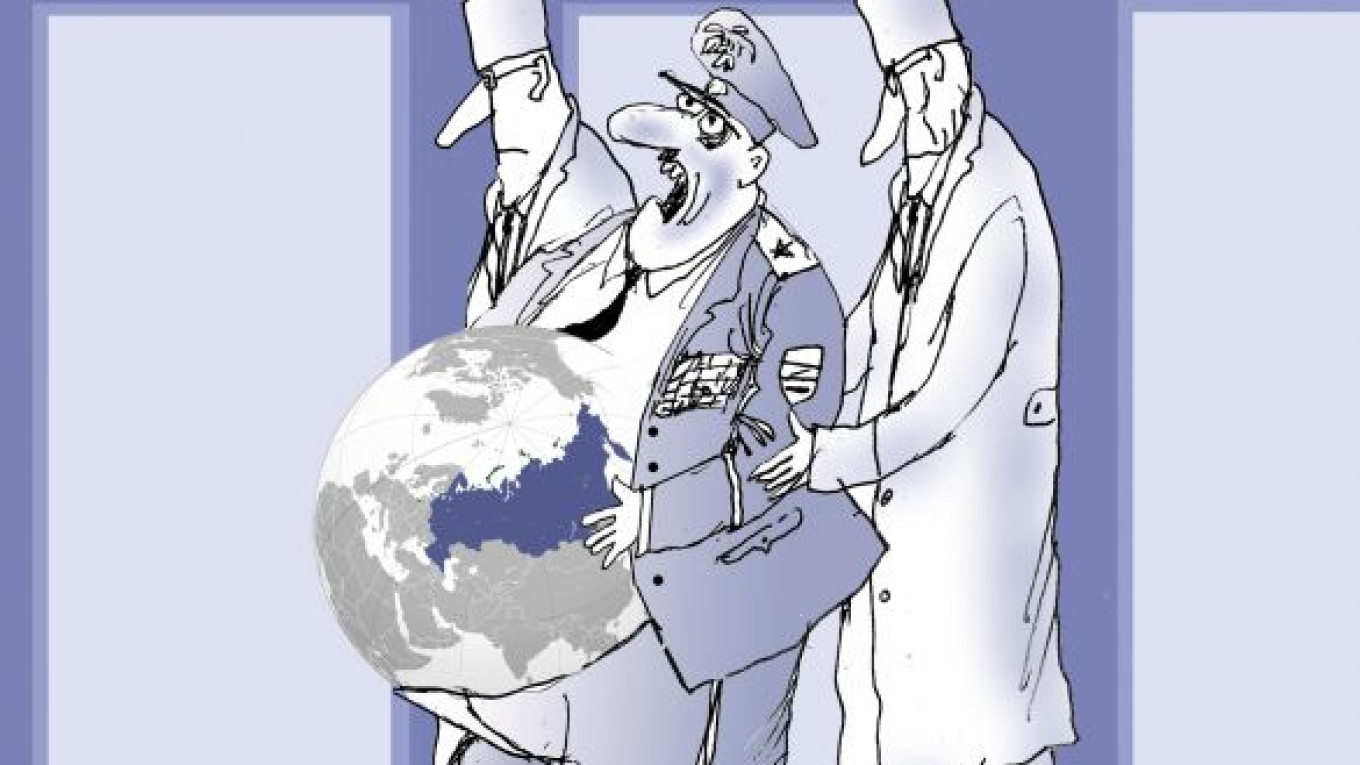
Pseudocyesis, or false pregnancy, is the psychological syndrome when a woman is convinced she is pregnant after experiencing similar symptoms that are associated with pregnancy.
Russia’s military hawks, who constantly warn that U.S. missile defense will undermine Russia?€™s strategic nuclear deterrence, are experiencing a similar hallucination.
We have been hearing these overblown, alarmist cries ever since President George W. Bush announced the U.S. withdrawal? from the Anti-Ballistic Missile Treaty in December 2001.
Strangely enough, these cries continued unabated even after U.S. President Barack Obama drastically scaled back Bush?€™s missile defense program in September 2009 — a move that was intended, above all, to be more effective against a missile threat by a Middle Eastern rogue state, such as Iran or Syria, but also to help appease Russia?€™s concerns and boost the reset in relations between the two countries.
We heard the latest round of Russian military bluster on May 20, when General Staff deputy chief Andrei Tretyak claimed that by 2015, the third phase of Obama?€™s planned European missile defense system ?€” which would be only able to intercept intermediate-range missiles that Russia doesn?€™t even possess ?€” would somehow pose a threat to Russia?€™s intercontinental missiles and even its submarine-based nuclear missiles.
“This is a real threat to our nuclear deterrent forces,” Tretyak said with the kind of straight face that only a Cold War-era general could muster.
For his part, President Dmitry Medvedev ?€” albeit with a much softer face ?€” has warned that if Russia feels threatened by a U.S. or European missile defense system, the Kremlin would be forced to beef up its strategic nuclear arsenal despite New START limits, possibly leading to an arms race.
Medvedev also pressed for a written, binding U.S. guarantee that no missile defense system could ever be targeted against Russia.
But a quick look at the globe will show that this proposal is a nonstarter at best and nonsensical at worst. Since Russia covers one-seventh of the world?€™s landmass, even the most modest missile defense installment intended to defend against a rogue state and placed forward of Russia?€™s northern borders ?€” for example, the current 30 intercepters in Alaska and California ?€” could be considered by the Kremlin as being ?€?targeted against Russia.?€? How far does Moscow really expect Washington to go to cater to its whims?
There have been numerous commentaries on these pages explaining the objective reasons why U.S. missile defense poses no threat to Russia. The main reason is geography. Another quick look at the globe shows that the current Aegis-based SM-3 missiles ?€” which are short- and medium-range intercepters ?€” cannot reach Russia?€™s strategic land-based nuclear missiles, much less its submarine-based ones.
If the United States were really intent on weakening Russia?€™s strategic forces, it wouldn?€™t deploy Aegis-based SM-3 intercepters, but a much more powerful missile defense system that is intended to intercept ICBMs. Moreover, these intercepters would have to be deployed along the Russia-U.S. trajectory in a forward position ?€” for example, in Norway, Greenland and northern Canada ??€”? and certainly not in the Black Sea region or Central Europe. In addition, the United States would have to install 15,000 intercepters to come even close to weakening Russia?€™s nuclear forces, even at its reduced New START level of 1,550 warheads.
The U.S. strategic nuclear deterrent has always been an important component of Washington?€™s military strategy, but far from a dominating one for the simple reason that strategic nuclear weapons are, by definition, not intended to be used in combat. They are intended only as a deterrent against a nuclear first strike from another country. The much larger priority for the U.S. military is high-precision conventional weapons, which it can actually use in combat.
But for Russia, as military analyst Ruslan Pukhov wrote in a May 27 column on these pages, its nuclear forces play a hypertrophied role in its military strategy for two reasons ?€” first, as a superpower status symbol; and, second, as a surrogate military tool that it brandishes in a vain attempt to compensate for its lagging conventional forces. Just as Russia exaggerates the importance of its nuclear weapons, it also exaggerates the threat that U.S. military missile defense poses to its nuclear forces.
Since Russia?€™s military hawks view its nuclear weapons as the holy of holies ?€” or, to put it more bluntly, the only military component that still makes it a superpower ?€” even the slightest hint of a theoretical devaluation of Russia?€™s strategic forces from U.S. missile defense gets blown out of proportion and is viewed as a matter of life and death for the country?€™s national security, however irrational this may appear to outsiders.
In most cases, false pregnancy is treated by a psychotherapist. The most successful treatment is to simply show the patient ultrasound images that objectively and conclusively refute pregnancy. In Russia?€™s case, which can be diagnosed as ?€?acute false missile defense panic,?€? a quick look at the globe would be a good way to start treatment.
Michael Bohm is the opinion page editor of The Moscow Times.
A Message from The Moscow Times:
Dear readers,
We are facing unprecedented challenges. Russia's Prosecutor General's Office has designated The Moscow Times as an "undesirable" organization, criminalizing our work and putting our staff at risk of prosecution. This follows our earlier unjust labeling as a "foreign agent."
These actions are direct attempts to silence independent journalism in Russia. The authorities claim our work "discredits the decisions of the Russian leadership." We see things differently: we strive to provide accurate, unbiased reporting on Russia.
We, the journalists of The Moscow Times, refuse to be silenced. But to continue our work, we need your help.
Your support, no matter how small, makes a world of difference. If you can, please support us monthly starting from just $2. It's quick to set up, and every contribution makes a significant impact.
By supporting The Moscow Times, you're defending open, independent journalism in the face of repression. Thank you for standing with us.

Remind me later.