

The Federal Court Marshals Service, long an innovator in the field of forcing individuals to pay their debts, is now looking to make collection less of a hassle for small-time delinquents owing less than $1,000.
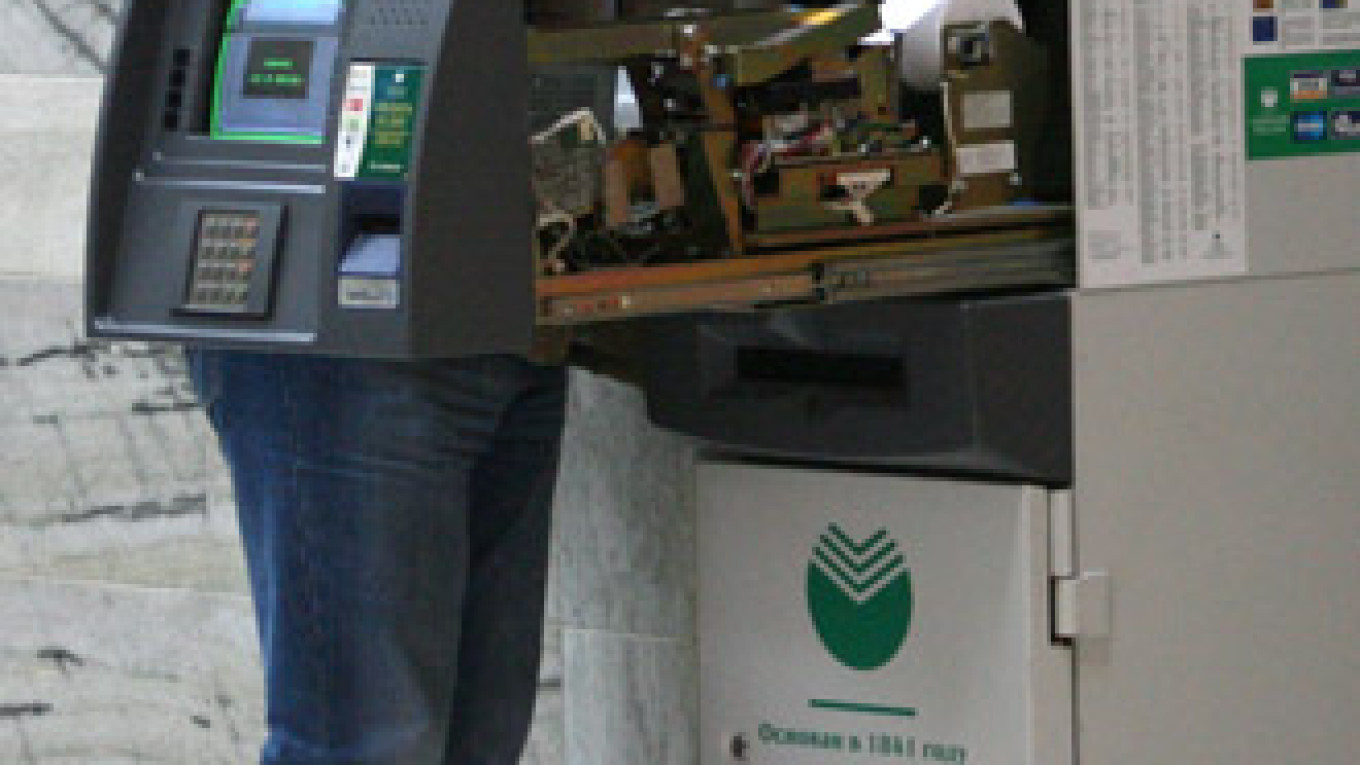
The service is working with state-controlled Sberbank on pilot projects in the Altai and Volgograd regions, where people with small debts — typically for taxes or utilities — can repay the sum at any of the bank’s automated teller machines. Under the program, which bypasses the paperwork traditionally required, the debtor simply uses a bank card to pay the loan, plus a 3 percent commission to Sberbank.
“We’re partnering with Sberbank because its branches are almost everywhere in Russia. If these projects are successful in the regions, we’ll launch it all over Russia,” Sergei Sazanov, the service’s first deputy chief, said at a news conference Wednesday.
The service, a part of the Justice Ministry, also plans to start collecting debts through the ubiquitous terminals where Russians typically pay bills for their cell phones and utilities. That project is being tested in the Tyumen region, where the number of terminals that can accept the debt payments will reach 600 by Dec. 1.
“A debtor just has to choose the option to pay a debt and enter his identity number to see how much he owes,” Sazanov said. “This system is used for debts of not more than 30,000 rubles. A debtor can pay his debt through the terminal immediately. After he pays, he receives a check that he can show the court marshals.”
On its web site, the service touted an additional benefit of the ATM payments: people can also bail out a hard-up friend or relative.
The marshals service has become notorious for its ingenuity in collecting debts, most notably in February 2008, when it began banning people with outstanding overdue loans from leaving the country.
In February of this year, with the economic crisis in full swing, President Dmitry Medvedev ordered the marshals to hire another 20,000 employees to deal with the added workload — an increase of one-third to its 60,000 staff at the time.
Since then, bailiffs have appealed to debtors’ consciences — signing a joint declaration with the Russian Orthodox Church in June on the sin of default — and their cell phone companies, drawing down balances to cover unpaid bills.
In August, the bailiffs also said they would seek permission to revoke licenses to operate cars, planes or boats, as well as to hunt and fish.
“If someone has enough money for an expensive gun or an expensive car, he needs to pay his debts first,” Sazanov told reporters, when asked about the proposals.
The proposal, which would prevent people from driving as part of their jobs, is still under consideration, he said.
Ultimately, the marshals hope to replicate the experience of their Finnish colleagues, who have a nationwide electronic database of debtors. “There is an automatic system of debt collecting in Finland. We are coming to that,” Sazanov said.
A Message from The Moscow Times:
Dear readers,
We are facing unprecedented challenges. Russia's Prosecutor General's Office has designated The Moscow Times as an "undesirable" organization, criminalizing our work and putting our staff at risk of prosecution. This follows our earlier unjust labeling as a "foreign agent."
These actions are direct attempts to silence independent journalism in Russia. The authorities claim our work "discredits the decisions of the Russian leadership." We see things differently: we strive to provide accurate, unbiased reporting on Russia.
We, the journalists of The Moscow Times, refuse to be silenced. But to continue our work, we need your help.
Your support, no matter how small, makes a world of difference. If you can, please support us monthly starting from just $2. It's quick to set up, and every contribution makes a significant impact.
By supporting The Moscow Times, you're defending open, independent journalism in the face of repression. Thank you for standing with us.

Remind me later.