

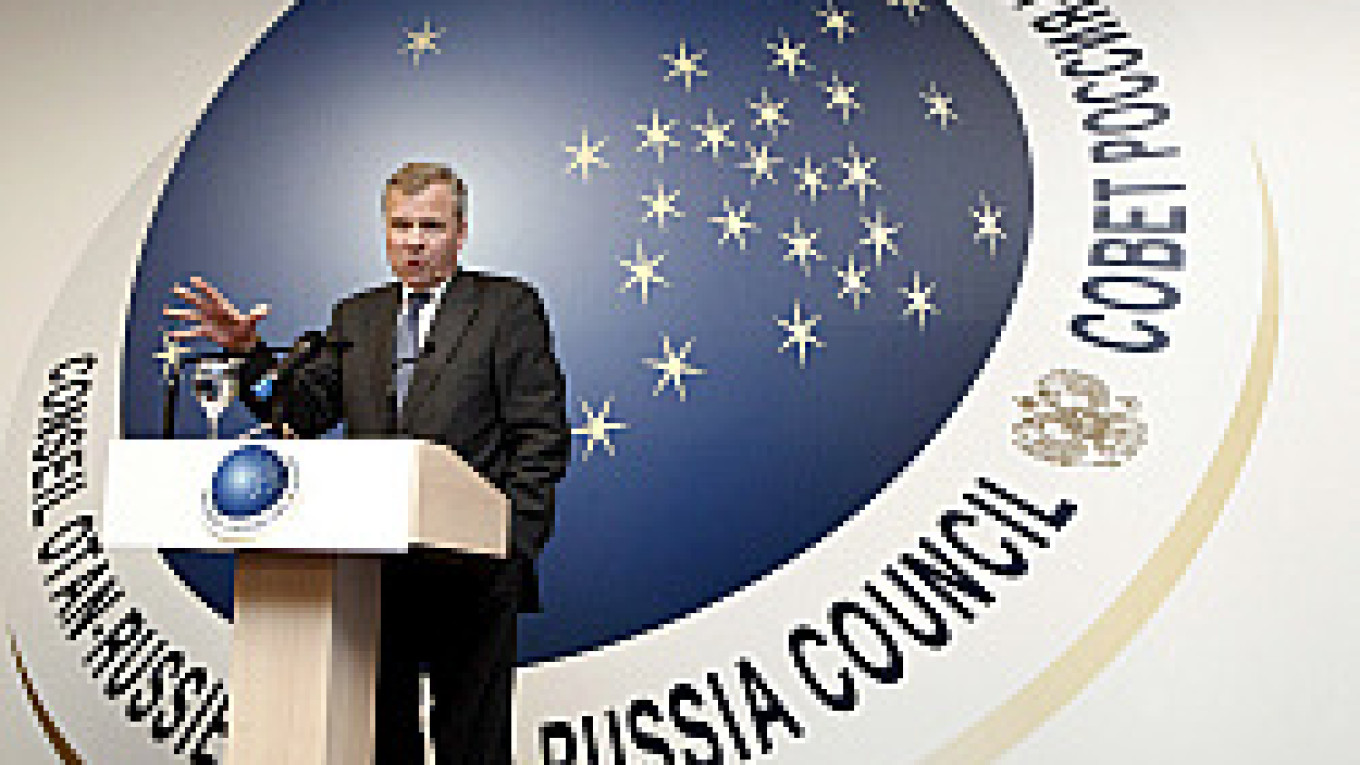
The deal emerged after NATO Secretary-General Jaap de Hoop Scheffer said the two sides recognized that it was time to crank up joint efforts against Afghan insurgents and drug trafficking, Somali piracy, terrorism and nuclear proliferation.
The Russia-NATO thaw emerged a week before a summit between U.S. President Barack Obama and President Dmitry Medvedev in Moscow and a summit of G8 powers in Italy.
"We have restarted our relations at a political level. We also agreed to restart the military-to-military contacts, which had been frozen since last August," de Hoop Scheffer told a news conference.
"The NATO-Russia Council is now back in gear. We agreed not to let disagreements bring the whole train to a halt. On Georgia, there are still fundamental differences. ... [But] Russia needs NATO, and NATO needs Russia," he said.
He said the two sides could also cooperate more closely on Afghanistan, including intensifying counternarcotics operations.
Russia was decidedly =more reserved about the foreign ministers' deal struck on the Greek island of Corfu after protracted recriminations over Moscow's military intervention to repel Georgia's attempt to wrest back rebel territory.
Lavrov said the meeting was "to a certain extent a positive development" and cited "very frank exchanges," alluding in part to intractable differences over Georgia's status.
Lavrov repeated that Russia's recognition of the "independence" of two rebel regions from Georgia was an irreversible "new reality" and the West should get used to it.
Russia routed Georgian troops who tried to retake South Ossetia in August 2008 and has blocked an extension of an OSCE peace monitoring mission in Georgia, which expires on Tuesday, by insisting on a separate mandate for South Ossetia.
Western diplomats fear that the OSCE military observers' imminent departure might lead to new fighting in the tinderbox Caucasus.
Despite the impasse over Georgia, de Hoop Scheffer said efforts to flesh out Saturday's accord would begin soon at an ambassadorial level in Brussels.
Many of the ministers will stay on for an informal European Union review of ties with Iran over its postelection crackdown on opposition protesters, and an OSCE session to tackle Western-Russian grievances stoked by the Georgia conflict.
A senior U.S. official, speaking on condition of anonymity, said NATO also hoped for cooperation with Russia in counterpiracy operations off Somalia and to extend to a NATO level bilateral talks on the transit of military supplies to Afghanistan through Russian territory.
A Message from The Moscow Times:
Dear readers,
We are facing unprecedented challenges. Russia's Prosecutor General's Office has designated The Moscow Times as an "undesirable" organization, criminalizing our work and putting our staff at risk of prosecution. This follows our earlier unjust labeling as a "foreign agent."
These actions are direct attempts to silence independent journalism in Russia. The authorities claim our work "discredits the decisions of the Russian leadership." We see things differently: we strive to provide accurate, unbiased reporting on Russia.
We, the journalists of The Moscow Times, refuse to be silenced. But to continue our work, we need your help.
Your support, no matter how small, makes a world of difference. If you can, please support us monthly starting from just $2. It's quick to set up, and every contribution makes a significant impact.
By supporting The Moscow Times, you're defending open, independent journalism in the face of repression. Thank you for standing with us.

Remind me later.