

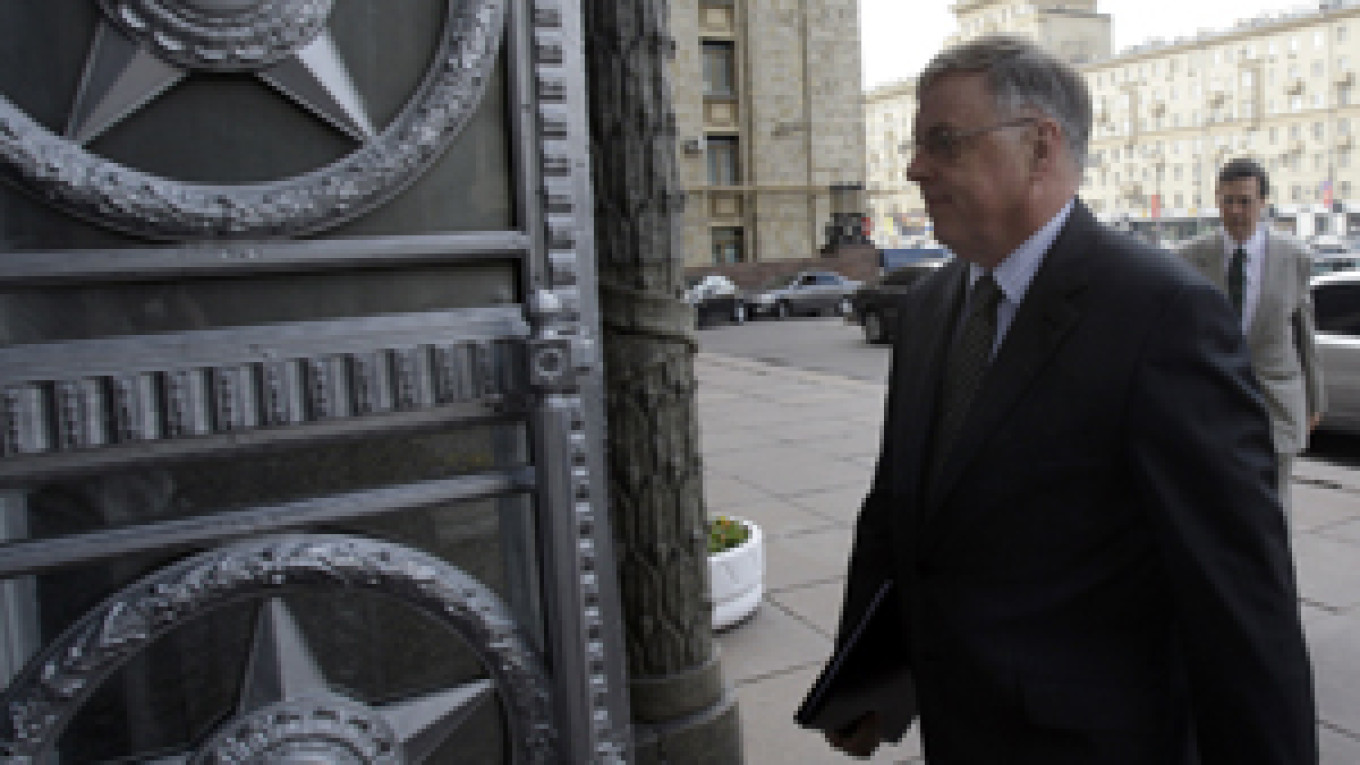
Canadian Ambassador Ralph Lysyshyn was summoned to the ministry Wednesday, where he was informed that Isabelle Francois, head of the NATO Information Office in Moscow, and another diplomat at the office, Mark Opgenorth, would have their accreditations revoked.
Both officials are Canadian citizens and accredited as attaches with the Canadian Embassy.
The tit-for-tat expulsions follow Belgium's announcement Tuesday that it would expel two diplomats from Russia's permanent mission to the alliance's headquarters in Brussels as tensions ratcheted up between Moscow and its Cold War foe.
"Lysyshyn was informed that in reply to NATO's unfriendly move … the Russian side has taken the necessary decision to remove the diplomatic accreditation of the Director of NATO's Information Office," the Foreign Ministry said in a statement on its web site.
Francois had headed NATO's bureau in Moscow since 2004. She has worked with NATO since 1998, focusing on the alliance's relations with Moscow and on negotiations for the establishment of the NATO-Russia Council, according to the alliance's web site.
Foreign Minister Sergei Lavrov decided to skip a meeting of the NATO-Russia Council to protest the expulsions and upcoming NATO military exercises in Georgia.
Separately, Georgia linked a brief mutiny by a tank battalion on Tuesday to Russia's opposition to the exercises.
Belgium said Tuesday that it would expel two members of the Russian mission to NATO after the military alliance canceled their credentials and accused them of spying last week. NATO officials have linked the Russian expulsions to the February conviction by NATO member Estonia of an official who passed NATO secrets to Russia.
The expulsions come after NATO and Russia last week officially resumed ties severed by Moscow's brief conflict with Georgia last August.
Russia's NATO envoy, Dmitry Rogozin, said Tuesday that Lavrov would not attend a meeting of the NATO-Russia Council on May 19 to protest NATO's expulsion of the two Russian diplomats and the month-long NATO exercises that started in Georgia on Wednesday.
Georgian President Mikheil Saakashvili linked the brief mutiny by a tank battalion at the Mukhrovani military base, 30 kilometers east of Tbilisi, to Russia and the NATO military exercises.
"We have the information that the Russian Federation wishes to further aggravate the situation in Georgia," Saakashvili said, Interfax reported.
"We call our northern neighbor to refrain from any provocations because no provocations will succeed."
But his office later appeared to backtrack on the comments, saying the mutiny was inspired by a small group of disgruntled officers who were involved in a similar action at the same base in 2001, The Associated Press reported.
Also Tuesday, Georgia's Interior Ministry said it had arrested a senior former Georgian military officer who was on Moscow's payroll and had planned to stage a coup during the NATO exercises. It said 5,000 Russian troops were to participate in the coup.
Saakashvili said Moscow was hoping to undermine the NATO exercises. About 1,000 soldiers from more than a dozen countries will participate in the exercises at the Vaziani military base.
NATO said Tuesday that the exercises would not be canceled because of the latest events in Georgia.
Aspiring for NATO membership, Georgia is mired in a political crisis that has seen thousands of opposition activists take to the streets for the past three weeks to demand Saakashvili's resignation. Moscow and Tbilisi are foes after a military confrontation last August that led Russia to recognize the independence of Georgia's separatist republics of Abkhazia and South Ossetia and base troops there.
David Zurabishvili, a leading member of the oppositional Republican party, told The Moscow Times that the mutiny might have started after the officers rejected orders to break up the opposition protests in Tbilisi.
The commander of the mutinous tank battalion, Mamuka Gorgishvili, criticized Saakashvili's government earlier Tuesday but pledged not to use force. "One cannot look calmly at the process of the country falling apart, at the ongoing confrontation. But our tank unit will not resort to any aggressive actions," Gorgishvili said before the mutiny was quelled, Interfax reported.
Saakashvili also said Tuesday that Russia had tripled the number of its troops based in Abkhazia and South Ossetia and beefed up its Navy in the Black Sea with reinforcements — developments that he called "provocative steps."
Russian officials denied any involvement in the Georgian events.
When asked for comment about Saakashvili's accusations, an unidentified Kremlin official told Interfax, "Turn to a doctor."
Rogozin, the envoy to NATO, called the claims "nonsense."
"If Saakashvili gets diarrhea, it must be an act of Moscow," Rogozin said in televised remarks from Brussels. "We are tired of responding to such provocative stupidity, such hogwash put out by the Nazi leader of Georgia."
Foreign Ministry officials and several deputies from the State Duma's Security Committee also denied Russia's involvement and accused Saakashvili of anti-Russian paranoia.
Georgian opposition leaders also said they did not believe that any coup had been planned with Moscow's backing.
Nino Burdzhanadze, a former speaker of the Georgian parliament who had a falling out with Saakashvili, called his claims "absolute absurdity" and said the mutineers had fought against Russian troops in South Ossetia last year, Interfax reported.
Sergei Markedonov, a Caucasus analyst with the Institute for Political and Military Analysis, said no political group vying for power in Georgia would resort to Russia's backing after the August war.
Georgia's former ambassador to Moscow, Erosi Kitsmarishvili, said Tuesday's events resembled a "pure provocation by the Georgian special services," Ekho Moskvy reported. He said the only information about the mutiny had come from Georgian government officials and the television stations controlled by Saakashvili.
Georgian television had showed Saakashvili coming to the rebellious base along with tanks. Saakashvili declared a state of emergency in the areas where Georgian military personnel are based.
Saakashvili could use the mutiny to send a message to the opposition protesters that he might use force to disband them, said Alexei Malashenko, a Caucasus analyst with the Carnegie Moscow Center.
A Message from The Moscow Times:
Dear readers,
We are facing unprecedented challenges. Russia's Prosecutor General's Office has designated The Moscow Times as an "undesirable" organization, criminalizing our work and putting our staff at risk of prosecution. This follows our earlier unjust labeling as a "foreign agent."
These actions are direct attempts to silence independent journalism in Russia. The authorities claim our work "discredits the decisions of the Russian leadership." We see things differently: we strive to provide accurate, unbiased reporting on Russia.
We, the journalists of The Moscow Times, refuse to be silenced. But to continue our work, we need your help.
Your support, no matter how small, makes a world of difference. If you can, please support us monthly starting from just $2. It's quick to set up, and every contribution makes a significant impact.
By supporting The Moscow Times, you're defending open, independent journalism in the face of repression. Thank you for standing with us.

Remind me later.