

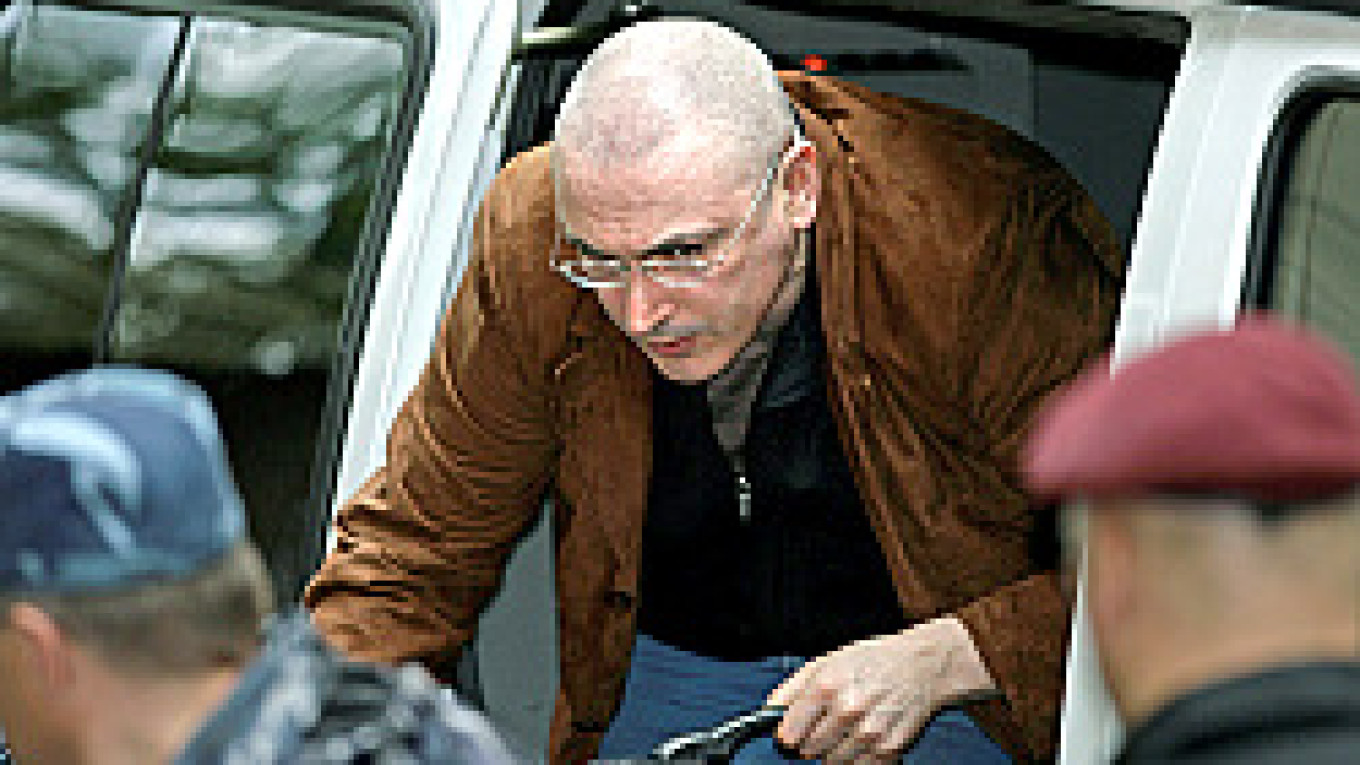
Khodorkovsky, in a far-ranging written interview, also expressed hope that he would be acquitted in his ongoing second trial, because he believed that those behind the case were not as powerful as when they began the legal onslaught against him in 2003.
He said he wanted to work in risk management and renewable energy projects once he got out of prison.
Khodorkovsky, founder of Yukos, once Russia's largest oil company, stood to be freed from prison in 2011 after serving an eight-year sentence on fraud and tax charges, which he and his supporters call punishment from a Kremlin angered by his political and commercial ambitions. But prosecutors have brought additional charges of theft and money laundering against him, raising the specter that he will spend another 22 1/2 years in prison. The second trial started in March.
Khodorkovsky railed against the business leaders whom he once led for their "irresponsibility" in good economic times and lack of desire to confront problems during bad times.
"There has so far been no desire among the business elite to properly analyze the crisis," Khodorkovsky, 45, said in a four-page written response to questions submitted through his lawyers.
"They don't understand that the reason for the crisis in Russia is not only the collapse of the U.S. derivatives market but the weakness of the Russian commodity-based economy and their own irresponsibility for not modernizing the economy … under more advantageous conditions," said Khodorkovksy, who has been in prison since 2003.
He said business leaders who rose to prominence in the turbulent 1990s should know better — and his experience back then made him well-suited to work in risk management today.
"No matter what the propaganda says today, our generation, including me, managed to do a lot to recreate Russian industry on a new economic foundation despite the deterioration of management systems and the utter degradation of industrial capacities," he said. "If Russia seriously decides to develop an innovative economy, we will see the same situation in many sectors of the industry. There is a huge field to work on."
Khodorkovsky said he wasn't sure what Russia would look like after the crisis. "It depends on the business elite," he said. "If they find enough strength within themselves to draft a new strategy of development, an optimistic scenario for Russia is possible. But it will not happen if they don't draft it.
"So far, Russia is following the same path, earning on commodities and several 'prestige' projects, most of which are probably unprofitable," Khodorkovsky said, without elaborating.
As for himself, Khodorkovsky said that as a free man he would like to return to an interest in alternative energy projects that predates his Yukos days. "I began to work with this back in 1987, " said Khodorkovsky, a graduate of the Mendeleyev Institute of Chemical Technology.
"I am especially interested in solar and power cells," Khodorkovsky said, adding that he hoped that it would be possible to cooperate with the state on renewable energy projects.
Meanwhile, the ongoing deterioration of the economic situation will lead to an increase in public protests, Khodorkovsky said. "What one should be apprehensive about is that the protests may turn into revolts," he said. "I am not claiming that it will definitely happen like that. But it might happen, and one can't turn a blind eye to that."
Any unrest, however, is unlikely to be part of a conscious struggle for a change of power, Khodorkovsky said. "It is a complicated question whether these protests would have a political character," he said. "There have been no real politics for quite a long time, no legal political infrastructure in the country."
He said political changes away from the "authoritarian-bureaucratic regime" were needed to nurture innovation and thus boost the economy. "This is understood by everyone, even by the people in the government. The time is ripe for the political model to be changed, but a decision hasn't been made yet because the elite are extremely corrupt," he said.
In the ongoing trial, Khodorkovsky and his business partner Platon Lebedev are accused of embezzling 350 million tons of oil valued at about 892.4 billion rubles between 1998 and 2003 from three Yukos-controlled production units ?€” Samaraneftegaz, Yuganskneftegaz and Tomskneft ?€” and laundering 487.4 billion rubles and $7.5 billion between 1998 and 2003.
Independent lawyers raise questions about the legal soundness of the case, including whether the state is violating double-jeopardy rules by trying a defendant twice for the same crime. It also isn't clear how Yukos had managed to allegedly steal 20 percent of the oil that Russia produced from 1998 to 2003 ?€” the volume in question ?€” without being detected by any law enforcement bodies.
"From a legal viewpoint, the charges I've been presented with are intentionally absurd," Khodorkovsky said. "It is evident not only to me but to any person who is at least superficially familiar with Russian legislation. The written work of my prosecutors depicts events of a crime that never happened."
Last Thursday, the European Court of Human Rights agreed to consider a complaint by Khodorkovsky that his arrest and subsequent detention was unlawful and politically motivated and that he had experienced inhuman and degrading treatment. The complaint was submitted in 2004.
"My application to the Strasbourg court was necessary so that corrupt Russian strongmen know and understand that their actions will be evaluated on the international level," Khodorkovsky said in the interview. "The verdict of the Strasbourg court will be important for all in Russia who have become victims of raiders' attacks and contract criminal cases."
However, Khodorkovsky said he wanted to be acquitted by an "independent Russian court."
"I pin my hopes on an acquittal," he said. "First, those who ordered and organized the Yukos case don't possess the same influence on the judicial system that they did three to four years ago. Second, you can't help but understanding that if this prosecution ends with a guilty verdict, no one in the world will believe in any talk about justice in Russia, court reform and so on for the next five to 10 years."
Analysts, though, do not share Khodorkovsky's optimism. "When Khodorkovsky was arrested, Vladimir Putin, who is believed to have instigated the investigation, was the president, and he hasn't lost his influence since then," said Olga Kryshtanovskaya, director of the Center for Elite Studies at the Russian Academy of Sciences. "Even though some changes have taken place since Dmitry Medvedev became president, strongmen still occupy about half of the key posts in the government."
In a rare sign of dissent in business circles, the head of the Russian Union of Industrialists and Entrepreneurs, Alexander Shokhin, has said he was puzzled by the latest case against Khodorkovsky. "If people are charged for not paying taxes, how can they be accused of stealing something they haven't paid taxes for?" Shokhin told Rossia state television on March 7. "I'm not a lawyer, but in my opinion, no laws in Russia or elsewhere allow [a defendant] to be tried twice for the same crime."
Khodorkovsky thanked Shokhin for the support in the interview. "I think the management of the Russian Union of Industrialists and Entrepreneurs are quite cautious people, and if they feel that they can say something new ?€¦ about my case, it means that they feel some changes in the political atmosphere in Russia. God grant that their political instinct doesn't fail them."
A Message from The Moscow Times:
Dear readers,
We are facing unprecedented challenges. Russia's Prosecutor General's Office has designated The Moscow Times as an "undesirable" organization, criminalizing our work and putting our staff at risk of prosecution. This follows our earlier unjust labeling as a "foreign agent."
These actions are direct attempts to silence independent journalism in Russia. The authorities claim our work "discredits the decisions of the Russian leadership." We see things differently: we strive to provide accurate, unbiased reporting on Russia.
We, the journalists of The Moscow Times, refuse to be silenced. But to continue our work, we need your help.
Your support, no matter how small, makes a world of difference. If you can, please support us monthly starting from just $2. It's quick to set up, and every contribution makes a significant impact.
By supporting The Moscow Times, you're defending open, independent journalism in the face of repression. Thank you for standing with us.

Remind me later.