

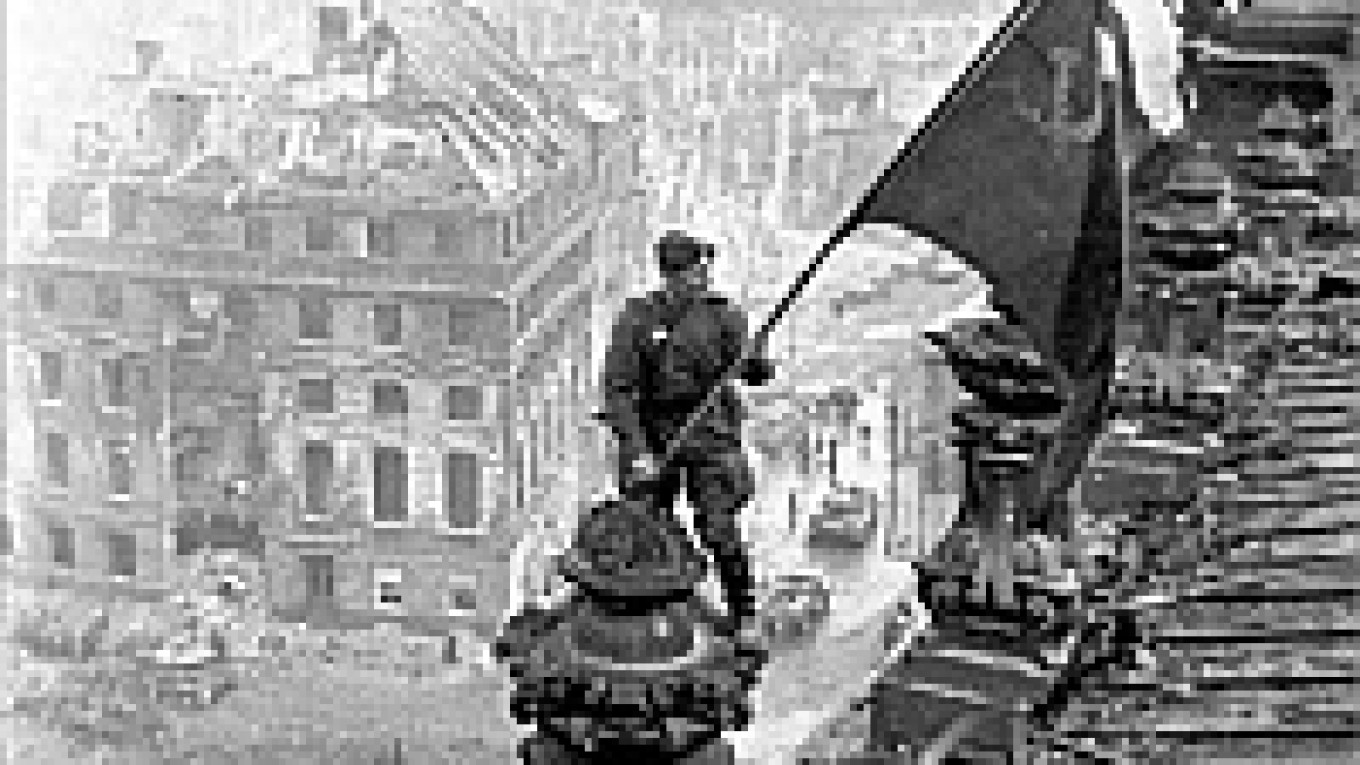
What most people don't realize, however, is that the photograph isn't capturing the historic moment. Yevgeny Khaldei staged the scene on May 2, 1945 ?€” three days after the Soviets captured Germany's parliament building.
The picture is the centerpiece of an exhibit ?€” "Yevgeny Khaldei ?€” The Decisive Moment" ?€” that bills itself as the first comprehensive retrospective of the photographer's World War II work.
The show at Berlin's Gropius-Bau museum reveals the extent to which Khaldei's work as a war correspondent and later a staff photographer for Pravda blurred the boundaries between photojournalism, art and propaganda.
For Russians, the Reichstag photo is as potent a symbol of victory as Associated Press photographer Joe Rosenthal's shot of the U.S. flag being raised on the Japanese island of Iwo Jima is for Americans.
But the Reichstag image was heavily manipulated: Smoke in the background was etched later on the negative, to create the impression the battle was still unfolding.
In another version, a soldier's wristwatches have been deftly edited out lest they give the impression he looted them.
Ernst Volland, one of the exhibit's curators, calls the Reichstag photo "120 percent propaganda" ?€” especially since it was made to order according to Soviet dictator Josef Stalin's specifications.
"Stalin badly wanted the combination of Reichstag and the red flag," Volland said.
 Itar-Tass / AP Yevgeny Khaldei in February 1990 |  |
| |
Another image shows a tank planted in front of the Brandenburg Gate, while a straight line of fighter planes soar overhead. Closer scrutiny reveals that the tank is a cutout from another picture and the planes are painted into the frame.
Khaldei saw no ethical problem with the doctoring. If challenged about a photo's truthfulness, Volland said, the photographer would simply reply: "It's a good photo. I made it. 'Auf wiedersehen.'"
Khaldei toiled in obscurity for most of his life and lived out his retirement in a small Moscow apartment on a modest pension until his death in 1997.
The retrospective of over 200 images was put together by private photography collectors Volland and Heinz Krimmer, who have been instrumental in bringing Khaldei's work to a broader public.
"Khaldei's photos are in every German schoolbook. His images are known, but the man behind them is not," said Krimmer. Khaldei never considered himself an artist, and only sold his work in small quantities from his apartment.
Born to a Jewish family in 1917, Khaldei built his first camera at age 12. In 1936, he began to shoot for the Soviet news agency Tass, creating his most memorable images during World War II and its aftermath, notably the Potsdam Conference of Allied leaders in 1945 and the Nuremberg Trials of Nazi war criminals.
After the war, Khaldei had difficulty finding full-time work because of Stalin's anti-Semitic purges and campaigns.
Only after Stalin died in 1953 was Khaldei hired by Soviet newspapers.
Volland and Krimmer met him in Moscow in 1991 and began collecting his work. Their collection of his images is now the largest outside Russia.
In 1994 in Berlin, they mounted the first exhibition of Khaldei's work and published a book with some of his pictures.
The current show, which opened May 8 and runs through July 28, was supported by Germany's Federal Culture Fund. It will travel to Ukraine this year and a U.S. visit is also likely, though no details have been cemented.
While war photography makes up the heart of the exhibit, it also includes Khaldei's images of Europe in ruins. From the 1950s onwards, his work focuses on workers, politicians and artists, such as cellist Mstislav Rostropovich and composer Dmitry Shostakovich.
The curators said Berlin was an appropriate first stop for the tour.
"Khaldei's most famous images were made right around the corner," Krimmer said.
A Message from The Moscow Times:
Dear readers,
We are facing unprecedented challenges. Russia's Prosecutor General's Office has designated The Moscow Times as an "undesirable" organization, criminalizing our work and putting our staff at risk of prosecution. This follows our earlier unjust labeling as a "foreign agent."
These actions are direct attempts to silence independent journalism in Russia. The authorities claim our work "discredits the decisions of the Russian leadership." We see things differently: we strive to provide accurate, unbiased reporting on Russia.
We, the journalists of The Moscow Times, refuse to be silenced. But to continue our work, we need your help.
Your support, no matter how small, makes a world of difference. If you can, please support us monthly starting from just $2. It's quick to set up, and every contribution makes a significant impact.
By supporting The Moscow Times, you're defending open, independent journalism in the face of repression. Thank you for standing with us.

Remind me later.