

Gazprom chief Alexei Miller and Eni chief Paolo Scaroni signed an agreement Friday to boost the South Stream's capacity to 63 billion cubic meters a year from 31 bcm after the Italian company pressed for the boost, Miller said.
He said it would cost 8.6 billion euros ($11.6 billion) to build the pipeline, which will cross the Black Sea to Bulgaria and potentially have two legs going through Serbia, Hungary, Greece — and likely Slovenia ?€” and ending in Austria and Italy.
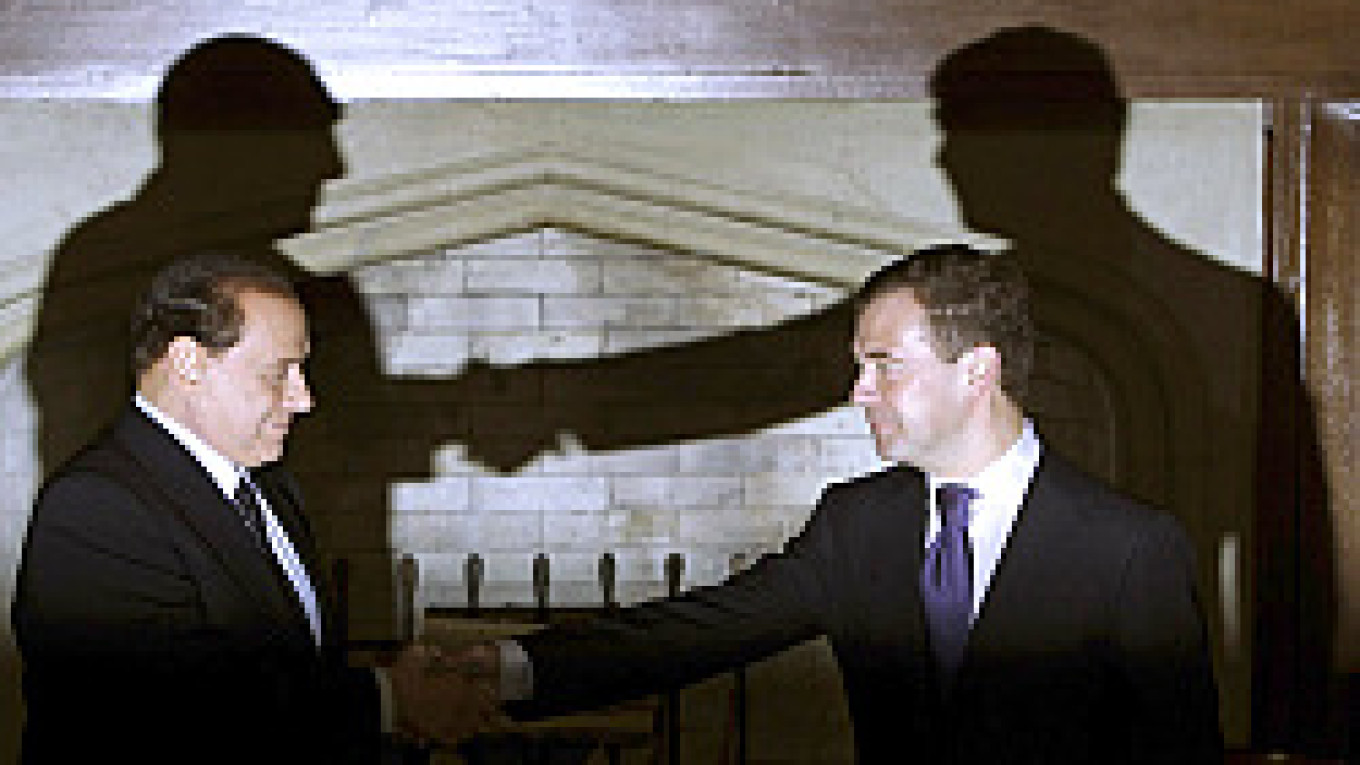
The agreement, signed in the presence of Prime Minister Vladimir Putin and his Italian counterpart, Silvio Berlusconi, also defined how Gazprom and Eni would divide the gas to sell from the pipeline.
Neither company said why they agreed to expand the pipeline or what proportion of the gas they would own.
Also Friday, Gazprom and national gas companies from Bulgaria, Serbia and Greece signed deals to create joint ventures in these countries to perform feasibility studies and construction for the project.
Construction will finish by the end of 2015 at the latest, Miller said, adding that Gazprom and its partners would try to speed up the work.
"We … see the potential for this deadline to be moved forward, and we will do our best for the project to begin operation earlier," he said, Interfax reported.
Miller said the agreements on Friday marked the start of work to actually implement the project. Gazprom, however, has not yet enlisted Slovenia or Romania to fill the gap as the one remaining transit link for the pipeline to reach Austria.
For Russia, which has long touted itself as the only realistic gas supplier for Europe from the east, South Stream would capture an extra slice of a lucrative market where Gazprom already provides a quarter of the imports. In a further attempt to underline the futility of seeking alternative deliveries, Putin on Friday took a dig at Nabucco as an ill-conceived way for Europe to grow more independent from Russia by importing gas from Central Asia and the Caspian Sea area.
"For starters, before investing billions of dollars in a pipeline, burying the money in the ground, they need to understand where the gas will come from for this pipeline," Putin said, referring to Nabucco backers. "By all means, if there's confidence that the project will be implemented, for God's sake let them do it."
On Sunday, two companies that are key partners in Nabucco announced that they had entered a deal that would give them enough gas to fill the pipeline by 2014. Austria's OMV and Hungary's MOL received 10 percent each in Pearl Petroleum, a company that is investing $8 billion in two Iraqi gas fields.
OMV will produce gas from "very large gas reserves ?€¦ which has significant potential to serve as feedstock for the Nabucco pipeline," Helmut Langanger, the company's executive vice president who signed the deal, said in a statement.
The European companies acquired the stakes from United Arab Emirates-based Crescent Petroleum and Dana Gas, OMV and Dana announced in separate statements. OMV paid $350 million for its stake, while MOL gave 3 percent of its shares to each of the Arab companies in exchange for the interest in Pearl Petroleum.
Badr Jafar, a Crescent Petroleum executive director, said the project had the potential of "linking the region's significant gas reserves to Europe by pipe for the first time." He stressed that the partners would first seek to meet the local demand.
The fields ?€” Khor Mor and Chemchemal, located in Iraq's semiautonomous Kurdistan region ?€” could produce more than 3 billion cubic feet of gas by 2014, Dana Gas said. Nabucco's first phase, expected to be completed by 2015, will require half of this amount to operate.
This is the exact amount of gas that will remain available after the fields supply the local market and Turkey, Reuters reported, citing an unidentified industry source.
The deal is not a sure bet, however, with some challenges coming from Iraq's shaky statehood. Iraq's Oil Ministry has attacked oil and gas contracts awarded by the Kurdish regional government to international oil companies as illegal. Kurdish authorities have denied any wrongdoing, saying the agreements comply with the Iraqi constitution.
Deputy Foreign Minister Alexander Saltanov downplayed Nabucco's progress, saying on the sidelines of an economic forum in Jordan that it wasn't "tragic" for Russia and would not prevent the country from being a key supplier to Europe, Reuters reported.
Germany's RWE, another shareholder in Nabucco, signed a potential supply deal for the pipeline in Turkmenistan last month that gave the company rights to develop a Caspian Sea gas field.
In a further victory for Nabucco, the European Union won Turkey's consent at an energy summit in Prague earlier this month to sign a transit agreement for the pipeline by the end of next month.
Estimated to cost 7.9 billion euros to build, Nabucco is planned to take Caspian and Asian gas at the eastern Turkish border and carry it to Austria. Its other shareholders are Bulgaria's Bulgargaz, Romania's Transgaz and Turkey's Botas.
A Message from The Moscow Times:
Dear readers,
We are facing unprecedented challenges. Russia's Prosecutor General's Office has designated The Moscow Times as an "undesirable" organization, criminalizing our work and putting our staff at risk of prosecution. This follows our earlier unjust labeling as a "foreign agent."
These actions are direct attempts to silence independent journalism in Russia. The authorities claim our work "discredits the decisions of the Russian leadership." We see things differently: we strive to provide accurate, unbiased reporting on Russia.
We, the journalists of The Moscow Times, refuse to be silenced. But to continue our work, we need your help.
Your support, no matter how small, makes a world of difference. If you can, please support us monthly starting from just $2. It's quick to set up, and every contribution makes a significant impact.
By supporting The Moscow Times, you're defending open, independent journalism in the face of repression. Thank you for standing with us.

Remind me later.