

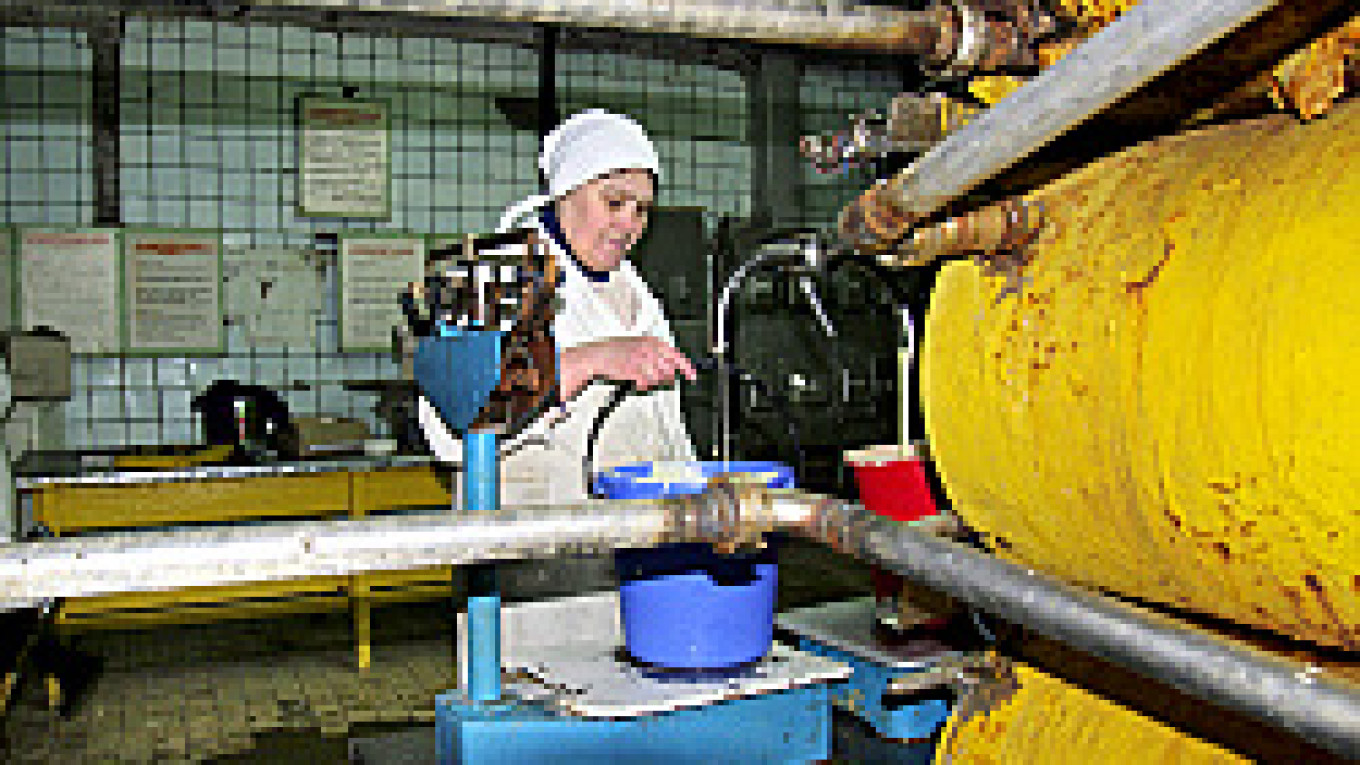
Processing 120 tons of milk a day in better times, the factory has now scaled down to 4 tons a day and uses only a fifth of its space. Businessman Andrei Muzalevsky bought the plant at the end of 2007 after it stood idle for almost a year.
Determined to take his business to new heights, Muzalevsky took out a loan to purchase a new cooling system to replace the old one that ran on ammonia, a dangerous chemical.
The new equipment also cuts electricity usage by 20 percent, a welcome change for the small plant, whose monthly electric bill of 30,000 rubles ($834) went up 15 percent last month.
Although energy tariffs are climbing sharply with the liberalization of the power market, the government only started paying attention to the issue of energy efficiency last June, when President Dmitry Medvedev signed a decree ordering the government to prepare legislation stimulating usage of "energy-efficient and environmentally clean technology." The decree optimistically set a goal to reduce the amount of energy used by the Russian economy by 40 percent.
A federal law on energy saving and increasing energy efficiency is currently under development.
In the meantime, a handful of banks have started offering energy-efficiency loans under a program jump-started by a credit line from the International Finance Corporation, a member of the World Bank group.
Muzalevsky's dairy plant is among a growing number of small industries that are securing the loans to cut electricity costs and gain an edge on rivals. The dairy received 10 million rubles ($278,000) to buy new equipment from MDM-Bank, which used IFC's credit line to create MDM Energy, a loan with a slightly lower interest rate than the bank's other products.
"The energy-efficiency financing market has a great potential in Russia, which opens additional possibilities for banks," said Andrei Kuznetsov, head of the small-business development department at MDM.
MDM gave out 400 million rubles ($11 million) in energy-efficiency loans last year. Implementation of projects financed by the money lets businesses save 100 million rubles per year and reduce their carbon emissions by 250,000 tons, Kuznetsov said.
While small businesses are hesitant to borrow money for long-term projects, the benefits of these loans can speak for themselves if the energy savings offset the loan repayments and make the project pay for itself faster. By the same token, industry's growing demand for energy and rising energy tariffs hurt companies' profits and competitiveness, Kuznetsov said.
With the power market gradually liberalized and decentralized, electricity prices have been going up by about 20 percent every year, depending on region and provider.
The inefficiency of Russian industry is partly a management problem.
"In small companies, financial managers think in terms of money, while energy managers think in terms of kilowatts and calories," said Maxim Titov, deputy manager of IFC's sustainable-energy finance program in Russia. "The two don't understand each other."
While large companies are often more progressive, small businesses have no understanding of efficiency, Titov said. "The term 'energy efficiency' is not in their vocabulary," he said.
IFC, which has distributed $150 million under the loan program since its inception in Russia in 2005, aims to introduce the concept of energy efficiency to small industry owners who don't see it as an opportunity to cut costs and improve their long-term prospects. Along with financing, IFC educates banks to calculate energy savings and the resulting increase in operating profit.
"It's possible to cut energy costs by over 50 percent at many Russian industries," said Dmitry Ponarovkin, an energy auditor in Moscow who surveys companies' energy usage and identifies potential savings.
Few companies, however, take the initiative to invest in new equipment just to improve efficiency, he said. "In sectors with the most potential for energy savings, like construction, energy costs are a very small fraction of total cost of production," he said.
"Companies are more likely to modernize and become more efficient if there is real competition on the market for supplying their product," Ponarovkin said.
Lack of competition is especially apparent in Russia when looking at utility bills, which invariably go up every year while the quality of municipal services in building upkeep stays level, at best.
Concern for carbon emissions and global warming has yet to reach mainstream Russia, and efficiency is still not a priority for businessmen, who focus on increasing output and quality in order to compete with other producers.
So the measures adopted by people who have taken out energy-efficiency loans are big steps from the usual lack of efficiency-best practices. In Russia, small industries often have broken windows or windows so dirty that the lights have to be turned on all day long, said Titov of IFC.
IFC's donor-funded program was launched with regional banks Center Invest, Tatfondbank and NBD Bank. Four years later, Center Invest uses the same setup, with financing from the European Bank of Reconstruction and Development.
IFC's program will run until 2010, Titov said. "We want to be a catalyst for this type of financing scheme and to make this banking product totally commercial," he said.
Among the program's satisfied clients is Alexei Timofeyev, a Tyumen-based businessman who received a loan of $200,000 from MDM last summer to install a new bottling and packing line for his soft drink company. The resulting energy savings per unit of output were 58 percent, while savings on his electricity bill covered 25 percent of the company's loan repayments.
"I paid up to 30,000 rubles per month for electricity, and now I can produce twice as much and still pay the same amount," said Timofeyev, who plans to test the full capacity of his production line when the soft drink season starts in March.
"The worst times are over," Timofeyev said, referring to the economic crisis.
Muzalevsky from the Oryol region also has big plans, including the start of cheese and ice cream production this summer and eventually expanding the factory to its former glory.
"We are growing during the crisis -- people are cutting down on meat, but they still buy dairy for their children," he said.
He said the next stage is to upgrade his "wasteful" boilers to more efficient ones that use 30 percent less energy and will further cut his energy bill.
A Message from The Moscow Times:
Dear readers,
We are facing unprecedented challenges. Russia's Prosecutor General's Office has designated The Moscow Times as an "undesirable" organization, criminalizing our work and putting our staff at risk of prosecution. This follows our earlier unjust labeling as a "foreign agent."
These actions are direct attempts to silence independent journalism in Russia. The authorities claim our work "discredits the decisions of the Russian leadership." We see things differently: we strive to provide accurate, unbiased reporting on Russia.
We, the journalists of The Moscow Times, refuse to be silenced. But to continue our work, we need your help.
Your support, no matter how small, makes a world of difference. If you can, please support us monthly starting from just $2. It's quick to set up, and every contribution makes a significant impact.
By supporting The Moscow Times, you're defending open, independent journalism in the face of repression. Thank you for standing with us.

Remind me later.