

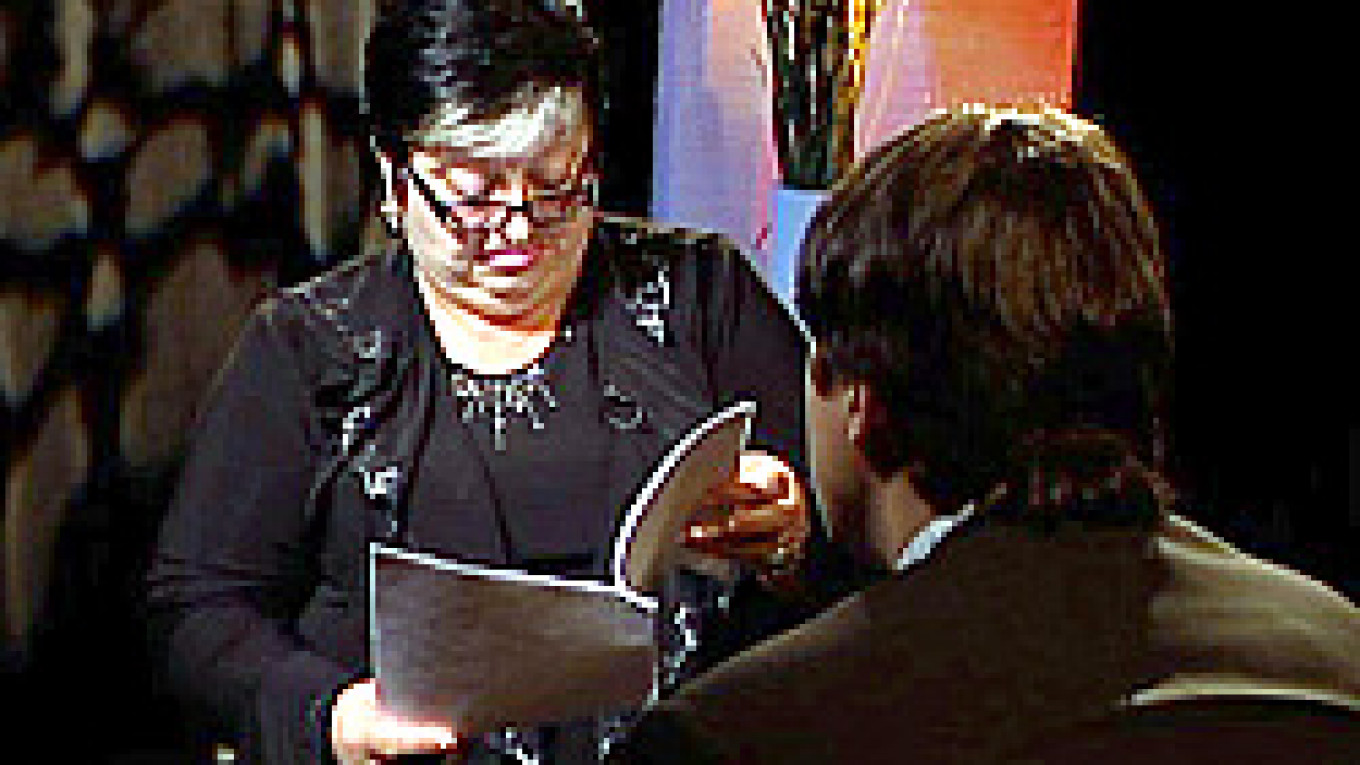
Backed by an expensive public relations firm, Tskhovrebova lined up meetings with U.S. officials, including staff for Senator Patrick Leahy, chairman of a panel overseeing foreign aid. The U.S. government itself paid for an academic event where she plans to speak this week.
What Americans meeting with Tskhovrebova didn't know is that she has ties to South Ossetia's KGB security service.
Georgia says she's a spy. Tskhovrebova ridicules the idea and says she is the victim of a smear campaign. But U.S. officials have become wary of her -- questioning who paid for her Washington tour.
Tskhovrebova's trip reflects the high-stakes campaign between Georgia and Russia, each eager to blame the other for their August war and to influence U.S. policy as Barack Obama assumes the presidency.
Georgian intelligence provided The Associated Press with secretly recorded conversations in which Tskhovrebova appears to discuss assignments, money and information with Vasily Guliyev, deputy director for counterintelligence for the South Ossetian security agency still known by the Soviet-era acronym KGB.
"I don't have any money left. Yesterday I learned super -- not super -- but very important information completely by chance," she told Guliyev during a call in June 2005, according to the recordings. Guliyev quickly agreed to meet with her privately.
Tskhovrebova said she did not know Georgian intelligence had been intercepting her calls until the AP showed her transcripts of the conversations. The wiretaps make clear her conversations have been routinely intercepted since at least 2005.
There is no evidence Tskhovrebova had access to secret information, but Guliyev appeared interested in her frequent contact with Western organizations.
Tskhovrebova acknowledged that she routinely speaks and meets with Guliyev, a family friend.
During a television interview with the AP, she said she knows Guliyev works for the KGB. She denied working for the KGB herself. Her U.S. public-relations handler, Mark Saylor of the Saylor Co., objected to the questions and ordered AP's cameras turned off, while she reviewed transcripts of her wiretapped conversations.
Later, in a statement, Tskhovrebova called the release of the recordings "vicious, false and predictable." She said Georgian President Mikheil Saakashvili routinely calls his opponents spies. "It is a charge easily made and impossible to disprove," she said.
"Nobody working for human rights in my part of the world can avoid contact with security officials," she said. "This is as true in Georgia as it is in Ossetia and everybody familiar with human rights work knows it."
South Ossetia is tightly controlled by security services. Mamuka Areshidze, an unaffiliated Tbilisi-based analyst who follows intelligence activities in the region, agreed with Tskhovrebova's assessment. "It's absolutely impossible for those going abroad and working with international organizations not to give information," he said.
Tskhovrebova said she works independently of any government and has not received instructions for her trip. The tapes offer no evidence otherwise.
In registering as a lobbyist for Tskhovrebova, Saylor Company certified that no foreign government directed the lobbying. In U.S. paperwork filed with Congress, Saylor affirmed that no foreign entity "plans, supervises, controls, directs, finances or subsidizes" Tskhovrebova's organization.
But Matthew Bryza, the U.S. deputy assistant secretary of state who works closely with Saakashvili and is responsible for U.S. policy in the Caucasus, said he had doubts about Tskhovrebova's independence. Bryza canceled a meeting his deputies had planned with Tskhovrebova after the AP asked about it.
"It is unique in my years of experience in the Caucasus that someone like this has representation by an expensive public relations firm. That sets off alarm bells," Bryza said.
Tskhovrebova said she could have answered Bryza's concerns. She said in her statement she was disappointed Bryza would not allow his deputies "to hear from victims of the August war, especially since his boss and many of his colleagues have met many times with Georgia's lobbyists." U.S. records reflect frequent meetings between State Department and lobbyists for Georgia.
In the earlier AP interview, Tskhovrebova, speaking through an interpreter, described how her trip took shape: Before the war, she worked within South Ossetia. But she started an international campaign after surviving Georgia's bombardment of South Ossetia's capital, Tskhinvali. She emerged to a city in ruins with many dead after shelling by Georgia.
"I thought the world would stand against those who committed the war crimes," she said. Instead, Western media coverage favored Georgia.
Tskhovrebova says she met famed Russian conductor Valery Gergiev, an ethnic Ossetian, who led a concert in Tskhinvali weeks after its bombardment. She says Gergiev introduced her to Andrei Konchalovsky, an acclaimed Russian director, who helped her hire the Saylor Co.
Tskhovrebova declined to say how much she is spending or to identify most of her financial backers, but Saylor has made extensive efforts for her. He traveled to Moscow and Tskhinvali to document her aid efforts, while the firm set up two web sites, arranged the public events and appointments in Congress and helped Tskhovrebova place opinion pieces in the Los Angeles Times and the Christian Science Monitor.
Tskhovrebova plans to participate this week in a conflict resolution event at George Mason University that was funded by a U.S. Agency for International Development grant. In a statement, the agency said it did not select the participants. It was unclear how much USAID paid for the event.
Georgian Interior Ministry spokesman Shota Utiashvili said Tskhovrebova's contacts with the KGB meant she was also working with the Russia's Federal Security Service, or FSB, because "it's the same organization."
A Message from The Moscow Times:
Dear readers,
We are facing unprecedented challenges. Russia's Prosecutor General's Office has designated The Moscow Times as an "undesirable" organization, criminalizing our work and putting our staff at risk of prosecution. This follows our earlier unjust labeling as a "foreign agent."
These actions are direct attempts to silence independent journalism in Russia. The authorities claim our work "discredits the decisions of the Russian leadership." We see things differently: we strive to provide accurate, unbiased reporting on Russia.
We, the journalists of The Moscow Times, refuse to be silenced. But to continue our work, we need your help.
Your support, no matter how small, makes a world of difference. If you can, please support us monthly starting from just $2. It's quick to set up, and every contribution makes a significant impact.
By supporting The Moscow Times, you're defending open, independent journalism in the face of repression. Thank you for standing with us.

Remind me later.