

The world’s third most-spoken first language and, more importantly, its most popular second language, English is often, somewhat ironically, labeled the lingua franca of the business world.
But not all Russia’s businesspeople are English speakers, and learning a language to study for a master of business administration degree can be time-consuming. “When I was looking at studying, I had a choice: either study language or an Executive MBA,” said Vladimir Verbitsky, first deputy director of the Russian Institute of Directors.
As a result Verbitsky, an independent director at several Russian firms, opted to look for a Russian-language program. Having originally decided on a course at a Russian institution, he changed his decision on finding a Western business school offering EMBA courses in Russian.
Lecturers at Western business schools have a deep understanding of business practices, Verbitsky said. Although Russian lecturers have a great grasp of the subject, they were brought up in a completely different environment, he said. “World outlook is very important in business education.”
Russian-language courses are not only for those with no English. “Many people have a knowledge of English in one particular sector but not a clear understanding in all,” Verbitsky said. “A course in Russian can help you understand the nuances of different sectors.”
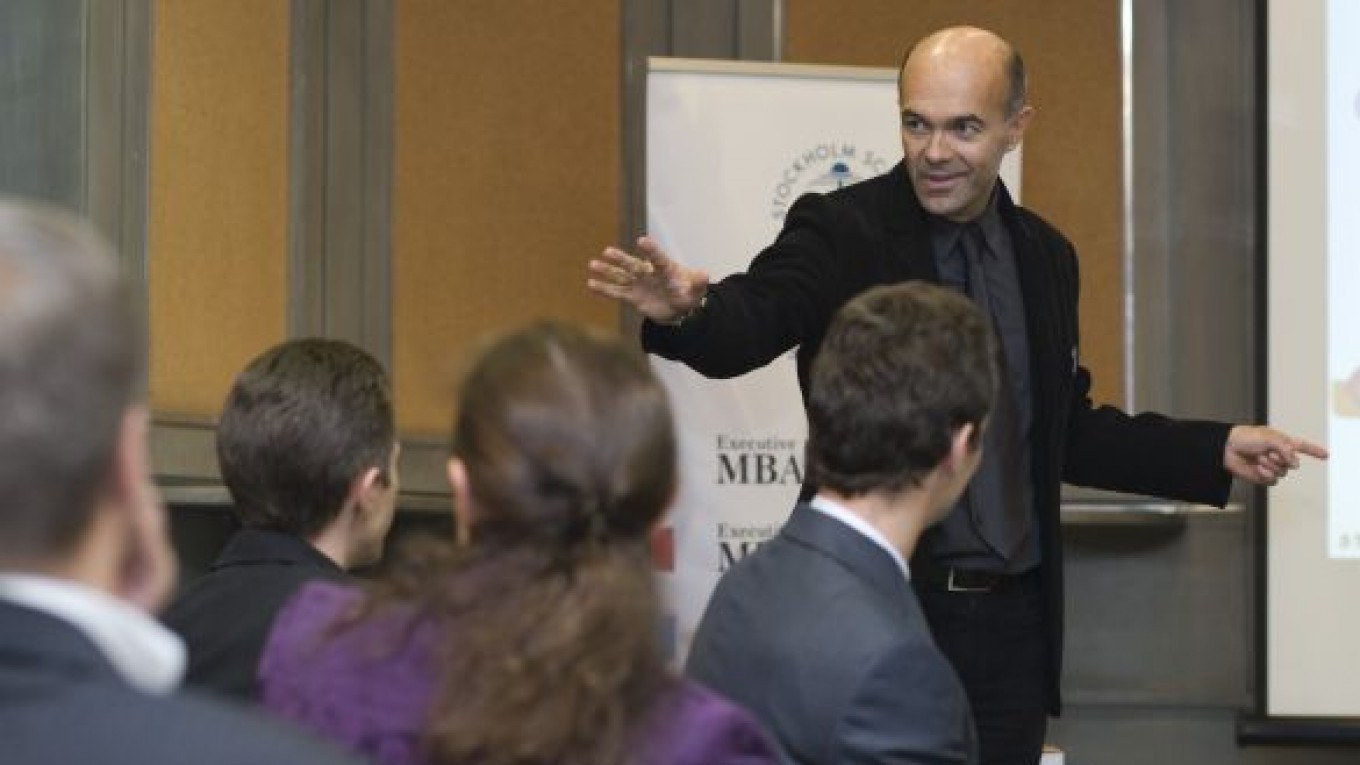
Verbitsky is currently studying in an EMBA program at the Stockholm School of Economics’ campus in St. Petersburg. The school launched a new Russian-language EMBA program last fall alongside its English-language courses. Following high demand, SSE Russia is preparing a second intake for the program, which has developed from the schools’ previous Oil & Gas MBA. “This is the first time we are having a spring intake,” said Anders Liljenberg, dean of SSE Russia, adding that when the school launched the course it was unsure what the demand would be.
Given the reduced number of applicants in Russia, the course, it appears, has found a niche in demand. “This year the fall in recruitment is, according to our figures, 40 to 50 percent, compared with last spring,” said Yury Tazov, president of the Russian League of MBAs. “Several Russian business schools have completely postponed their courses to the fall because of recruitment levels.”
Instruction in Russian does not mean that the education is any less international. The program is for students with a global mind regardless of language abilities, Liljenberg said. “If you want to learn about running a small business in a Siberian village, this course is not for you,” he added. “If you want to stay in Russia and get an international education, it is.”
The course content is the same as the school’s English-language program and also includes modules abroad — for this particular course, in China. “Sometimes the details of the content may be altered depending on the course books available in Russian, but students get exactly the same diploma,” Liljenberg said.
Other institutions offering MBAs in both languages provide different content for each. “Our Russian-language program has a maximum number of cases from the Russian economy,” said Alla Grobovskaya, director of the Moscow office of LINK, the Open University’s Russian partner. “Mainly middle and senior managers from large Russian firms study in our Russian-language program,” she added.
Students in the English-language course gain an Open University degree, while those in the Russian-language program receive a state-accredited MBA from LINK. But, the first two parts of the Russian-language program follow the OU course, so those students gain an OU diploma in management.
Teaching methods also differ. “While the English-language course is taught by native-English-speaking lecturers, lecturers in the Russian language program are Russian,” Grobovskaya said.
SSE Russia, however, uses simultaneous translation for its courses. The instructors from the course in English lecture in the Russian-language programs with an interpreter and translated materials. While this sometimes causes difficulties if students with basic language skills ask questions in English, there were few problems, Verbitsky said.
A Message from The Moscow Times:
Dear readers,
We are facing unprecedented challenges. Russia's Prosecutor General's Office has designated The Moscow Times as an "undesirable" organization, criminalizing our work and putting our staff at risk of prosecution. This follows our earlier unjust labeling as a "foreign agent."
These actions are direct attempts to silence independent journalism in Russia. The authorities claim our work "discredits the decisions of the Russian leadership." We see things differently: we strive to provide accurate, unbiased reporting on Russia.
We, the journalists of The Moscow Times, refuse to be silenced. But to continue our work, we need your help.
Your support, no matter how small, makes a world of difference. If you can, please support us monthly starting from just $2. It's quick to set up, and every contribution makes a significant impact.
By supporting The Moscow Times, you're defending open, independent journalism in the face of repression. Thank you for standing with us.

Remind me later.