

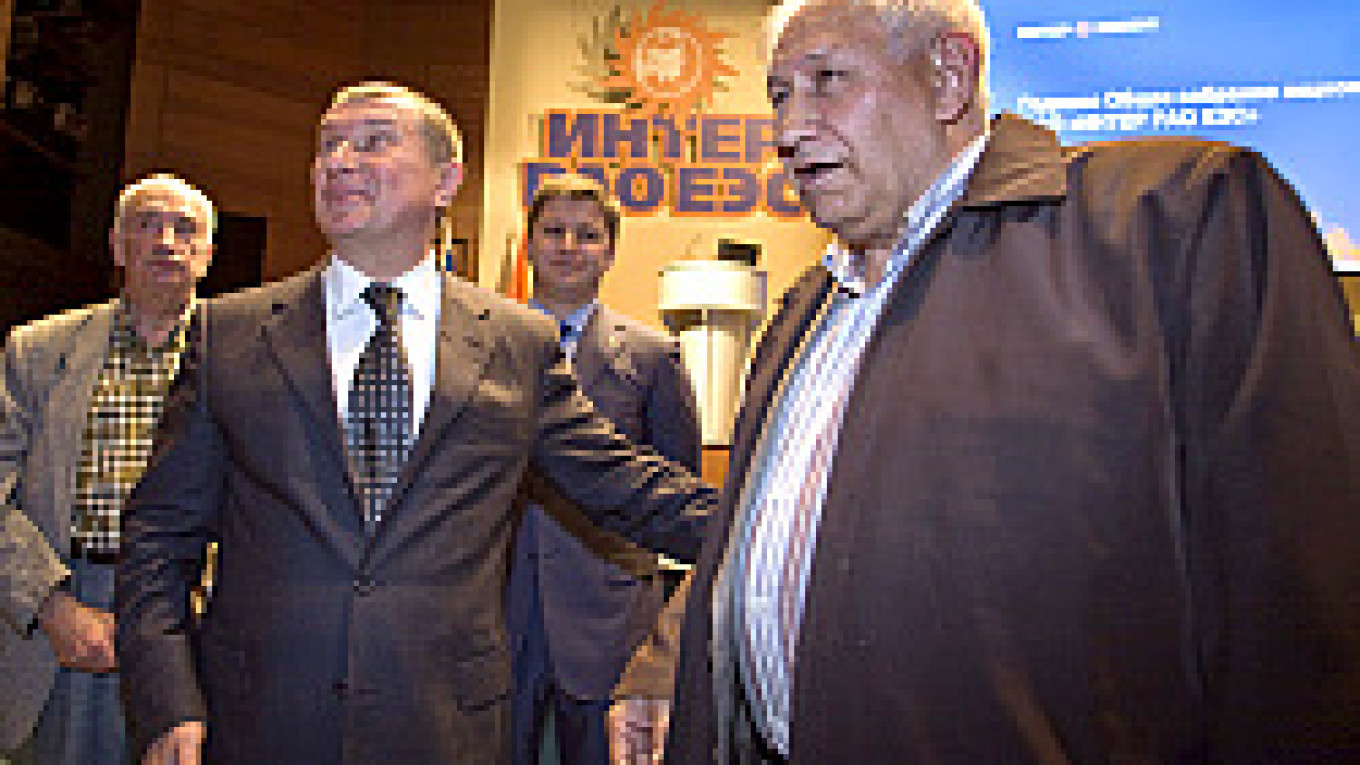
Three hours later, the shareholders -- mostly retirees -- left the meeting grinning, with neither dividends nor lower compensation to show for it.
The magician and master of ceremonies was Inter RAO chairman and Deputy Prime Minister Igor Sechin, the once publicity-shy Kremlin powerbroker who now oversees the Russian energy sector. Shareholders said after the meeting that he persuaded them with lengthy explanations and a healthy dose of charm.
Before opening the floor to questions, Sechin made a pitch for the board's recommendations and Inter RAO's aggressive expansion plans.
"While electricity consumption is falling on the European markets, demand in Latin America and Southeast Asia will allow us to diversify and grow," he said, adding that Southern Europe and the Middle East were also interesting markets for expansion.
The shareholders, however, weren't there to hear about expansion. They wanted to know why the 11-member board's four independent directors were being paid a fixed 1.4 million rubles ($45,000) each for attending all board meetings. It was one of the 11 questions put on the vote.
"Are we going to pay them for sitting in a chair? Why not pay for the results of their work?" shareholder Vladimir Kryukov asked in a written question handed to Sechin.
Inter RAO's director for corporate governance, Yevgeny Gorev, said the economic crisis had thrown into chaos the usual parameters for evaluating their contributions.
"The work of the independent directors is tremendously difficult," he said. "Some of them don't live in Moscow. So we actually compensate them for travel expenses and time, rather than pay them a salary."
Sechin -- who along with the seven other state representatives on Inter RAO's board is not eligible for compensation -- chimed in with support for his colleague. Nikolai Anoshko, head of Russische Kommerzial Bank, the Swiss VTB affiliate recently sold to Gazprombank, lives in Zurich, Sechin said.
"Mr. Anoshko, who is responsible for attracting foreign capital for us, is in permanent contact with Inter RAO managers in Moscow, he calls them and sends e-mails," Sechin said. "So the 1.4 million payment is actually compensation for our directors' expenses."
But the shareholders were still having none of it. How could someone spend 1.4 million rubles sending e-mails?
Several men in the second row stood up and began arguing loudly with Sechin, who was seated onstage. "Calm down, calm down, this is not a rally, it's a shareholders meeting!" Sechin shouted.
Minutes later, he got a note suggesting that the independents be paid a symbolic 10 rubles ($0.3) per year. "Believe me, we're giving them quite modest compensation compared with other companies," he told the shareholders.
Explaining why the dividends would not be paid turned out to be a harder task.
"It's because of a technicality, which we're going to change soon," said Yevgeny Dod, Inter RAO's CEO. "Under the law, if our charter capital is not less than or equal to net assets, we can't pay dividends. That's why we suggest you to vote to decrease the charter capital by cutting our shares' nominal price."
After another few assurances that the move would not affect the value of their shares, the audience voted for the changes. Most of the 2008 net profit, or about 1 billion rubles ($32 million), will be put toward covering previous losses.
Still, not everyone was convinced. A shareholder identified only as Stoyanov suggested that the company at least cut pensioners a break and pay them a dividend.
"They never pay us," said Svetlana Yeneva, 70, who has 51,000 shares of Inter RAO. The stake was worth 1,020 rubles ($33) at Thursday's closing price of 2 kopeks on the MICEX.
"They should at least pay dividends to pensioners," she said. "How can I survive on a pension of 4,700 rubles?"
Several others told Sechin that they were worried about having their shares taken in an obligatory buyout, or what they called an expropriation.
"I want to calm everyone down. There won't be any expropriation or any other extreme actions," he said.
Persuaded and calmed, the shareholders voted for an additional 25.8 billion ruble share emission, to be bought by VEB, the Federal Property Management Agency and Rosatom.
After the meeting, Sechin told reporters to leave. He was seen posing for a group picture with shareholders, hugging them and shaking hands as he said goodbye.
"I didn't think it would be so easy to talk to the deputy prime minister. He answered all our questions," one smiling shareholder said.
An elderly female woman approached Sechin and spoke with him for about five minutes as he was leaving. When asked what they talked about, the shareholder lowered her eyes, smiling. "It was something personal."
A Message from The Moscow Times:
Dear readers,
We are facing unprecedented challenges. Russia's Prosecutor General's Office has designated The Moscow Times as an "undesirable" organization, criminalizing our work and putting our staff at risk of prosecution. This follows our earlier unjust labeling as a "foreign agent."
These actions are direct attempts to silence independent journalism in Russia. The authorities claim our work "discredits the decisions of the Russian leadership." We see things differently: we strive to provide accurate, unbiased reporting on Russia.
We, the journalists of The Moscow Times, refuse to be silenced. But to continue our work, we need your help.
Your support, no matter how small, makes a world of difference. If you can, please support us monthly starting from just $2. It's quick to set up, and every contribution makes a significant impact.
By supporting The Moscow Times, you're defending open, independent journalism in the face of repression. Thank you for standing with us.

Remind me later.