

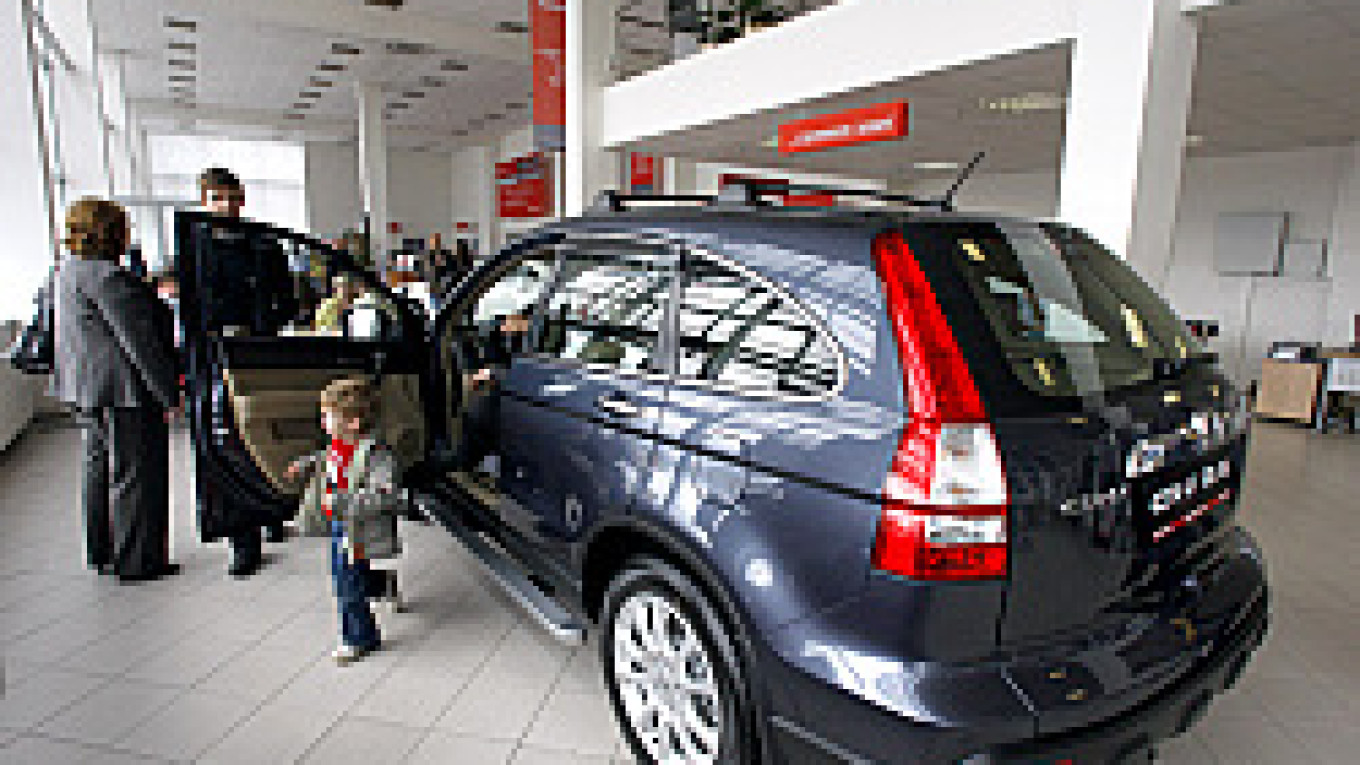
But even as the country becomes Europe's biggest car market, one Soviet-era hassle has not yet completely disappeared: the waiting list.
The spread of easier finance means that some customers are able to walk into a dealership, sign on the dotted line and drive out in a new car the same day. Supply is not keeping up with demand, however, and would-be buyers now typically wait up to a year for their model of choice.
And just like in Soviet times, it seems, the line can only be jumped by having connections ?€” or greasing someone's palm.
"When I was buying my new Honda Civic, the waiting period was a year," said car owner Anna Platonova, who works in Internet advertising. Platonova said she paid $2,000 through "a guy who knew a guy" because she didn't want to wait.
The country's car market overtook Germany this summer as the biggest in Europe, as half-year sales rose by 41 percent to reach 1.645 million cars, according to a report last month by PricewaterhouseCoopers.
Rising gasoline prices do not appear to be dampening demand yet, while car buyers continue to hanker after increasingly expensive foreign models. The average price of cars purchased in the country rose from $7,500 in 2002 to more than $17,000 in 2007, according to Avtostat, a consultancy based in Tolyatti, the home of the country's biggest carmaker, AvtoVAZ.
A factor contributing to sales growth is the simpler auto loan programs from Russian banks. The share of cars bought on credit is likely to pass the 50 percent mark in 2008, up from one-quarter in 2006. Total auto loans reached $17 billion in 2007, up from $9 billion a year earlier, according to Central Bank figures.
Another factor that could be expected to put a brake on car sales ?€” high inflation ?€” is also yet to have a serious effect. Many Russians are increasingly choosing to buy a car now and hold off on buying an apartment, given the pricey real estate market.
Customers are now also more discerning, said Anna Trofimova, spokeswoman for dealership Major Auto. "The average car buyer is becoming more informed and choosy," she said.
But the market is so hot that budget-conscious buyers frequently change their mind about what model to buy, based on what is in stock.
"Russians in the market for a budget model often choose a similar one from a different brand if it is made available faster," said Ivan Bonchev, an automotive analyst at Ernst & Young.
Lack of cars and yearlong lines lead to schemes reminiscent of Soviet times, forming a gray market for places on waiting lists and unofficial price tags for instant car delivery.
On an informal Internet forum for the Honda Civic, would-be buyers are checking out the going rate for bribes to get the car faster. Dealers are charging as much as 10 percent of the car's value under the table, depending on color and additional features, according to users of the site. People who don't want to pay the bribes use countdown banners for when their car will be delivered, making online discussions resemble those of expectant mothers.
Since it's becoming a critical factor, "instant availability" is increasingly used as an advertising tool by dealerships.
"There are customers who buy cars that are especially scarce simply to resell them" at a profit, said Trofimova, of Major Auto.
Among the best-selling foreign models, three are assembled in Russia ?€” the Ford Focus, Chevrolet Lacetti and Renault Logan ?€” as foreign carmakers vie with each other to build new assembly plants across the country.
Budget cars are a typical choice for first-time car buyers or for people upgrading to a foreign brand from a Russian model, Bonchev said.
Russian models' share of the country's car market has been falling steadily since 2003 and will continue to shrink, according to PwC. Although sales of Russian models have grown 27 percent to 380,000 in the first six months of 2008, compared with the same period last year, foreign models assembled in the country are closing the gap, jumping 85,000 to 290,000 in this year's first-half figures.
Meanwhile, sales of new foreign imports have jumped by 54 percent, reaching 785,000 units, while the number of used-car imports reached 190,000.
First-time buyers currently make up 25 percent of car sales, according to Avtostat, but families are increasingly purchasing second and even third cars, including cars for grown-up children or stay-at-home wives ?€” trends that are boosting sales of certain models.
Among the trends, analysts point out the rise of pricey foreign imports and an increase in female drivers, who tend to pick crossover [light SUVs] or class B [sub-compact] cars, Bonchev said.
About 20 percent of the country's car-owning households have more than one vehicle, said Sergei Udalov, an analyst at Avtostat, adding that the figure is much higher in Moscow, St. Petersburg and other large cities.
"If the first car purchased for a family tends to be a class C sedan, the second car can be either a class B or a larger car like an SUV or a crossover, which people use for going out of town and driving in bad weather," Udalov said, adding that the country's car owners changed their cars on average every three years.
Russians are ready to spend more on their cars than buyers in developed markets, said Bonchev, of Ernst & Young. One marked difference is that more than 40 percent of those buying new cars choose models with all the bells and whistles available, while only 5 percent opt for the factory's basic options.
Fuel efficiency does not play a crucial role in car preference either, Bonchev said.
Russians also tend to opt for the most prestigious model when choosing a car, said Trofimova, of Major Auto. "A known tendency for sedan buyers is to choose a more prestigious type of body rather than a more practical one," she said.
Platonova, the Honda Civic owner, said her first car was a used Peugeot that she used to learn to drive.
Since then, she has moved through four different models, changing cars every couple of years, usually through a dealership. She sold the Civic recently and upgraded to an Infinity sports car.
"I wanted to keep in line with my husband's Mercedes jeep, so that he would be willing to switch cars now and then," she said. "The Civic was just not serious."
A Message from The Moscow Times:
Dear readers,
We are facing unprecedented challenges. Russia's Prosecutor General's Office has designated The Moscow Times as an "undesirable" organization, criminalizing our work and putting our staff at risk of prosecution. This follows our earlier unjust labeling as a "foreign agent."
These actions are direct attempts to silence independent journalism in Russia. The authorities claim our work "discredits the decisions of the Russian leadership." We see things differently: we strive to provide accurate, unbiased reporting on Russia.
We, the journalists of The Moscow Times, refuse to be silenced. But to continue our work, we need your help.
Your support, no matter how small, makes a world of difference. If you can, please support us monthly starting from just $2. It's quick to set up, and every contribution makes a significant impact.
By supporting The Moscow Times, you're defending open, independent journalism in the face of repression. Thank you for standing with us.

Remind me later.