

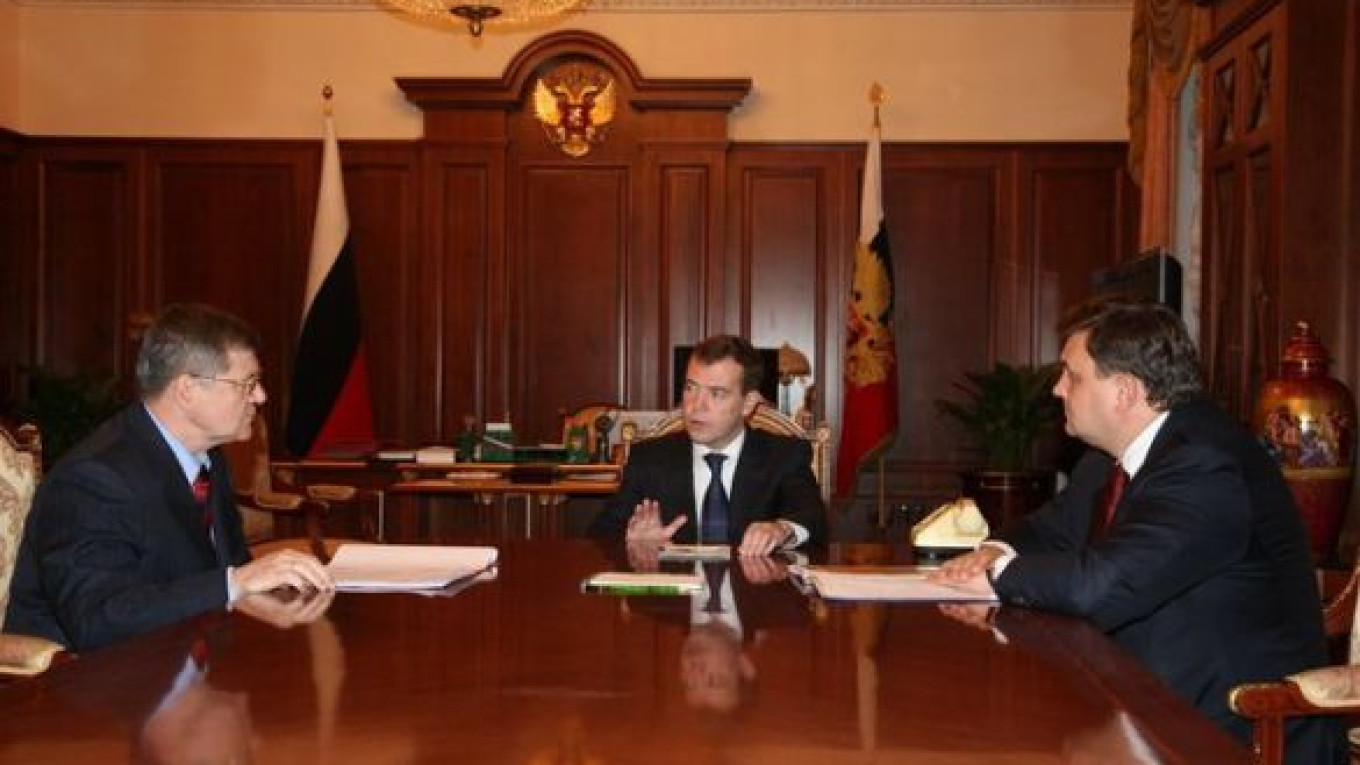
Prosecutor General Yury Chaika presented the results of his inspection of state corporations Tuesday and revealed that 22 criminal cases had been opened in connection with the activities of state corporations.
“Facts have come to light indicating inappropriate and ineffective spending of state funds and material resources on the part of state corporations,” Chaika told President Dmitry Medvedev.
“In connection with the wrongful disposal of property, first and foremost by enterprises under the jurisdiction of Russian Technologies … 22 criminal cases have been opened,” he said in comments posted on the Kremlin web site. Russian Technologies received controlling stakes in more than 400 companies in 2008 under a decree signed by Medvedev.
Rusnano, the state’s nanotechnology investment firm, also came under direct fire. Of the 130 billion rubles that Rusnano received from the state two years ago, only 10 billion rubles ($348,280) has been used. Of that, 5 billion rubles went to fulfilling its day-to-day operations.
“Since its creation, [Rusnano’s] supervisory council has approved 36 nanotechnology projects out of more than 1,200 applications, and it is currently financing only eight,” Chaika said.
In September, Rusnano said it had invested a cumulative 52.4 billion rubles in 36 projects.
In August, Medvedev ordered the Prosecutor General’s Office and the Kremlin’s oversight department, headed by Konstantin Chuichenko, to investigate the activities of the seven state corporations, which include Rosatom, Russian Technologies, Rusnano, Vneshekonombank, Olimpstroi, the Mortgage Lending Agency and the Housing and Utilities Reform Fund.
State corporations have come under fire from influential quarters since they were created in 2007. Presidential aide Arkady Dvorkovich and Finance Minister Alexei Kudrin have spoken out against state corporations, saying they hamper growth.
Medvedev said in October that many state corporations must either change their legal status or be shut down.
In addition to the criminal cases opened, the prosecutor’s office uncovered a host of other problems, including unsanctioned outsourcing, excessive bonuses and absent supervisors.
Because of a lack of qualified employees, state corporations have outsourced much of the work that they should be doing themselves, the report found. “Specifically, Russian Technologies paid Troika Dialog 130 million rubles for doing work that the corporation itself should have done,” Chaika said.
Also, the investigation found that members of the supervisory council were ignoring council meetings and shirking their duty to oversee corporate activities. “Eight of the 15 members on Rusnano’s supervisory council didn’t take part in … two-thirds of the council meetings held in the last two years,” he said.
Further, the absence of a law regulating pay for employees of state corporations has led to unjustifiably high bonuses. “The federal law on state corporations doesn’t deal with basic salary questions or the legal status of workers,” he said, adding that the report found excessive bonuses and salaries at Rusnano, the Housing and Utilities Reform Fund, Olimpstroi and VEB.
Chuichenko, who was also present at the meeting, said since the corporations carry out state objectives, the status of their employees should be brought in line with that of civil servants.
A Message from The Moscow Times:
Dear readers,
We are facing unprecedented challenges. Russia's Prosecutor General's Office has designated The Moscow Times as an "undesirable" organization, criminalizing our work and putting our staff at risk of prosecution. This follows our earlier unjust labeling as a "foreign agent."
These actions are direct attempts to silence independent journalism in Russia. The authorities claim our work "discredits the decisions of the Russian leadership." We see things differently: we strive to provide accurate, unbiased reporting on Russia.
We, the journalists of The Moscow Times, refuse to be silenced. But to continue our work, we need your help.
Your support, no matter how small, makes a world of difference. If you can, please support us monthly starting from just $2. It's quick to set up, and every contribution makes a significant impact.
By supporting The Moscow Times, you're defending open, independent journalism in the face of repression. Thank you for standing with us.

Remind me later.