

Faced with a crumbling road and airport network, Russia says it envisages a $1 trillion construction program to upgrade its Soviet-era infrastructure. Easier said than done.
The program risks being undermined by bureaucratic complexities and a lack of agreement on infrastructure bonds to fund the investments, discouraging foreign investors whose cash would be required to finance the mammoth construction programs.
Granted, three major infrastructure projects, all involving foreign capital, secured final investment in the past two months, finally bringing five-year-old ideas closer to materialization.
But the Moscow to St. Petersburg highway, Moscow to Minsk highway and St. Petersburg's Pulkovo Airport, costing a total of $4.35 billion, still make up a tiny fraction of the ambitious 10-year program of investment set out by Prime Minister Vladimir Putin before the global economic crisis first derailed the plans in 2009.
Some say Russia's economic recovery is at risk as a result.
"Russia's infrastructure is worn out. … Most of the existing infrastructure was built in the Soviet time and is now becoming a major drag on Russian economic development," said Fedor Teselkin, a senior associate at Freshfields Bruckhaus Deringer, an international law firm that has advised the Russian government on many projects.
Greater consistency in government decisions and the easing of currency and market risks would boost transparency and create a more persuasive case for investors, industry insiders say.
"The lost opportunity today is that funding is not being attracted because we haven't created a mechanism to solve a problem if [one] arises," says Damian Secen, managing director in the CIS at investment bank Macquarie Capital.
Joakim Forsberg, director of project and capital advisory at Deutsche Bank, says problems including delays and cancellations are all too common — delays that can have a startlingly inflationary effect on project costs.
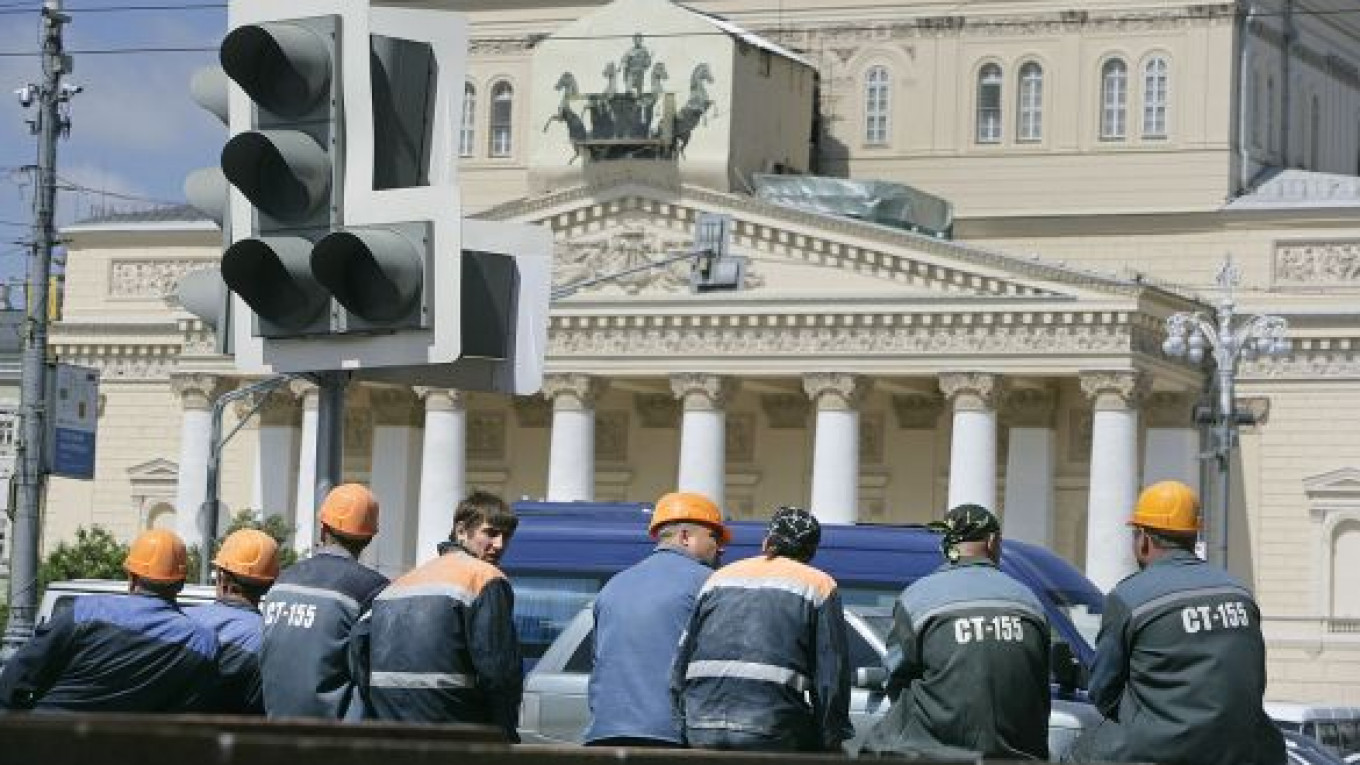
Renovation of Moscow's world-famous Bolshoi Theater for instance, which started in 2005, was originally expected to cost $700 million, but after three delays, its cost has more than tripled to $2.2 billion, Forsberg says.
Russia has considered issuing infrastructure bonds to foreign investors as state guarantees in the event a project makes a loss, but a consensus on the idea has not been reached despite more than six months of negotiations.
"I expected the bonds to be out in December of last year," said Maxim Sokolov, director of the department of industry and infrastructure of the government of the Russian Federation.
"I would like to see them out by the end of 2010, and as soon as the Duma passes them into the government, I'll do everything on my part to catalyze the process," Sokolov added.
While the decision on infrastructure bonds is up in the air, currency risk continues to leave Russia at a disadvantage when attracting foreign investors.
"The ruble has been strong for only the past couple of years … But a couple of years of good currency performance are not enough to secure a road project, which may take 10 years to complete," said Deutsche's Forsberg.
Russia is hungry for foreign capital and experience, while foreign construction companies, banks and consulting agencies are attracted by Russia's low taxes and relative ease of borrowing compared with many other economies.
But the marriage of interests has not yet produced the offspring to seal the companionship.
"People need data, and there's no data in Russia," Macquarie's Secen says. "That puts a cap on their [investors'] appetite."
Russia's infrastructure projects contracted 12 percent in value in real terms during 2009, according to an independent report by Business Monitor International.
"Two years ago, before the financial crisis, Western investors were ready to invest in both big and small roads," says Oleg Pankratov, head of infrastructure capital at VTB Capital.
"The crisis scared them. Today, they are starting to look again, but primarily on safer projects promising a decent return," Pankratov added.
France's Vinci, the world's leading private motorway concessions operator, is about to invest more than $1 billion in the construction and financing of the first part of the M-10 road linking Moscow and St. Petersburg. Whether it invests more remains to be seen.
"This is a test for us," said Vincent Piron, Vinci's business development director. "We'll see how this project goes before we consider further investments in this country."
A Message from The Moscow Times:
Dear readers,
We are facing unprecedented challenges. Russia's Prosecutor General's Office has designated The Moscow Times as an "undesirable" organization, criminalizing our work and putting our staff at risk of prosecution. This follows our earlier unjust labeling as a "foreign agent."
These actions are direct attempts to silence independent journalism in Russia. The authorities claim our work "discredits the decisions of the Russian leadership." We see things differently: we strive to provide accurate, unbiased reporting on Russia.
We, the journalists of The Moscow Times, refuse to be silenced. But to continue our work, we need your help.
Your support, no matter how small, makes a world of difference. If you can, please support us monthly starting from just $2. It's quick to set up, and every contribution makes a significant impact.
By supporting The Moscow Times, you're defending open, independent journalism in the face of repression. Thank you for standing with us.

Remind me later.