

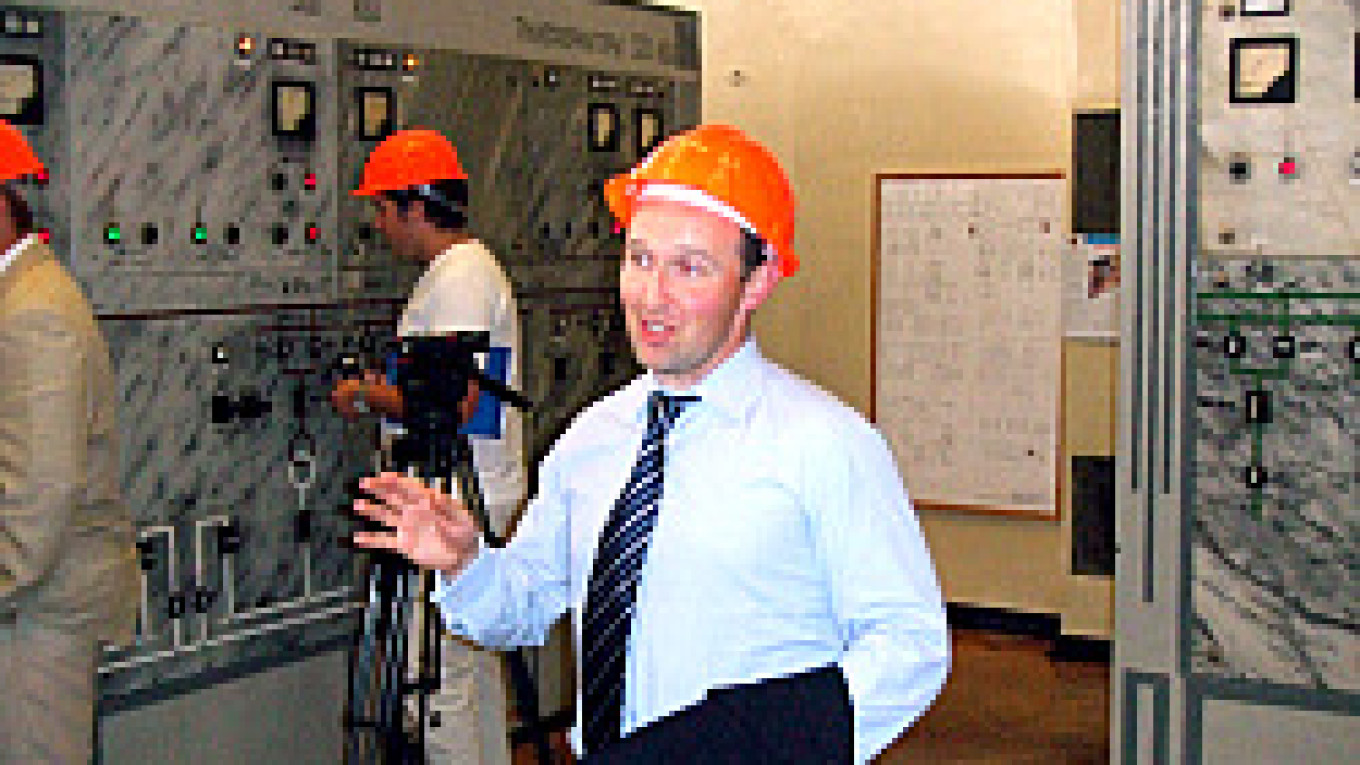
The 26 billion rubles will be invested in modernizing equipment used by TGK-7 in the Samara, Saratov, Orenburg and Ulyanovsk regions, Slobodin said. The funds will be spent under a six-year investment program worth 146 billion rubles at IES, the country's biggest private electricity producer.
"Our dream is to modernize the equipment we use in a timely manner. Otherwise the Russian economy will not be competitive," Slobodin said during a visit to a Samara power station.
"The problem is that we have all gotten used to working with old equipment, mending it all the time, and we don't have enough money for new equipment," he said as he handed the old German turbine over for shipment to a Berlin museum.
AEG Industrial Engineering CEO Heinrich Otterpohl, whose company supplied the station with the turbine in 1931, said it was unusual to see a turbine working for so long. "The last time we replaced such an old turbine was in Tasmania in January," he said. "[It] was 100 years old."
AEG will pay to ship the 22-ton, 6-megawatt turbine to the German Museum of Technology in Berlin. The 32-megawatt Samara station, which supplies one-third of the heating needs of Samara's 1.15 million population, will receive a new 12-megawatt turbine from a Kaluga plant next year.
"We haven't got much to boast about if we have been operating an 80-year-old turbine," Slobodin said.
Slobodin said government help was needed to speed up the development of Russian-built machinery.
"If the work of Russian engineers is not supported by the state, we will have to continue standing in long lines and overpaying heavily for Siemens and GE turbines," he said.
Up to 80 percent of the machinery in the electricity sector is worn out and needs to be replaced, industry insiders say. Domestic machinery builders lagged behind their Western competitors during the turmoil of the 1990s, and production has fallen dramatically at the firms that have managed to survive.
"Russian engineering is very good, but the biggest problem for the development of the country's machinery has been a lack of materials, as the Soviet Union has been putting import duties on them," Otterpohl said.
"Fortunately, there is no such problem any more, so I expect your machinery will get to the world level soon," he said.
The Samara station's equipment was produced between the 1930s and 1960s, said the station's chief engineer, Dmitry Garshin.
While it could operate for another 50 years, he said, the problem is that it consumes 1.5 to 2 times more fuel than modern equipment. "So we have no choice but to modernize it some way," he said.
Slobodin predicted that 20 percent of the country's electricity machinery would be modernized by 2020. "And by 2030 we may get to the point that only 10 to 20 percent of the electricity machinery operated in the country is outdated," he said in an interview after the ceremony.
A Message from The Moscow Times:
Dear readers,
We are facing unprecedented challenges. Russia's Prosecutor General's Office has designated The Moscow Times as an "undesirable" organization, criminalizing our work and putting our staff at risk of prosecution. This follows our earlier unjust labeling as a "foreign agent."
These actions are direct attempts to silence independent journalism in Russia. The authorities claim our work "discredits the decisions of the Russian leadership." We see things differently: we strive to provide accurate, unbiased reporting on Russia.
We, the journalists of The Moscow Times, refuse to be silenced. But to continue our work, we need your help.
Your support, no matter how small, makes a world of difference. If you can, please support us monthly starting from just $2. It's quick to set up, and every contribution makes a significant impact.
By supporting The Moscow Times, you're defending open, independent journalism in the face of repression. Thank you for standing with us.

Remind me later.