

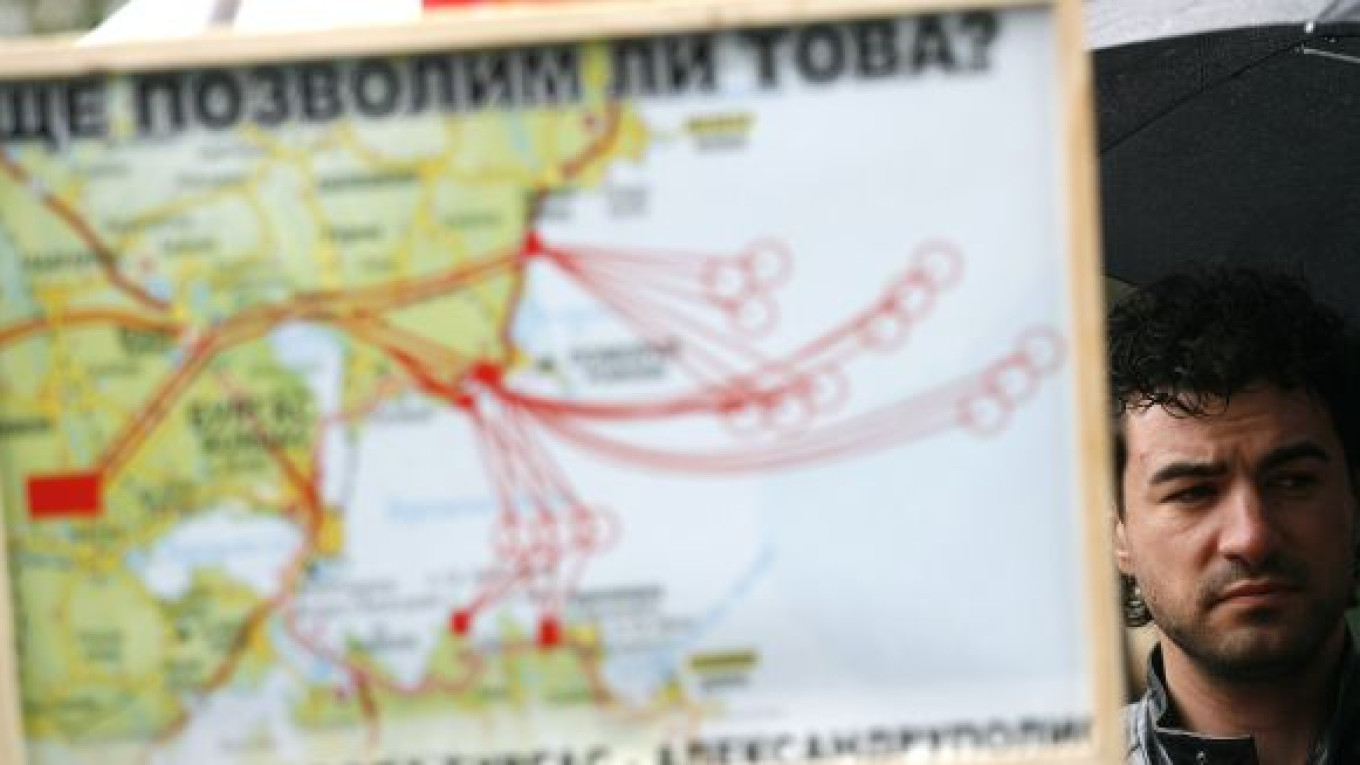
SOFIA, Bulgaria — Bulgaria is likely to pull out of a trans-Balkan oil pipeline to carry Russian crude through its territory to Greece but will first await an environmental assessment on the project, officials said.
Speaking after a meeting with European Union ambassadors Friday, Prime Minister Boyko Borissov said Sofia would not participate in the project because of strong opposition from residents of the Black Sea coast where the 300-kilometer pipeline was due to start.
Hours later, the government press office played down Borissov's words, quoting him as saying the Balkan country would await an environmental assessment on the project before it decides whether or not to abandon it.
Borissov said the pipeline, estimated to cost a total 1 billion euros ($1.2 billion), posed serious environmental risks and did not offer enough economic benefits for Bulgaria.
"This is a project that the population of Burgas do not want," he said. "We all saw what happened in the Gulf of Mexico."
Economy and Energy Minister Traicho Traikov said the Cabinet had not officially decided to scrap plans for the pipeline but said the outlook did not look good.
"There is no decision to pull out of the project. What we have are very serious arguments that are negative," he said.
Traikov expressed concern whether Russia will provide the necessary oil for the link, saying that if the pipeline project fails, it would not only be because of Bulgaria.
Greece had also questioned Russian oil supply.
But on Friday, Athens said it remained committed to the pipeline that would pump up to 50 million metric tons of Urals crude a year from the Black Sea port of Burgas to Alexandroupolis on the Aegean Sea.
"The Greek side remains committed to the completion of this project and continues its efforts toward this direction," government spokesman George Pelalotis said.
Under tough-talking Borissov, Sofia has started to review Russian-backed energy projects to ensure that they match national interests and the EU agenda.
Sofia has declined a Russian loan for a new, 2,000-megawatt nuclear power plant. Belene and Borissov reiterated Friday that the plant will be built only if a western investor for it is found.
Analysts say the move shows Bulgaria's readiness for closer ties with the EU after the previous Socialist-led Cabinet irked Brussels and the United States by appearing to side with Russia.
"Russia will not be pleasantly surprised. … But it is time to understand that Bulgaria will carry out only projects that make economic sense for it," said Ognian Minchev, a Sofia-based analyst with the Institute for Regional and International Studies.
"This is a clear demonstration of firm political will and the government's desire for a bigger energy independence," said Kiril Avramov, with independent think-tank Political Capital.
Bulgaria's only nuclear plant is Russian-built, and it is fully dependent on Russia's natural gas supplies. The country's only oil refinery is controlled by LUKoil.
In 2007, after decades of political bickering, Bulgaria agreed with Russia and Greece to build the pipeline, allowing Russian crude to bypass the traffic-clogged Bosporus Straits.
Russia holds 51 percent in the link, while Sofia and Greece kept 24.5 percent each.
The residents of Burgas and nearby Black Sea resort towns held a series of protests opposing the project, which they fear may cause serious environmental damage to the coast and scare away tourists, their main livelihood.
A Message from The Moscow Times:
Dear readers,
We are facing unprecedented challenges. Russia's Prosecutor General's Office has designated The Moscow Times as an "undesirable" organization, criminalizing our work and putting our staff at risk of prosecution. This follows our earlier unjust labeling as a "foreign agent."
These actions are direct attempts to silence independent journalism in Russia. The authorities claim our work "discredits the decisions of the Russian leadership." We see things differently: we strive to provide accurate, unbiased reporting on Russia.
We, the journalists of The Moscow Times, refuse to be silenced. But to continue our work, we need your help.
Your support, no matter how small, makes a world of difference. If you can, please support us monthly starting from just $2. It's quick to set up, and every contribution makes a significant impact.
By supporting The Moscow Times, you're defending open, independent journalism in the face of repression. Thank you for standing with us.

Remind me later.