

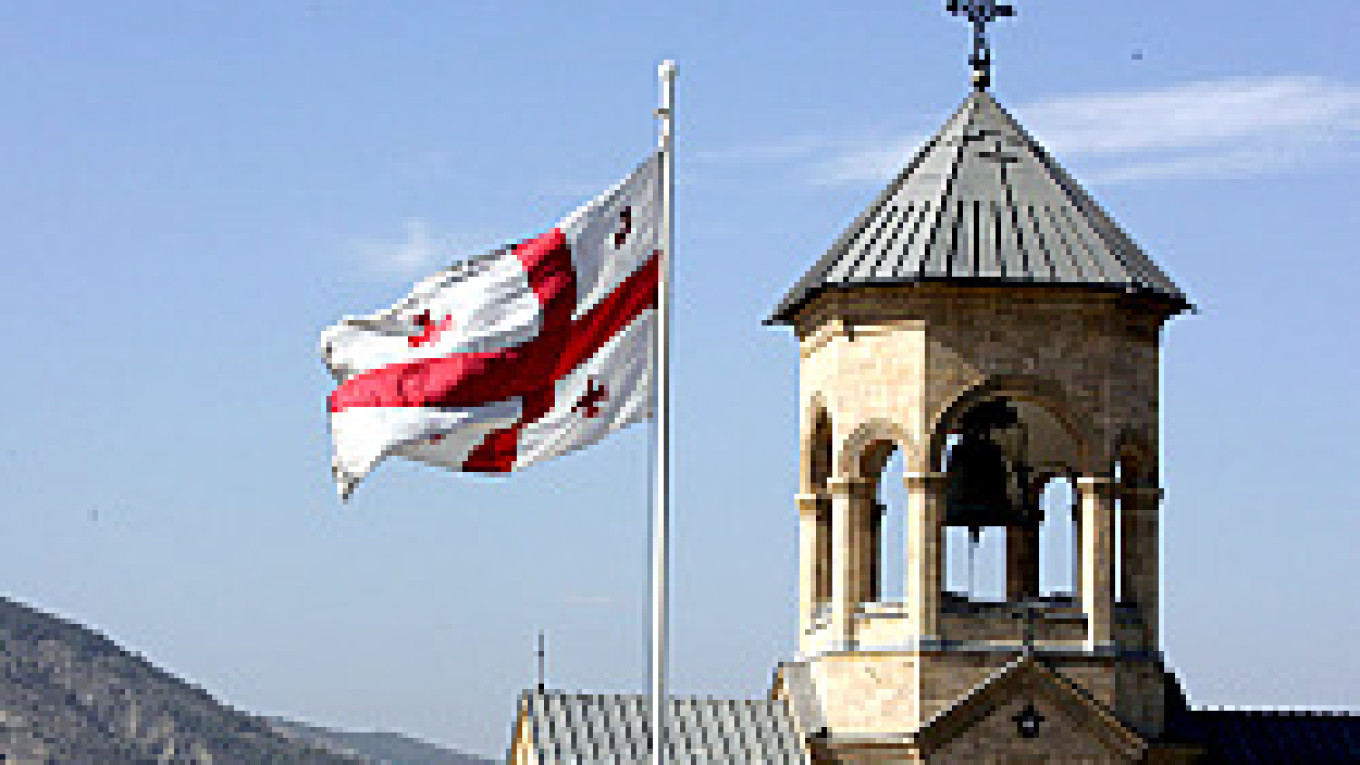
I, too, plead guilty to the Georgia obsession, but I concede that, to a detached outsider, this level of attention seems unjustified. The young presidency of Mikheil Saakashvili has scored some notable successes, mainly in cracking down on corruption and raising budget revenues, but its democratic scorecard is actually fairly mixed: The media is less free than it was three years ago, the rule of law is frequently subverted by politicized court cases, minorities still feel uncomfortable. This is not a model government and it does not deserve the recent comment from the United States' normally sober former UN ambassador Richard Holbrooke that "the 38-year-old Saakashvili represents almost everything the United States and the European Union should support."
So what is the Georgians' secret? They have produced some great theatrical and film directors, and their capacity for grand gesture must have something to do with it. In a gray bureaucratic world, the Georgians give us dash and spectacle. Bernardo Bertolucci could have directed the drama of the 2003 Rose Revolution, the culmination of which had Saakashvili marching at the head of a throng of leather-jacketed supporters through Tbilisi and into the parliament chamber to overthrow the ancien regime, unarmed and clutching only a single rose. Since then, Saakashvili has been a master of PR and grand gestures, his presidential practice marked more by style than by substance.
The deeper reason for this kind of interest lies in the Soviet past, in Georgia's special place within the Soviet Union and in the double strand of Georgian history that has tied it to both Russia and Europe. All kinds of Russians find it harder emotionally to let go of Georgia than, say, Kazakhstan or Moldova. The interpenetration of Russian and Georgian culture, combined with the memory of Georgia as a beloved childhood vacation destination, leads them to unthinkingly assume that Georgia is part of "their" space -- and that an independent Georgia that wants to embrace the West is guilty of some kind of disloyalty. This in turn only drives the Georgians' fiercest nationalism, bolstering the response that they have an ancient culture and a Christian tradition that predate Russia's, and strong ties with Europe that bypass Russia.
 Routledge |  |
| |
Stalin inevitably makes an appearance in both of these fascinating books on Georgia. Peter Nasmyth is made to drink to Stalin, "the great general," during an alcohol-soaked trip to the mountains of Svaneti. Thomas Goltz tracks the influence of Stalin and Beria in his thrilling reporter's account of good times and bad in post-Soviet Georgia.
Both of these authors know and love the place well. The danger -- one that neither avoids -- is that the story turns into one of those over-long Caucasian feasts, in which you are offered far too much to eat, the digressions get ever lengthier and you begin to forget where you started. A bit more Anglo-Saxon editing would have helped. Nasmyth, a professional Georgiaphile, co-founded the indispensable English-language bookshop Prospero's Books in Tbilisi and has also written a walking guide to the mountains. The first edition of "Georgia: In the Mountains of Poetry" dates back to 1998, and this new edition brings it up to date with material that covers the Rose Revolution and its aftermath. It is a first-person story of two decades of journeys to Georgia and has all the pluses and minuses of an insider's account. Yet the book is worth having for the photographs alone, and should be on the shelf of anyone who wants to understand the Caucasus.
 M.E. Sharpe Georgia Diary: A Chronicle of War and Political Chaos in the Post-Soviet Caucasus By Thomas Goltz M.E. Sharpe 312 pages. $39.95 | |
| |
When I was living in Moscow in the 1990s and struggling to grasp the bigger meaning of the post-Soviet chaos around me, "Azerbaijan Diary" was a tonic. Not for this author reassuring platitudes about how this was a "transition to democracy and market economy" (as far too many Western analysts insisted on portraying it) -- here was an up-close account of the scramble for resources and power in a world without rules.
The best passages in the new book are about the breakaway region of Abkhazia and the unnecessary nationalist war there of 1992-93. Goltz was there before it started and after it was over, and in some of the most riveting and truthful chapters of war reportage you will ever read, he witnesses the fall of Sukhumi, the capital, to the Russian-backed Abkhaz, with Georgian President Eduard Shevardnadze clinging on to the end.
Goltz says that he first encountered Georgia in Bertolt Brecht's "The Caucasian Chalk Circle," and the most moving and mysterious character in his book is also the most Brechtian. While in Sukhumi, Goltz got to know a Georgian woman named Nunu Chachua, the commercial director of a theater and also a fanatical Zviadist, or in other words, a supporter of Georgia's nationalist and fiercely anti-Russian first president, Zviad Gamsakhurdia. She was, Goltz tells us, "Medea, a raven-haired beauty with dark almonds for eyes, who was tough as nails, and possessed an absolutism that was both splendid and frightening."
Chachua's story takes us through the whole tragic arc of Georgia's recent history. We meet her shortly after Gamsakhurdia is deposed in 1992; then again as war starts in Abkhazia, with her house on the front lines of the battle for Sukhumi; and then when she is in exile in Tbilisi, doing business deals and drawing refugee benefits while pouring scorn on the "so-called Rose Revolution." Goltz does not iron out her contradictions, and yet we admire her fortitude. In short, she is a very Georgian character and the kind of person with whom the professional policy strategists in Moscow or Washington have failed to come to terms. Perhaps it is the glorious devil-may-care attitude of people like Chachua that continues to draw us to Georgia -- in 2007 we long for places where chivalry still has value, even if the price the Georgians pay for it has been far too high.
Thomas de Waal is Caucasus editor for the Institute for War and Peace Reporting in London.
A Message from The Moscow Times:
Dear readers,
We are facing unprecedented challenges. Russia's Prosecutor General's Office has designated The Moscow Times as an "undesirable" organization, criminalizing our work and putting our staff at risk of prosecution. This follows our earlier unjust labeling as a "foreign agent."
These actions are direct attempts to silence independent journalism in Russia. The authorities claim our work "discredits the decisions of the Russian leadership." We see things differently: we strive to provide accurate, unbiased reporting on Russia.
We, the journalists of The Moscow Times, refuse to be silenced. But to continue our work, we need your help.
Your support, no matter how small, makes a world of difference. If you can, please support us monthly starting from just $2. It's quick to set up, and every contribution makes a significant impact.
By supporting The Moscow Times, you're defending open, independent journalism in the face of repression. Thank you for standing with us.

Remind me later.