

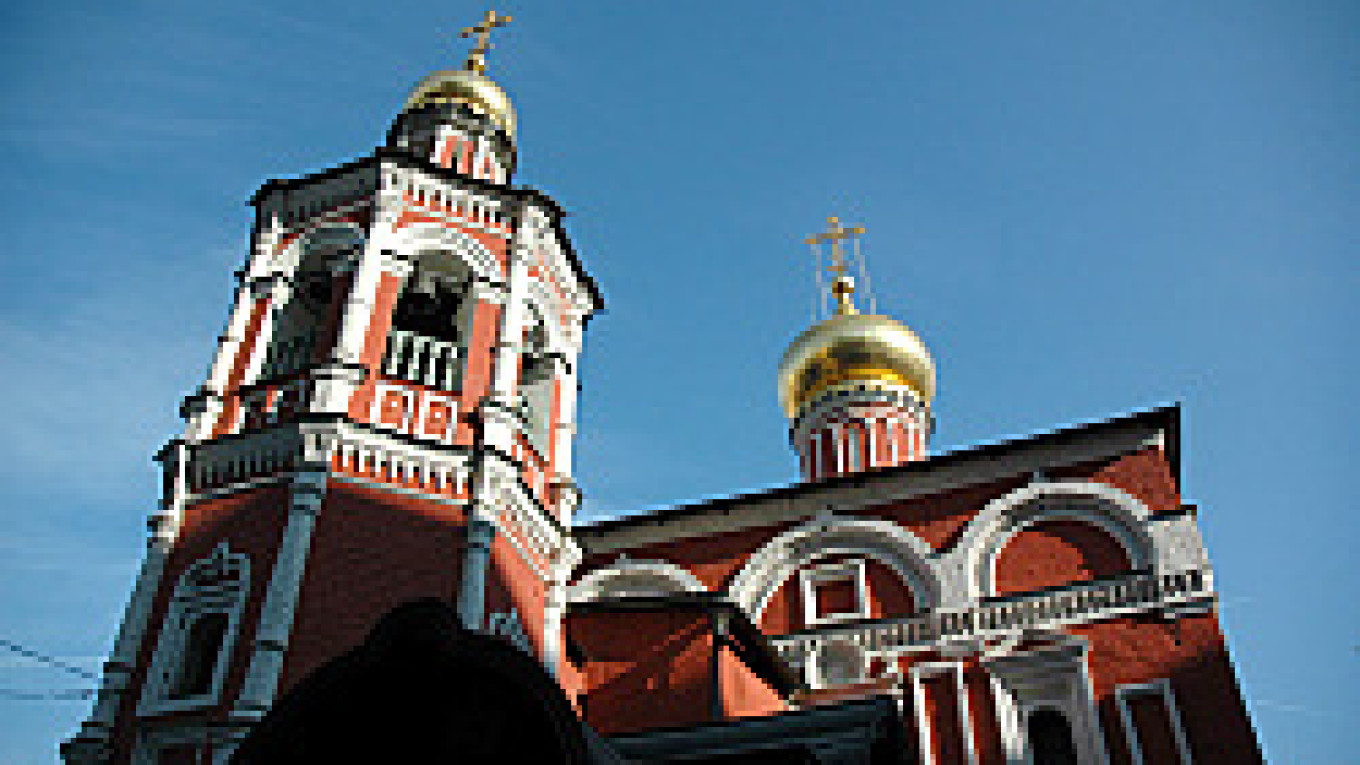
Looking at a church, one can see with patience the architectural changes, like wrinkles on a face, that show the passing of time. Inside, a little knowledge can add to your understanding of the churches around Moscow.
"You can see the various time periods and life stories of different churches through their architecture," said Konstantin Mikhailov, a tough-looking preservationist who has written a series of books on architectural preservation in the city.
The church of All Saints at Kulishki is a red building that greets everyone coming out of Kitai Gorod metro station at the Solyanka end.
It is a 16th-century church that was founded in honor of those who had died in the battle on Kulikovo Field in 1380. "It is from the 16th century but has been altered again and again and again," said Mikhalkov.
From the street, the facade looks harmonious, but on closer inspection a chaotic architectural history is revealed. The top row of decorations consists of white, semi-circular frames, kokoshniki with small points at their peak from the 17th century. Close to street level, the outline of an 18th century circular arch can be seen.
"This was from a baroque architectural style that was fashionable in the 18th century, but [they] realized that it was too cold to have such big windows."
A classical influence from the late 18th century to early 19th century can be seen here, said Mihailkov, pointing to a triangular pediment with a circular pattern inside it. Underneath it are fluted Doric columns. "But these angular windows here are much older."
Orthodox churches are built on an east-west axis. "The altar of orthodox churches always faces east," Mikhailov said. The entrance is usually on the west side. In the morning, this is the darker side, and walking into a church is therefore a journey from dark to light.
It was common in Russia to have separate chapels for summer and winter. Most churches have heating now, but you can tell a winter chapel by its more compact space -- meaning that it was easier to heat.
The architectural floor plan often forms a shape like a ship. The ship is symbolic, and it represents the church as a vessel, carrying its worshippers into the kingdom of God. It is also common for the floor plan to form the shape of a cross.
 Igor Tabakov / MT |  |
| |
Inside the church, if you look closely at the iconostasis, which comes from a Greek word meaning "icon stand," you can see it is made up of different tiers.
There are certain guidelines for where an icon is placed. If you look at the bottom tier, sometimes called the Sovereign, there will be an icon of Christ to the right and on the left, one of the Virgin Mary. The icon of Christ symbolizes his second coming, whilst the Virgin Mary symbolizes Christ's coming to the world.
In between, there are usually icons related to the saint or feast that the church is named after and usually icons for John the Baptist, St. Nicholas and the apostles Matthew, Mark, Luke and John.
Reading icons well can take years, said Alina Loginava, a curator at the Pushkin Museum of Fine Arts, but there are some simple things to look out for.
"St. Paul will always have a beard, receding hairline and high forehead, while St. Peter has a full head of white hair and a very thick beard." Sometimes a saint will have an object to distinguish him. A saint with a set of keys is always St. Peter.
The number of domes on the main part of the church is also symbolic, representing the religious hierarchy. "If there is one dome, it's Jesus Christ, three domes it's the Holy Trinity," said Mikhailov. After that, it becomes like a math equation. "Five domes is Christ and the three evangelicals, seven domes it's the Holy Trinity and four evangelicals, 13 domes is Christ and the 12 apostles."
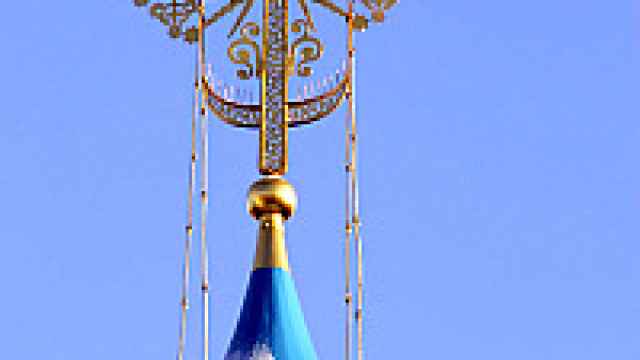
On top of the domes stands a cross. There are many different symbolic interpretations to explain the distinctive beam at the bottom of the Orthodox cross. One says it is connected to the two thieves who were crucified alongside Jesus, one on his left and one on his right. The thief on the left mocked Jesus while the one on the right repented of his sins and accepted the word of God -- this is why one side of the cross is up and the other side is down.
"I haven't heard this reason," said Mikhailov. "I have heard that this bar is where he would have rested his feet."
Like many churches in Moscow, the Church of All Saints at Kulishki has a crescent underneath its cross.
"People say this is from the time when the Tartars had ruled Moscow -- they added the Islam crescent onto the cross," said Mikhailov.
Back inside the church at Kitai Gorod, Mikhalkov goes down into the cellar and tries to read the different signs.
The cellar is expansive, with a network of vaulted ceilings. At one end, it looks as if an altar had once stood there. The church has sunk over the centuries.
"This used to be the original church, from the 16th century," said Mikhalkov.
A Message from The Moscow Times:
Dear readers,
We are facing unprecedented challenges. Russia's Prosecutor General's Office has designated The Moscow Times as an "undesirable" organization, criminalizing our work and putting our staff at risk of prosecution. This follows our earlier unjust labeling as a "foreign agent."
These actions are direct attempts to silence independent journalism in Russia. The authorities claim our work "discredits the decisions of the Russian leadership." We see things differently: we strive to provide accurate, unbiased reporting on Russia.
We, the journalists of The Moscow Times, refuse to be silenced. But to continue our work, we need your help.
Your support, no matter how small, makes a world of difference. If you can, please support us monthly starting from just $2. It's quick to set up, and every contribution makes a significant impact.
By supporting The Moscow Times, you're defending open, independent journalism in the face of repression. Thank you for standing with us.

Remind me later.