

Novaya Opera’s annual “Epiphany Week” festival came to a close at the end of January with the premiere of a new production of the last of Pyotr Tchaikovsky’s 10 operas, “Iolanta,” a work originally written to play in a double bill with the composer’s ballet “The Nutcracker.”
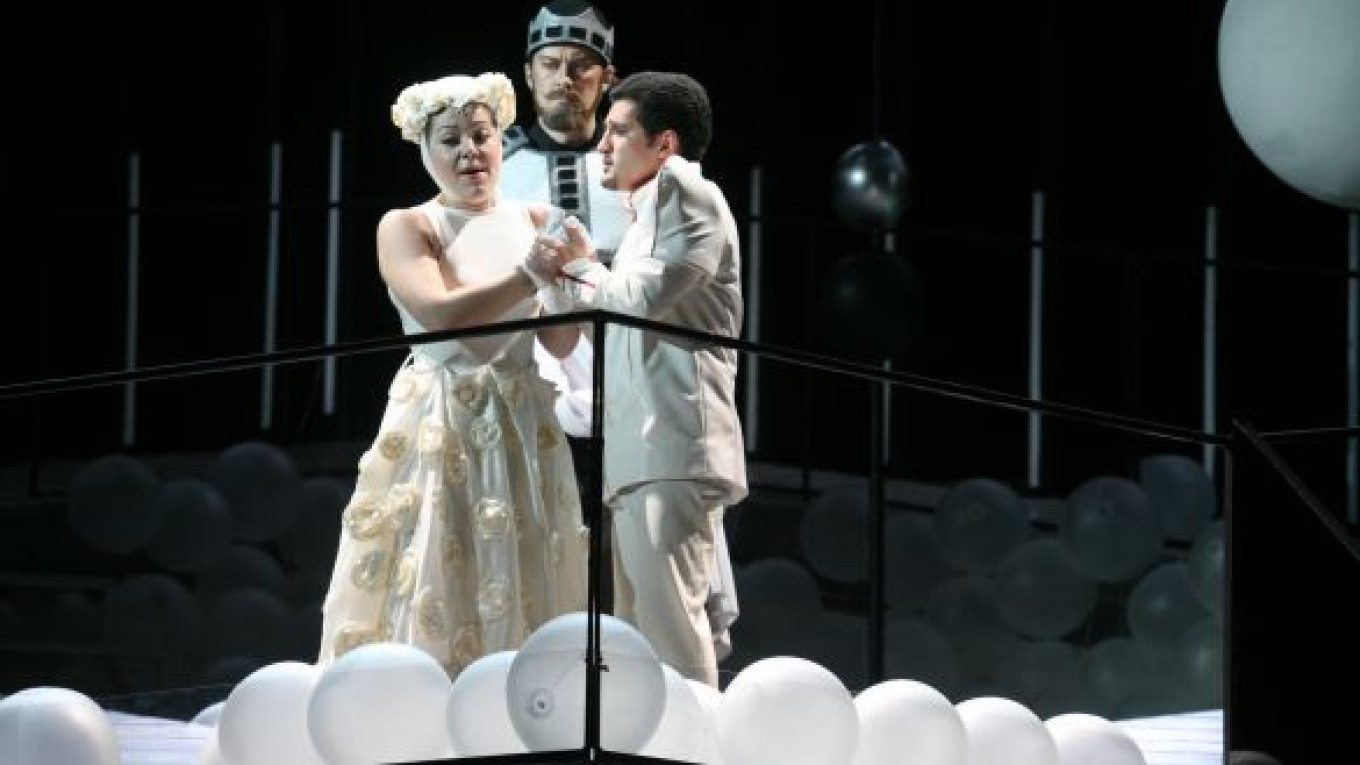
As heard at its second performance, the production proved to be mostly a treat musically. But its staging, by Irkutsk-based director Gennady Shaposhnikov, though innovative, often clever and generally enjoyable to watch, ultimately failed to come to grips with the mystery surrounding the title character’s blindness and her eventual cure.
Does the comely Provencal princess suffer blindness from a physical cause or is her sightlessness the result of some mental disorder? And whatever the answer to that, does she gain the power of sight from the treatment administered by the Moorish doctor Ebn-Hakir or from the emotions of love aroused in her by the young Burgundian knight Vaudemont, or perhaps from some combination of the two? As with nearly every other “Iolanta” in my experience, Shaposhnikov’s version leaves those questions unexplored.
The production plays quite effectively on a two-level set, the upper level, where Iolanta dwells, decorated in white, the lower level arrayed with black metallic panels. The contrast between Iolanta’s sightless realm and the seeing world outside is emphasized by the white costumes of her entourage and the vividly colored, carnival-like dress of the other denizens of her castle.
The warm soprano voice and engaging manner of Ksenia Volkova proved a near-perfect fit for the title role. Bass Alexei Antonov sang the part of Iolanta’s father, King Rene, with more splendor than I have ever heard it sung before. And baritone Andzhey Beletsky gave yet another of his vocally polished performances as Ebn-Hakir. The two young men of the opera, Vaudemont and Duke Robert of Burgundy, were sung a shade less well by tenor Alexander Bogdanov and baritone Ilya Kuzmin, respectively, though Kuzmin’s failure to make much impact with Robert’s rousing aria in praise of his beloved Matilda may have been because of an acoustical quirk of the theater. Conductor Yevgeny Samoilov led the score with great sensitivity.
Despite my reservations, the new “Iolanta” is very much worth a visit and certainly superior to the two or possibly three other versions of the opera currently on the Moscow stage.
Among other highlights of the “Epiphany Week” festival was a performance of British director Elijah Moshinsky’s wonderfully inventive staging of Gioacchino Rossini’s “The Barber of Seville” that featured a trio of guest artists from Italy. The production still sparkled as it did at its premiere in 2008, and the guests added a nice note of authenticity. But the real star of the performance was Novaya Opera’s own Vasily Ladyuk, arguably the finest baritone currently on the Russian operatic stage and much sought-after elsewhere, both here and abroad, who delivered a truly great performance of the title role.
The festival also produced a concert version of Giuseppe Verdi’s “Il Trovatore,” probably indicating, as in the case of past concert performances at Novaya Opera, that a full-scale staging of the opera will crop up there sometime soon. To be effective, “Il Trovatore” demands five singers of the very finest Verdian sort. Unfortunately, Novaya Opera managed to provide only two: baritone Vitaly Bily, as an elegant-sounding Count di Luna, and bass Vladimir Kudashev, who brought an appropriately sturdy voice to Ferrando, the count’s captain of the guard. The other three, all of whom have distinguished themselves in other roles at the theater, did their best to cope with the music, but never reached the vocal heights required to make an “Il Trovatore” performance memorable.
The very best of what I heard at the festival came on its opening night, with a superbly played and sung performance of Benjamin Britten’s “War Requiem” under the baton of British guest conductor Jan Latham-Koenig. A moving expression of the composer’s anti-war sentiments, the “War Requiem” combines the words of the Latin Mass for the Dead and poems by the great British poet of World War I, Wilfred Owen, and calls for enormous musical forces: a full-sized and a chamber orchestra, an adult mixed chorus and a boys’ choir and three vocal soloists. Latham-Koenig brilliantly knit those forces together and drew playing from the orchestra of the quality remembered from performances under the baton of Novaya Opera’s late founder, Yevgeny Kolobov, and singing from the theater’s chorus even better than its usual high-standard best.
The “War Requiem” is due to be repeated at Novaya Opera on Victory Day, May 9.
“Iolanta” next plays March 13 at 2 p.m., and “The Barber of Seville” (Sevilsky Tsiryulnik) — on Feb. 28 at 2 p.m. at Novaya Opera Theater, located at 3 Karetny Ryad. Metro Mayakovskaya. Tel. 694-0868. www.novayaopera.ru
A Message from The Moscow Times:
Dear readers,
We are facing unprecedented challenges. Russia's Prosecutor General's Office has designated The Moscow Times as an "undesirable" organization, criminalizing our work and putting our staff at risk of prosecution. This follows our earlier unjust labeling as a "foreign agent."
These actions are direct attempts to silence independent journalism in Russia. The authorities claim our work "discredits the decisions of the Russian leadership." We see things differently: we strive to provide accurate, unbiased reporting on Russia.
We, the journalists of The Moscow Times, refuse to be silenced. But to continue our work, we need your help.
Your support, no matter how small, makes a world of difference. If you can, please support us monthly starting from just $2. It's quick to set up, and every contribution makes a significant impact.
By supporting The Moscow Times, you're defending open, independent journalism in the face of repression. Thank you for standing with us.

Remind me later.