

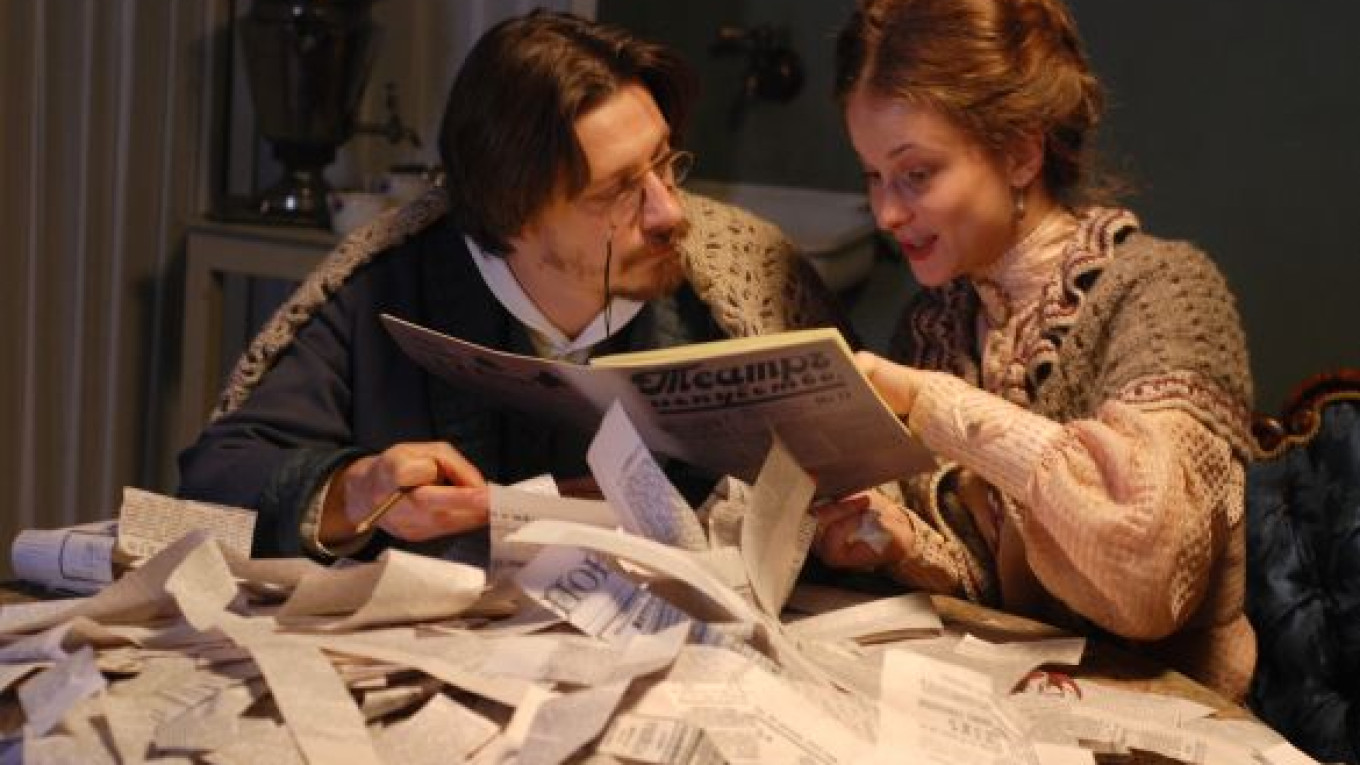
Perhaps I am too close to today's topic to be believed. You are hereby forewarned that I attended the premiere of Vitaly Melnikov's new movie "The Admirer" in St. Petersburg last week not as a reporter for The Moscow Times, but as the husband of actress Oksana Mysina.
The reporter, however, rarely lags far behind the husband.
Still, my point here is not to write about Oksana's hilarious — I can say that much, can't I? — performance of an extravagant decadent poetess, who repeatedly badgers the great writer Anton Chekhov at the most inopportune times. I rather mean to talk about Melnikov's beautiful, atmospheric film that brings to the screen one of the most believable, convincing screen portrayals of Chekhov that I have ever seen.
"The Admirer" (which could also be translated as "The Lady Admirer" — Poklonnitsa in Russian) focuses on Chekhov through the eyes of a woman named Lidia Avilova. She was the author of some stories published in the popular press at the end of the 19th century and is often mentioned as one of Chekhov's many love interests. There are hefty scholarly debates about how close Avilova really was to Chekhov and how reliable her memories are of what transpired between them.
Melnikov, who based his screenplay on writings by Avilova, Chekhov and the writer Ivan Bunin, isn't the least interested in any of that. He immediately waves off anyone's attempt to pin him down to historical accuracy (as if that could be an absolute) by beginning his film with an epigraph drawn from Avilova's words: "These are not reminiscences. They are dreams. Dreams of my life."
"The Admirer" is a subtle, quiet, though remarkably tense film about the gray areas of life in general, and, specifically, of the lives of two people whom fate brought together for a short time. As one St. Petersburg critic wrote, the film "reveals the beauty of understatement, of restraint, of self-sacrifice — after all, it is a film about a love affair that, essentially, never happened."
A film about a love affair that never happened. Now, doesn't that sound Chekhovian?
Following the screening, I had the distinctly humorous opportunity to overhear an exchange between a photographer and Kirill Pirogov, the actor who plays Chekhov in the film.
"You are the spitting image of Chekhov," the photographer stated admiringly.
"Oh no," Pirogov replied.
"You look exactly like him!"
"No, we don't look anything alike."
"I don't mean physically, necessarily," the photographer responded, changing tactics.
"No, no. I am nothing like Chekhov at all," Pirogov insisted.
"But you are, on screen, I mean," the photographer tried one last time.
"Oh, no. There is nothing common whatsoever between Chekhov and me," the actor stated flatly, effectively killing the conversation.
Be that as it may, Pirogov provided a rich, convincing, living image of Chekhov. He did so by playing virtually nothing. He eschews physical mannerisms and never strikes poses he could have imitated from famous photographs. He rarely wears the famous pince-nez. But Pirogov's interpretation of Chekhov surely approximates the original in much deeper ways. Pirogov's Chekhov is a listener. He is protective of his privacy. He is utterly modest about his accomplishments and fully aware of what he does well. When he speaks or acts, he does so with conviction and reason. He is so uninterested in pomp, ceremony and flattery that he merely turns and walks away from it — it isn't worth the energy he would have to expend to condemn it. He is instantly aware when something, or someone, of interest has appeared. And he responds to that simply and openly. He has a sharp eye and a keen ear. He has a quick, analytical mind.
I'm talking about an actor's interpretation of a beloved historical figure in a cinematic setting. But anyone who has admired Anton Chekhov will surely recognize some of their own impressions of the man in the descriptions I have given of Pirogov's performance. It is a performance that has the almost magical ability to make us feel we intimately know a human being we cannot possibly know.
Avilova, played with grace and depth by Svetlana Ivanova, is something of a collective portrait of the understanding and sensitive individual every artist would probably love to have as an admirer.
This is how Melnikov imagines Avilova. She makes no claims on Chekhov personally or professionally. She, indeed, appreciates Chekhov for what he does and who he is. For her that is all one and the same. In her mind it would be silly to talk of the author as if the man did not exist, just as it would be wrong to speak of the man without taking into account his accomplishments as a writer.
Since Avilova is married and the mother of two children when she meets Chekhov, there is never any real question of her acting upon her attraction. This was the 19th century, after all. Avilova and Chekhov do exchange "private" names — they call each other Egyptians — and there is one moment when Chekhov's lips brush her cheek. But the considerable erotic tension of "The Admirer" is borne entirely in words, intonations, thoughts, glances and the most chaste of actions.
"The Admirer" is also a love letter to St. Petersburg. Melnikov is one of the great directors to have been based in that city since the early 1960s. Unlike many of his films, which have been recognized as classics, Melnikov himself has stubbornly remained in the shadow of his work. Every Russian knows and loves films such as "The Boss of Chukotka" (1966), and "Seven Brides for Private Zbruyev" although they may not know who made them.
Many of his films, such as "The Tsar's Hunt," are primarily set in St. Petersburg. In "The Admirer," Melnikov, his directors of cinematography Sergei Astakhov and Stepan Kovalenko, and his designer Alexander Zagoskin provide long, loving panoramas of the city under gray skies and in streets buried under snow. The city rightfully becomes an additional character in the film.
I was particularly impressed with one scene at a winter fair during which Chekhov and Avilova take a short, bumpy sleigh ride down a snowy hill. The snow is thick and realistic and a bit dirty, like any snow gets when people are around. This is no cinematic whitewash, no soap-suds fakery. Everything throughout this film has the same touch of believability and authenticity.
A Moscow premiere is scheduled for March. If you're at all interested in Anton Chekhov, Russian literature or Russian culture in general, my biased opinion is that you won't want to miss "The Admirer" when it comes, as they say, to a theater near you.
A Message from The Moscow Times:
Dear readers,
We are facing unprecedented challenges. Russia's Prosecutor General's Office has designated The Moscow Times as an "undesirable" organization, criminalizing our work and putting our staff at risk of prosecution. This follows our earlier unjust labeling as a "foreign agent."
These actions are direct attempts to silence independent journalism in Russia. The authorities claim our work "discredits the decisions of the Russian leadership." We see things differently: we strive to provide accurate, unbiased reporting on Russia.
We, the journalists of The Moscow Times, refuse to be silenced. But to continue our work, we need your help.
Your support, no matter how small, makes a world of difference. If you can, please support us monthly starting from just $2. It's quick to set up, and every contribution makes a significant impact.
By supporting The Moscow Times, you're defending open, independent journalism in the face of repression. Thank you for standing with us.

Remind me later.