

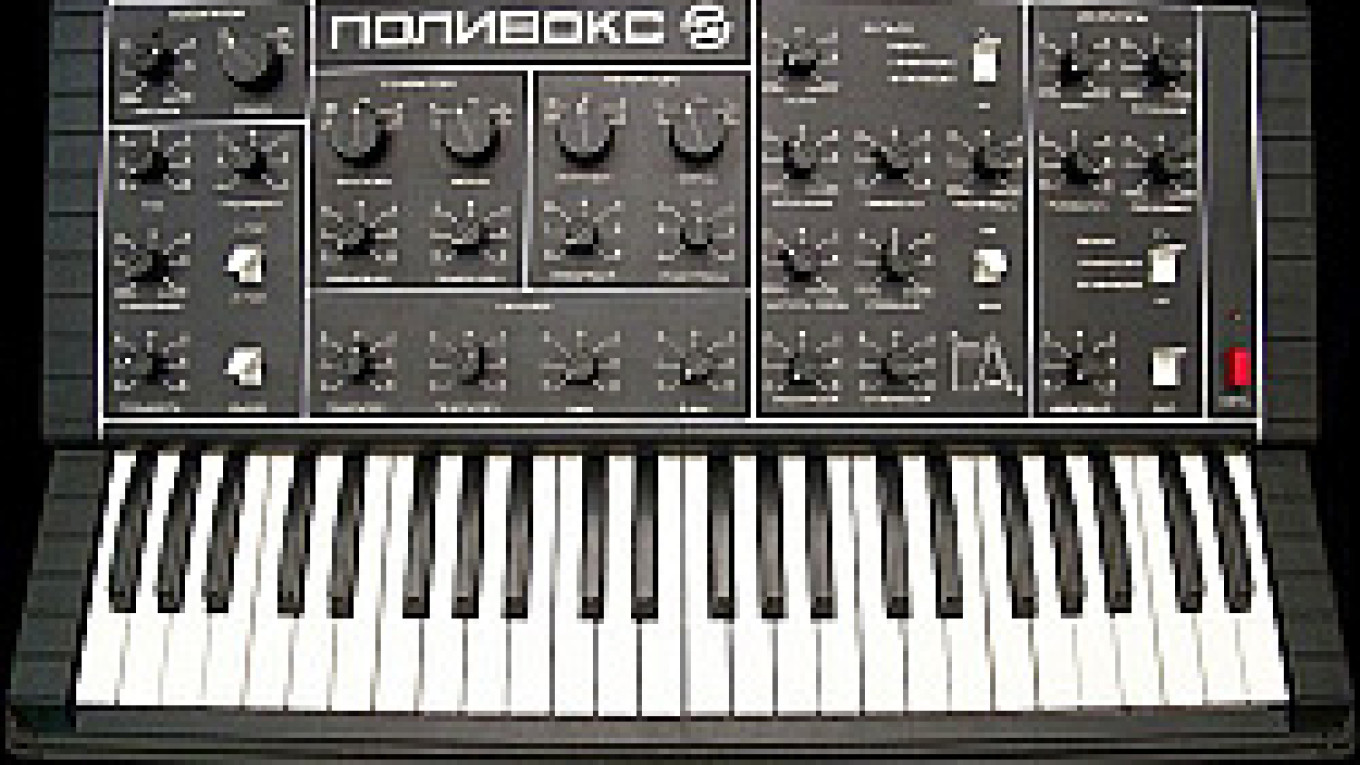
The reason they write is Vladimir Kuzmin, the man behind the Polivoks synthesizer, an instrument with a design based on Soviet military radio that was once one of the least coolest in Soviet times but is now one of the hippest amongst Western bands.
Franz Ferdinand's latest album "Tonight" is only one of many foreign acts, including Goldfrapp and Rammstein, to have used the distinctive sound of the synthesizer.
Franz Ferdinand said in interviews to publicize their latest album that they were fascinated with the synthesizer once they saw its strange design and even stranger sounds. It is a "machine that looks like the control panel of a Soviet tank, with big knobs and dials, Cyrillic labels everywhere," said bandleader Alex Kapranos.
Synthesizers became popular in the late 1970s in the Soviet Union as Western music began to filter through the Iron Curtain. There was little chance of buying foreign instruments, which is where Kuzmin, a circuit designer in Yekaterinburg, came in.
His design was produced by the Vector plant in the Urals as a synthesizer for nonprofessional musicians that could recreate the sound heard on foreign LPs of that time.

Franz Ferdinand
Franz Ferdinand use the Polivoks' unique sound on their album "Tonight."
|  |
| |
Polivoks production began in 1982, costing a huge 920 rubles, the equivalent of 8 months' salary at the time. Despite the price, the demand for the Polivoks was huge. By 1990 when production stopped, more than 100,000 instruments had been sold.
In the 1980s, the Soviet Union began to open up, and musicians could buy American and Japanese synthesizers, with the Polivoks losing any sheen that it had possessed.
"It was considered absolutely uncool to play a Polivoks because it was so cheap and Soviet and uncivilized, and everyone was dreaming about a Yamaha DX-7," said rock critic and historian Artemy Troitsky.
Today, the Polivoks has found a new generation of fans among famous foreign acts because of two things, said Troitsky. "One, it is really cool to use rare and vintage analog synthesizers, and reason No. 2 is that Polivoks produces very weird sounds that you cannot produce on any Western instruments."
It is also loved by less-famous foreign musicians who buy secondhand copies on the Internet.
"The sound is strangely off, something I haven't heard from other synths and haven't been able to really emulate on virtual analogs," said Kai Niggemann, an electronic musician from Nordrhein-Westfalen in Germany who bought his Polivoks in a Polish pawn shop for the equivalent of 70 euros. "I love the feel of the buttons and knobs."
"It is full of surprises and errors," said Mark Bihler, a music engineer from Berlin, who spent 800 euros on eBay for his Polivoks, which he received from Saratov with the help of a friendly train conductor. "Perfection is not interesting. Character is what triggers creativity. And the Polivoks has so much character. It never sounds sweet and clear, it sounds nasty and aggressive."
By comparison, Russian musicians retain a degree of suspicion. "It burns down after five minutes of working," and "Russians are just not any good in building instruments" are just two of the comments on music forums.
Kuzmin does not sell the Polivoks in his shop but is proud when letters from Finland, France and Germany arrive asking about his creation.
"Polivoks has a mellow and aggressive sound, which turned out to be very timely for contemporary music," he said in a telephone interview from Yekaterinburg.
"There are wide opportunities of creating original sounds, a showy design -- my wife Olimpiada is the author of the design. I guess that's why it has remained popular throughout the years."
A Message from The Moscow Times:
Dear readers,
We are facing unprecedented challenges. Russia's Prosecutor General's Office has designated The Moscow Times as an "undesirable" organization, criminalizing our work and putting our staff at risk of prosecution. This follows our earlier unjust labeling as a "foreign agent."
These actions are direct attempts to silence independent journalism in Russia. The authorities claim our work "discredits the decisions of the Russian leadership." We see things differently: we strive to provide accurate, unbiased reporting on Russia.
We, the journalists of The Moscow Times, refuse to be silenced. But to continue our work, we need your help.
Your support, no matter how small, makes a world of difference. If you can, please support us monthly starting from just $2. It's quick to set up, and every contribution makes a significant impact.
By supporting The Moscow Times, you're defending open, independent journalism in the face of repression. Thank you for standing with us.

Remind me later.