

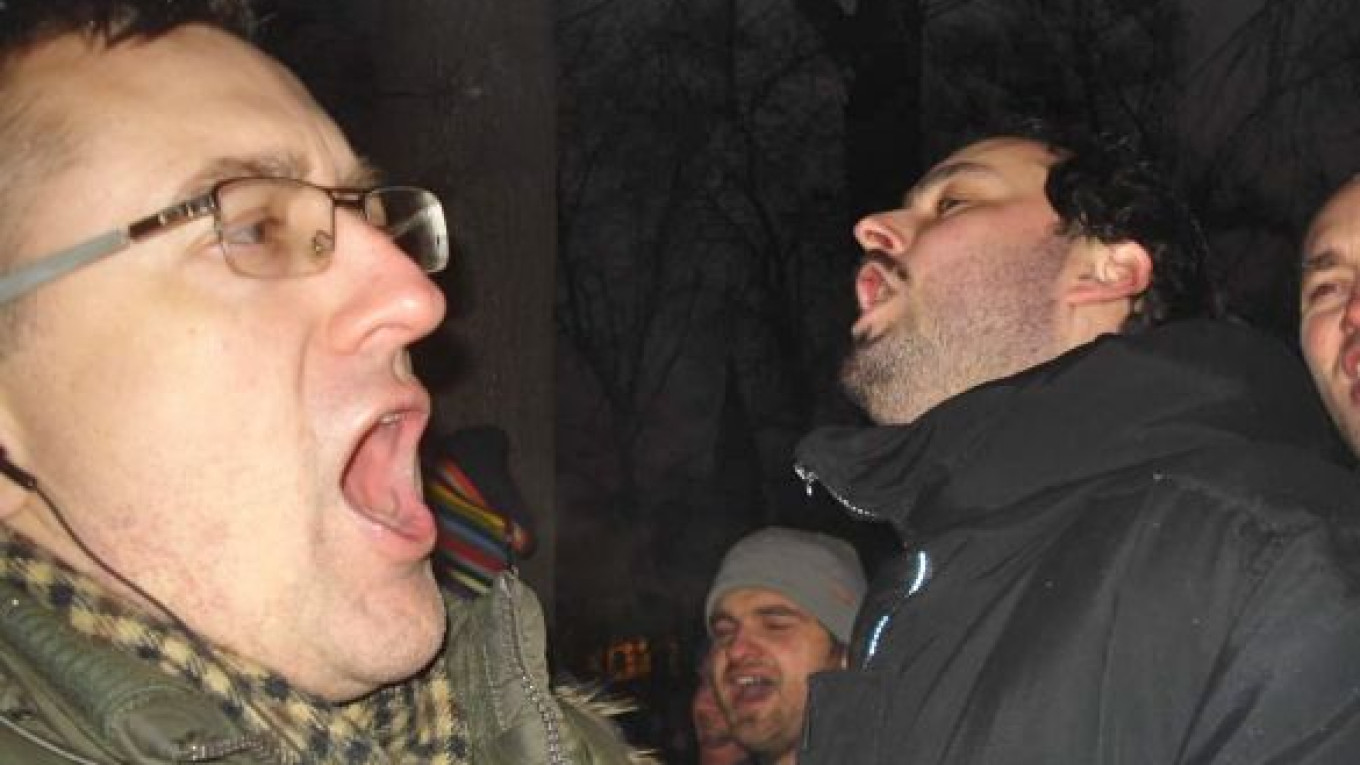
Life and the world will return to something resembling normalcy at some point. But at present, life in Moscow — and that includes the life of culture — is swept up in the fervor caused by disputed elections on Dec. 4 and amplified by subsequent protests Dec. 5 and Saturday.
Over the last 18 months, I have written much in articles and blogs about the interweaving of politics and arts. At times I have wondered whether I have overdone it. Events of the last week indicate that I did not.
As one hears phrases like "revolution," "the end of the Putin era" and "the reawakening of Russia" virtually on every street corner, it seems to be the perfect time to apply some historical perspective. I have compiled a chronology of events where politics and culture found themselves sharing common ground. This timeline is by no means exhaustive. It does, however, suggest how seemingly unconnected events may give rise to political movement. Not surprisingly, perhaps, satire, humor and blunders played a subtle, though important role in this development.
My list begins with an event that I believe signaled the resurgence of intelligent dissent like no other.
May 29, 2010 — Prime Minister Vladimir Putin hosts a meeting with artists in St. Petersburg. Unexpectedly, rock musician Yury Shevchuk asks the prime minister what his thoughts are on the erosion of freedom in the press. Shevchuk's chat with Putin is criticized by some as presumptuous; others are impressed that a citizen dared challenge authority.
May 30, 2010 — In a widely discussed video interview, actress Liya Akhedzhakova, who attended a meeting with Putin the day before, publicly regrets that she failed to support Shevchuk.
June 4, 2010 — Yelena Gremina's play "One Hour Eighteen," based on events surrounding the death of attorney Sergei Magnitsky in prison on Nov. 16, 2009, premieres at Teatr.doc.
Sept. 14, 2010 — Premiere of Vladimir Pankov's production of Yury Klavdiyev's "I Am the Machine Gunner," which completely rethinks this play about a modern gang member and his grandfather's stories of World War II as a rollicking contemporary political satire.
Nov. 25, 2010 — Accepting the Vlad Listyev award for journalism, popular television journalist Leonid Parfyonov stands up before a shocked, skeptical audience of peers to warn against increasing attacks on freedom of the press.
Dec. 10, 2010 — At a benefit dinner boasting the presence of Sharon Stone, Kevin Costner, Monica Bellucci, Goldie Hawn, Kurt Russell and other Western stars, Putin plays the piano and sings "Blueberry Hill" in English. Serious claims were later made that virtually none of the money donated for sick children reached those in need. Putin's image noticeably begins to sour.
Dec. 19, 2010 — The contested presidential election in Belarus causes reaction not only among artists in Belarus — the Free Theater of Belarus, for example, went underground and sent out information about evolving events by way of blogs — but among theater artists in Moscow as well. Over the course of several days, playwrights Mikhail Durnenkov, Maksym Kurochkin, Anna Yablonskaya, Yevgeny Kazachkov and others publish texts expressing concern about the way events in Belarus reflect a deepening political crisis in Russia.
Late Dec. 2010 — The second trial against jailed tycoon Mikhail Khodorkovsky and his business partner Platon Lebedev prompts numerous important artists to speak out. They include artist Bilzho, film director Eldar Ryazanov, and writer Lev Rubinshtein.
Jan. 5, 2011 — Speaking on Ekho Moskvy radio, director-playwright Mikhail Ugarov urges Muscovites to leave chairs at the door of the Moscow City court to protest the treatment of politician Boris Nemtsov, who was arrested at a demonstration on Dec. 31 and not allowed a chair to sit on when he was arraigned.
Feb. 2011 — The Dozhd, or Rain, television station begins airing a series of wildly popular satirical poetry videos created by journalist-poet Dmitry Bykov and actor Mikhail Yefremov. The unchanging targets of their barbs are President Dmitry Medvedev, Prime Minister Putin and the general political situation in Russia. This is another important event in the public perception of the two politicians as caricatures rather than as statesmen.
April 29, 2011 — Prime Minister Putin meets the heads of many Russian theaters in the city of Penza. It is a routine working meeting that addresses numerous serious problems, but the very fact that artists are put in the position of having to appeal to the prime minister with hands held out causes much discussion and criticism.
June 14, 2011 — The Joseph Beuys Theater premieres a theatricalized public affairs event directed by Varvara Faer, in which actors read excerpts from the published correspondence between Mikhail Khodorkovsky and novelist Lyudmila Ulitskaya.
Sept. 13, 2011 – Two heavily attended and hotly discussed readings at the Lyubimovka young play festival are pointedly political — "Two in Your House" is a spoof of the house arrest of Belarussian presidential candidate Vladimir Neklyayev, and "Conversations in a Kitchen Two Days Before Arrest" is an exploration of the two young people who murdered attorney Stanislav Markelov and journalist Anastasia Baburova in 2009.
Sept. 15, 2011 – Controversy arises as a result of a private visit of Prime Minister Putin to the Theater of Nations as the venue prepares to officially mark the completion of repairs to its main stage. As he did in December in St. Petersburg, Putin plays the piano, while artistic director Yevgeny Mironov — rightly or wrongly — is perceived as kowtowing to Putin.
Nov. 17, 2011 – Actor Alexei Devotchenko, a political activist and blogger, publicly renounces government awards that he has received over the years, including a State Prize and the status of Honored Artist of the Russian Federation.
Dec. 5, 2011 – At a demonstration convened to protest the alleged falsification of elections the previous day, a large number of artists are among the estimated 8,000 attendees.
Dec. 10, 2011 – A crowd estimated from 25,000 to 60,000 descends on Bolotnaya Ploshchad just south of the Kremlin, across the Moscow River. The activity of the artistic community is high. As an official speaker, novelist Boris Akunin calls the demonstration an "important day in his life" and demands the organization of new elections and "online transmissions from every precinct" that would stream "from the first voter to the last vote counted." Reporting later on his Facebook page, writer Lev Rubinshtein declares, "What happened today could not have been imagined a year ago, or even a week ago. We — many of us — suddenly remembered that personal dignity is worth struggling for and worth speaking out about."
A Message from The Moscow Times:
Dear readers,
We are facing unprecedented challenges. Russia's Prosecutor General's Office has designated The Moscow Times as an "undesirable" organization, criminalizing our work and putting our staff at risk of prosecution. This follows our earlier unjust labeling as a "foreign agent."
These actions are direct attempts to silence independent journalism in Russia. The authorities claim our work "discredits the decisions of the Russian leadership." We see things differently: we strive to provide accurate, unbiased reporting on Russia.
We, the journalists of The Moscow Times, refuse to be silenced. But to continue our work, we need your help.
Your support, no matter how small, makes a world of difference. If you can, please support us monthly starting from just $2. It's quick to set up, and every contribution makes a significant impact.
By supporting The Moscow Times, you're defending open, independent journalism in the face of repression. Thank you for standing with us.

Remind me later.