

The aforementioned house is a wedding palace in the Fergana Valley in Kyrgyzstan but one that leads only to unhappiness in an area blighted by drug addiction.
"The institution is supposed to serve as a place for official marriage registration, but in fact its colorful walls disguise violence and pain," said Effendi in an interview at the opening of the exhibition.
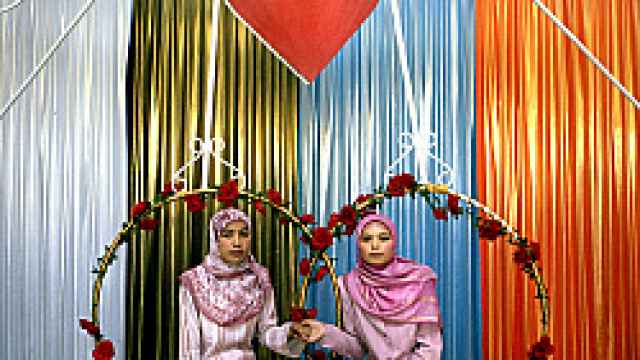
The exhibition initially plays up the brightly colored, vivid portraits Effendi takes that show ordinary women staring out with what could be patience, endurance or stoicism -- or even happiness.
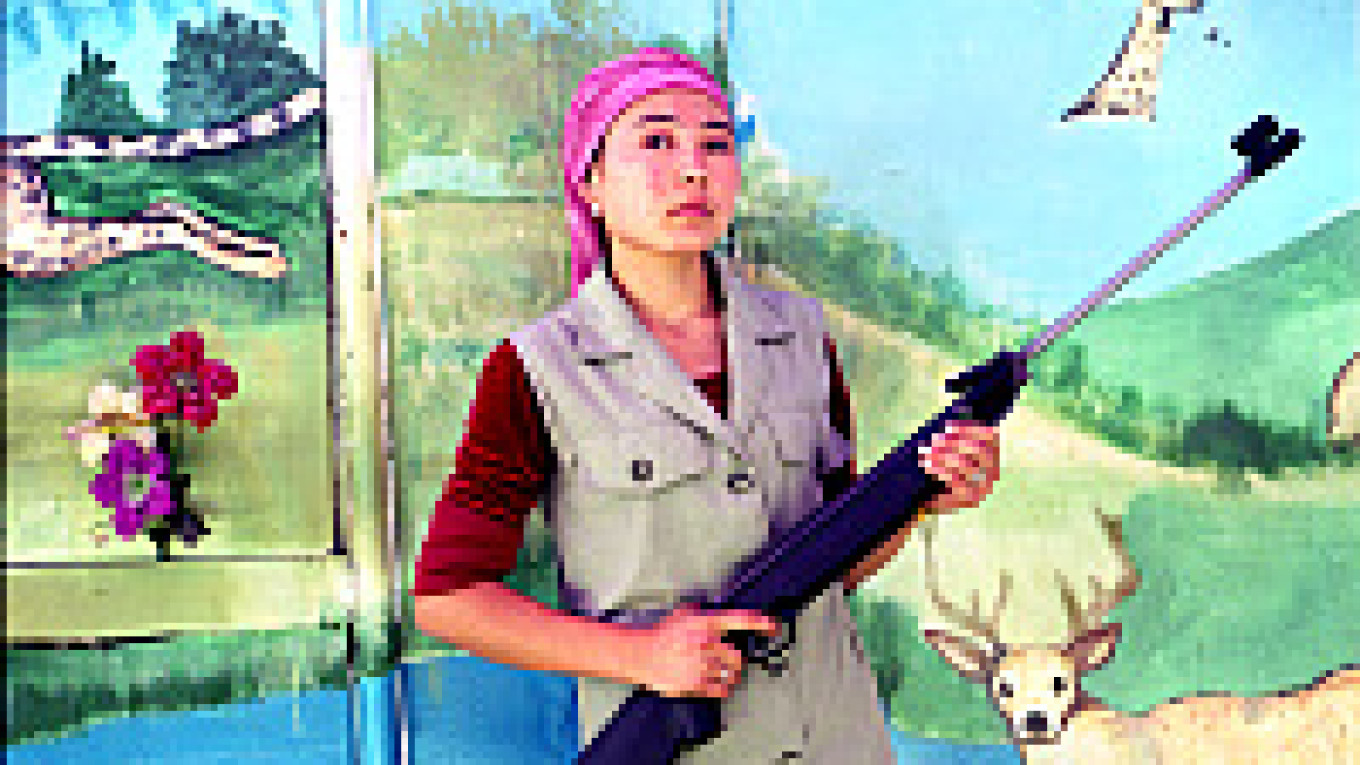
There is a woman with a gun who works at a fairground stand, women sliding down a stone believed to help with fertility. A child celebrates after a small wedding, the name given to a circumcision celebration.
The later pictures are darker, sometimes in style and always in content -- pictures of women who work in a brothel in Osh, Kyrgyzstan, sex workers waiting in groups on the street, a 40-year-old woman who has been a heroin addict for half her life, a man and a woman injecting heroin and the scarred leg of an addict who has infected a blood vessel through shooting up.
The United Nations estimates that nearly 60 percent of the drugs coming out of Afghanistan are trafficked through the Fergana Valley, along the ancient Silk Road, now known as "the heroin highway."
The heroin trade has a dramatic effect on the life of women in the area. Young brides are kidnapped, polygamy is practiced and forced marriages are common as radical Islam grows in the region.
 Rena Effendi |  |
| |
Effendi spent several days in the valley getting to know her subjects. Some still refused to pose for photos, she said, but others agreed, feeling sympathy for a young female photographer, without asking to see the photos.
Born in Baku, Azerbaijan, Effendi, 31, initially worked as an interpreter after graduating from the Azeri State Institute of Foreign Languages. She only became an artist much later after taking up photography in 2001 -- a groundbreaking decision for an Azeri girl.
Effendi found international acclaim with her series of photos that followed the 1,700-kilometer oil pipeline between Georgia and Turkey.
She has also taken pictures in Iran, Afghanistan, Egypt and during the recent war between Georgia and Russia.
Effendi's "House of Happiness" was a finalist in the 2008 PHotoEspana OjodePez Award, as one of the 10 best documentary projects of the year.
"Rena Effendi works at the junction of documentary photography and modern art. She is a young, promising photographer," said Larisa Grinberg of the Photographer.ru Gallery.
Rena Effendi's "House of Happiness" runs to March 3 at the Photographer.ru Gallery in the Winzavod Arts Center, 1st 4th Syromyatnichesky Pereulok, Bldg. 6. Metro Kurskaya. www.gallery.photographer.ru. Tel. 495 228-11-70
A Message from The Moscow Times:
Dear readers,
We are facing unprecedented challenges. Russia's Prosecutor General's Office has designated The Moscow Times as an "undesirable" organization, criminalizing our work and putting our staff at risk of prosecution. This follows our earlier unjust labeling as a "foreign agent."
These actions are direct attempts to silence independent journalism in Russia. The authorities claim our work "discredits the decisions of the Russian leadership." We see things differently: we strive to provide accurate, unbiased reporting on Russia.
We, the journalists of The Moscow Times, refuse to be silenced. But to continue our work, we need your help.
Your support, no matter how small, makes a world of difference. If you can, please support us monthly starting from just $2. It's quick to set up, and every contribution makes a significant impact.
By supporting The Moscow Times, you're defending open, independent journalism in the face of repression. Thank you for standing with us.

Remind me later.