

Isaac Bashevis Singer created stories specific to the Eastern European Jewish world in which he grew up, always giving them a universal spin.
His novel “Enemies: A Love Story” is even more specific in some ways — it narrates the tale of several adults who escaped the horrors of the Holocaust and came to New York to set up new lives. And yet on one level the sufferings and peregrinations of the novel’s main characters can be seen as a metaphor for the life that is lived by Everyman and Everywoman.
That, in any case, is the conclusion I took away from Yevgeny Arye’s dramatization of the novel at the Sovremennik Theater.
Arye established a reputation in Moscow in the late 1980s with successful productions at the Mayakovsky Theater before immigrating to Israel where he founded the now highly acclaimed Gesher Theater. “Enemies” at the Sovremennik is a homecoming, then, and a beautiful one at that.
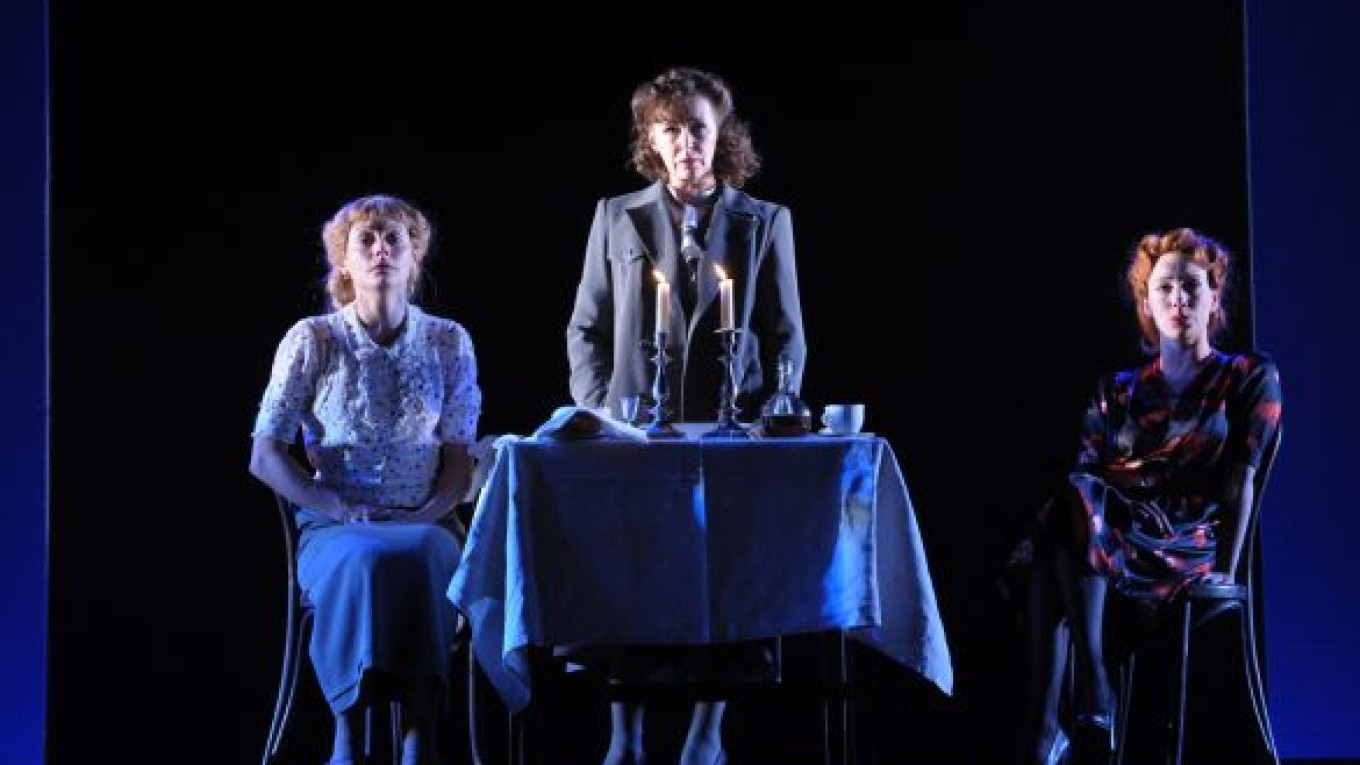
The set designed by Semyon Pastukh employs small realistic elements — two kitchen tables, a bathtub, a bed, two telephone booths — but it primarily puts Singer’s characters in a cosmic space outside of realism. Four sliding panels sweep across the stage, moving some characters out and depositing others in their places. Large screens occasionally show tight close-ups of faces in intimate moments. Damir Ismagilov provided stark, often cold, blue lighting that allows the actors to generate the warmth that emerges from this tale.
It is a harsh story of love, passion, lies, betrayal, twisted fates and striving for elusive personal, inner truths.
German Broder (Sergei Yushkevich) fled Poland, leaving a dead child and wife behind him. In New York he now lives with his second wife Jadwiga (Alyona Babenko), who once was the Broder family maid. Attentive, affectionate and devoted, she clearly is more a reminder of an idyllic past than she is a true soul mate in the present.
If any proof of that were necessary, German is hopelessly entangled in a roiling affair with Masha (Chulpan Khamatova), a lonely, hot-blooded woman who has every intention of marrying German as soon as each gets rid of their current spouses.
Masha is a painfully lonely and anguished woman who cannot rationally justify any kind of normalcy or comfort after having experienced the inexpressible during the Holocaust. Aside from the love and passion she shares with German, extremes, violations of community norms, hysterics and crippling depression are her ways of coping with her pain.
“Enemies” is as much comedy as drama, however, and one of the comic tricks Singer has up his sleeve is the unexpected return of German’s first wife Tamara (Yevgenia Simonova). To the horror of the meek Jadwiga, the shock of the unsuspecting German and the fury of domineering Masha — Tamara reappears one otherwise calm and uneventful evening.
What ensues is a harrowing and hilarious shaking-down of four lives that are bound for conflict and misery.
Singer being Singer, there are plenty of slings and arrows tossed at God and at the pitiful limitations of mortal men and women.
Yes, German is a weak-willed philandering husband, but he is also an intelligent man, who once saw his life ripped away from him and was then asked by an indifferent God to go on with his life. And, yes, Masha is borderline psychotic, but she is also deeply sensitive and wickedly vulnerable.
These may be the kinds of predicaments that Jewish writers love to tease, but they are hardly exclusive to the Jewish race, whatever the extenuating circumstances might be. In any case, Singer never lets any character explain away his or her anguish by using the Holocaust as an excuse.
More broadly, each character is a victim of a world that he or she did not make and that he or she cannot control. This is a tale of men and women making it up as they go, falling into heresy, sin and idiotic situations, and struggling as best as they can to get back out.
What is not universal about that?
The acting, particularly among the four central characters, is rich and engaging. German is something of a bumbling fool around the imperious Masha, but cold and just a bit tyrannical in the company of the self-effacing Jadwiga. Simonova’s Tamara is both bitter and wise at the same time.
Arye’s production is beautiful to the eye and moving to the heart. It points fingers at no one — unless at God for sending people such unbearable tribulations — and it lets no one off the hook of responsibility.
“Enemies: A Love Story” (Vragi: Istoria Lyubvi) plays Thursday, Friday and Saturday at the Sovremennik Theater, 19 Chistoprudny Bulvar. Metro Chistiye Prudy. Tel. 621-6473, www.sovremennik.ru. Running time: 3 hours.
A Message from The Moscow Times:
Dear readers,
We are facing unprecedented challenges. Russia's Prosecutor General's Office has designated The Moscow Times as an "undesirable" organization, criminalizing our work and putting our staff at risk of prosecution. This follows our earlier unjust labeling as a "foreign agent."
These actions are direct attempts to silence independent journalism in Russia. The authorities claim our work "discredits the decisions of the Russian leadership." We see things differently: we strive to provide accurate, unbiased reporting on Russia.
We, the journalists of The Moscow Times, refuse to be silenced. But to continue our work, we need your help.
Your support, no matter how small, makes a world of difference. If you can, please support us monthly starting from just $2. It's quick to set up, and every contribution makes a significant impact.
By supporting The Moscow Times, you're defending open, independent journalism in the face of repression. Thank you for standing with us.

Remind me later.