

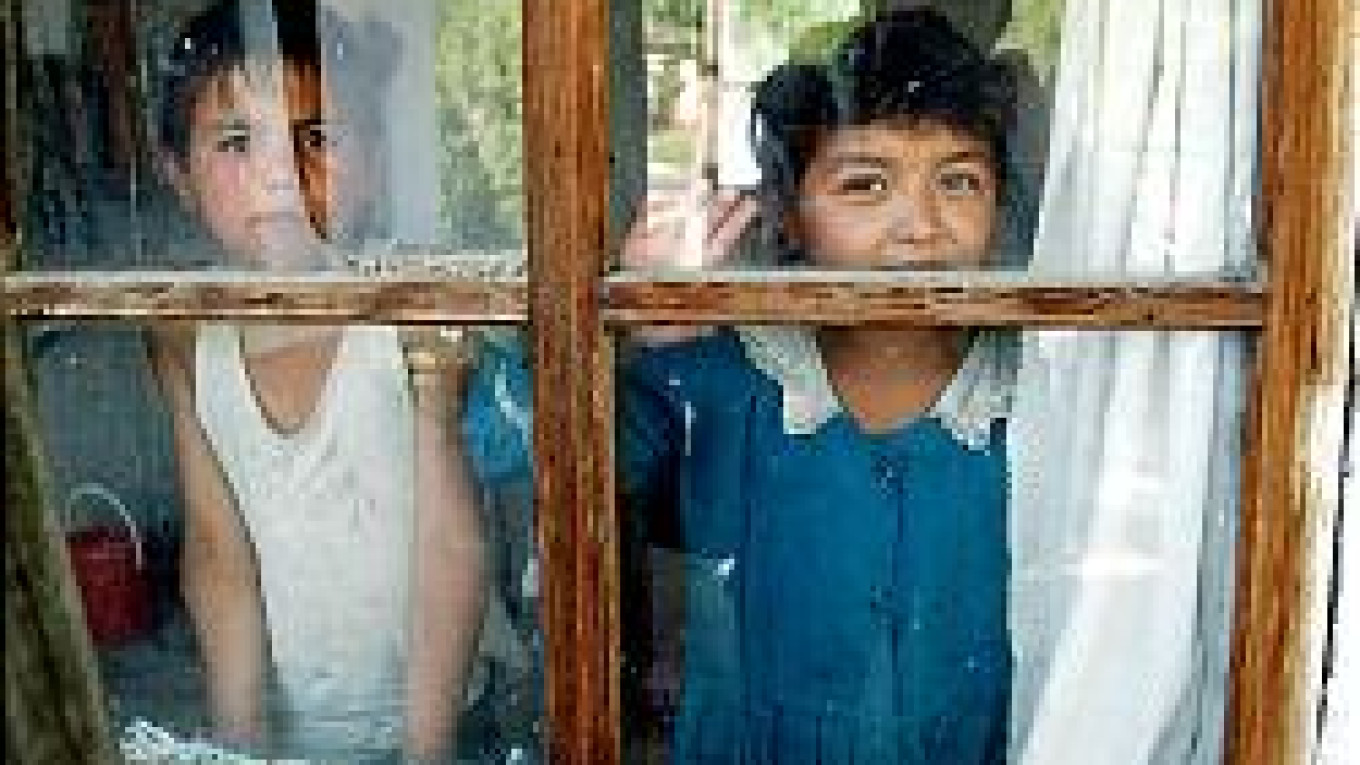
"This is the border," Rojaboy Khamrayeva insists, pointing at the ditch a few steps from her house in Aybek, a village about 120 kilometers south of the Uzbek capital, Tashkent.
On the other side, in Tajikistan, three men warm themselves by a bonfire near the ditch as their sheep graze in a field. Their village is just across the field, some 100 meters away.
Soon there will be no such contrast. Uzbekistan's government is moving to impose strict controls along the entire border, a response to growing tensions among the five former Central Asian states of the Soviet Union.
Some parts of the border -- in mountainous areas farther east -- are already strewn with land mines, weapons that have killed a few Tajiks who strayed while grazing their animals along the frontier.
The five former Soviet republics -- Uzbekistan, Tajikistan, Kazakhstan, Kyrgyzstan and Turkmenistan -- began drifting apart as soon as the Soviet Union collapsed in 1991.
Border disputes, economic hardship and security pressures have created an environment of distrust between ethnically and culturally close nations that for centuries lived side by side and knew no borders between them.
The region was cut into five republics in the 1920s during Soviet leader Josef Stalin's regime. His divide-and-rule approach created five ethnically mixed nations with borders cutting through areas populated by people of the same ethnic group.
Now all independent, the countries are pressing territorial claims against one another. No country wants to give in, and all have been putting armed guards and barbed wire along the borders and introducing visa requirements.
The travel restrictions and harassment by poorly trained and poorly paid border and customs officers anger people in the frontier zones who are losing the freedom to move about freely to visit relatives and do business.
Saodat Olimova, a Tajik sociologist, said the anger is a further threat to the whole region's security, which has already been strained by the rise of Islamic fundamentalism since the late 1990s -- a phenomenon inspired by events in nearby Afghanistan.
"This creates a very good breeding ground for various religious extremist groups that call for a single Muslim state," she said.
Yet, rather than unite the region's governments, the security threat has created more mistrust.
Uzbekistan -- the most populous and militarily most powerful country in the region -- has put land mines along its borders with Tajikistan and Kyrgyzstan, leading to more than 40 civilian deaths and many injuries.
The governments of Tajikistan and Kyrgyzstan have also complained about Uzbek air raids on their territories in the hunt for Islamic militants. Uzbekistan has denied the accusations.
In December, Turkmenistan accused Uzbekistan of aiding organizers of an alleged attempt on Turkmen President Saparmurat Niyazov's life on Nov. 25 and expelled the Uzbek ambassador. Uzbek officials denied that accusation.
Filip Noubel, an analyst from the International Crisis Group, said Uzbek leaders worry about the political instability in Turkmenistan, which has a lengthy, poorly controlled border with Afghanistan.
The Uzbeks are "willing to make sure that there will be no second Afghanistan in Turkmenistan," he said.
Uzbekistan secretly sheltered and armed opposition leaders during a five-year civil war in Tajikistan in the mid-1990s and it supported ethnic Uzbek warlord Abdul Rashid Dostum during Afghanistan's civil wars.
"The neighbors don't trust Uzbekistan," said an Uzbek political analyst, Fayzulla Iskhakov.
The lack of trust has badly hurt the region's economies, which under the Soviets worked as one, sharing water and energy resources, irrigation facilities and roads.
Failure to agree on prices and other trade terms at times has left whole Kazakh and Kyrgyz towns and villages cut off from Uzbek natural gas, Uzbek cotton and rice fields without water, and districts in Tajikistan without food.
Olimova, the Tajik sociologist, said the region desperately needs integration to prosper. "Any separation of our countries will lead to a dead end, catastrophe," she said.
For now, life around the Aybek border checkpoint is as it always was.
One of the Tajiks grazing sheep behind Khamrayeva's house, Komilzhon Toirov, said he and his neighbors do not bother to go through the checkpoint when they need to visit Uzbekistan.
"Why should I go through the checkpoint? I live here," he said in fluent Uzbek.
A Message from The Moscow Times:
Dear readers,
We are facing unprecedented challenges. Russia's Prosecutor General's Office has designated The Moscow Times as an "undesirable" organization, criminalizing our work and putting our staff at risk of prosecution. This follows our earlier unjust labeling as a "foreign agent."
These actions are direct attempts to silence independent journalism in Russia. The authorities claim our work "discredits the decisions of the Russian leadership." We see things differently: we strive to provide accurate, unbiased reporting on Russia.
We, the journalists of The Moscow Times, refuse to be silenced. But to continue our work, we need your help.
Your support, no matter how small, makes a world of difference. If you can, please support us monthly starting from just $2. It's quick to set up, and every contribution makes a significant impact.
By supporting The Moscow Times, you're defending open, independent journalism in the face of repression. Thank you for standing with us.

Remind me later.