

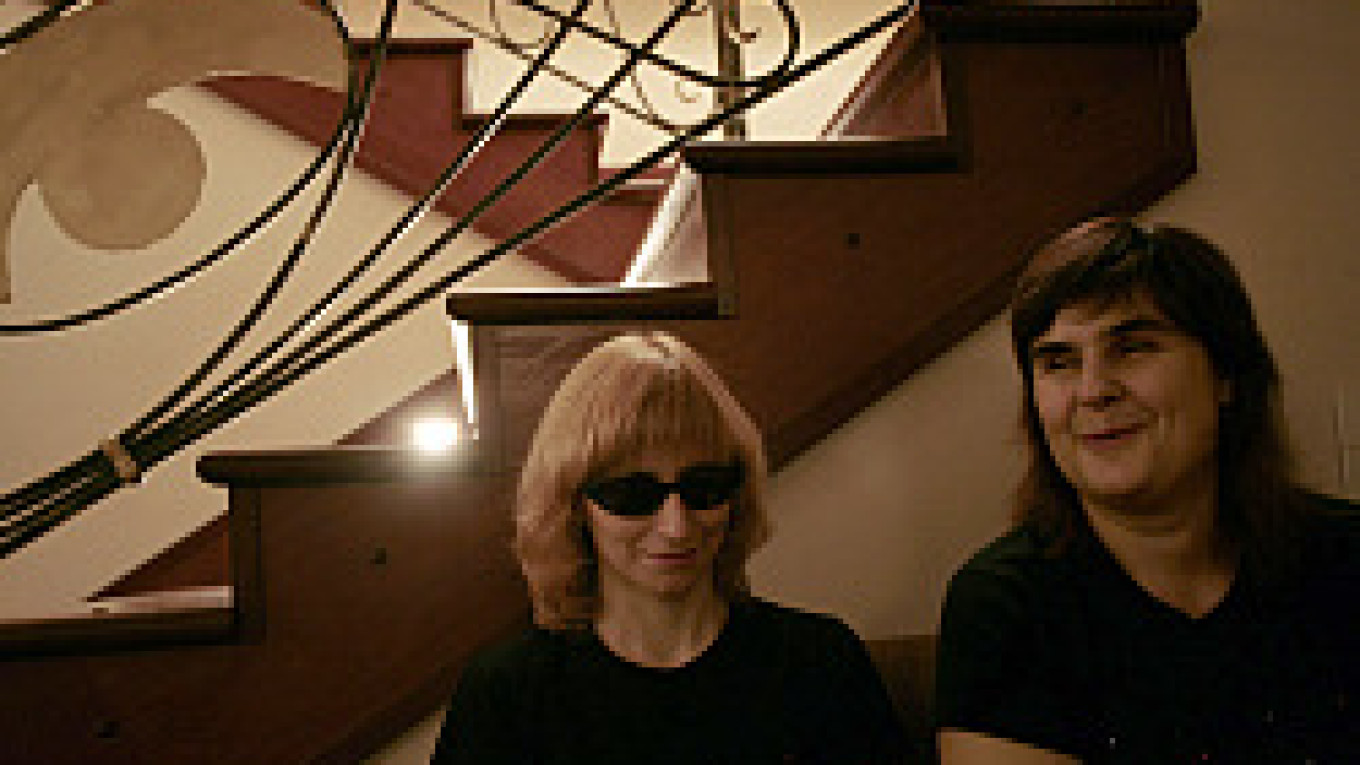
She works at a new restaurant located near the the Russian Army Theater called V Temnote, or In the Dark, where the dining rooms are pitch black and only the wait staff, who are blind, can find their way around.
On a recent evening, Mironova placed a customer's hand on her shoulder and guided him through three dark curtains and into the blackness of the dining room.
Once seated, the diners see nothing. All light is blocked out; even mobile phones and watches with luminous faces are surrendered at the cloakroom.
Dinner at the restaurant is limited to 1 1/2 hours so as not too strain the customers' eyes.
The three-course "surprise menu" confuses many guests, who on leaving the dark room are expected to guess what they have eaten.
"It should be easier to tell what the dessert is," said one customer sitting with her son, having been stumped by the starters and main course.
Ophthalmologist Igor Medvedev opened V Temnote on Nov. 24, and hopes to repeat the success of its sister restaurants Dans le Noir in Paris and London, where tables have to be booked weeks in advance.
Diners are not allowed to leave their tables without a guide and seem to compensate by talking loudly. Social boundaries and inhibitions often break down as people at different tables talk to each other.
"We were there and we laughed for an hour and a half," said Olga Agranovskaya, who works at Medvedev's clinic.
"If you are in the dark, that does not mean you are not alive," another customer said after the meal.
The first Dans le Noir was opened in Paris in 2004, followed early this year by the London location.
Medvedev, who still performs surgery two days per week, learned of Dans le Noir six months ago from a Moscow newspaper report. He immediately made a reservation for lunch at the Paris restaurant, and two days later he was sitting at a table in the dark.
The experience made a huge impression on him. "I was speechless until dinner," he said. For all his medical experience, Medvedev said, it was only at Dans le Noir that he began to understand what it means to be blind.
Within two months, the eye specialist had purchased a franchise from Ethik Investment, which owns the Dans le Noir chain.
Dining in the dark is said to trace its roots to 19th-century France.
In British author Salman Rushdie's novel "Midnight's Children," Bombay's "gilded youth" flock to a place called the Midnite-Confidential Club. In a dark room, served by a blind waitress, the young people can "avoid the Oriental shame of scandal." Rushdie writes of how "licentiousness" flourishes in "a world of Stygian darkness, black as hell; in the secrecy of midnight darkness."
Moscow's gilded youth don't seem particularly concerned about concealing their shame, however, and V Temnote is hardly a den of licentiousness.
On one evening last week, the only customers were an employee from Medvedev's clinic and his mother.
The All-Russian Association of the Blind helped Medvedev to find 50 part-time servers for the restaurant; the cook is not blind. All the workers received two days' training, and two of them served internships in the Paris and London restaurants.
The association estimates that there are 250,000 blind or visually impaired people in Russia and some 15,000 in Moscow and the Moscow region.
Yet, State Duma Deputy Oleg Smolin is a rare example of a blind person who has assumed a position of prominence in this country. For most blind people, integration into the mainstream is difficult in a city built without the needs of the disabled in mind.
"The situation can be difficult when you go along the street and people are in the hurry and they can say, 'Why are you going slow,'" said Mironova, a cheerful presence in the dining room, who lost her sight five years ago after contracting glaucoma.
The restaurant is useful in that it helps mainstream society make contact with the visually impaired, said Denise Roza, director of Perspektiva, a Moscow-based nongovernmental organization that provides support to people with disabilities.
Just as importantly, the restaurant provides jobs for the blind, she said.
"It is always good when there are job opportunities and people coming in and meeting blind people," Roza said. "They've probably never met blind people before. [The restaurant] is weird but positive."
Mironova said Medvedev had promised much better wages than she earned at her last job in a factory specially set up for blind workers.
Few blind people work in mainstream society. Those who do usually have jobs in special factories established in the Soviet era. There are nine such factories in Moscow, which produce goods such as medical equipment. Mironova worked in a factory that made medical pipettes.
"It is segregating people. If you don't see blind people, then you can forget they exist," Roza said.
Profits from V Temnote go to help train seeing-eye dogs and to fund other projects for the blind, Medvedev said.
A Message from The Moscow Times:
Dear readers,
We are facing unprecedented challenges. Russia's Prosecutor General's Office has designated The Moscow Times as an "undesirable" organization, criminalizing our work and putting our staff at risk of prosecution. This follows our earlier unjust labeling as a "foreign agent."
These actions are direct attempts to silence independent journalism in Russia. The authorities claim our work "discredits the decisions of the Russian leadership." We see things differently: we strive to provide accurate, unbiased reporting on Russia.
We, the journalists of The Moscow Times, refuse to be silenced. But to continue our work, we need your help.
Your support, no matter how small, makes a world of difference. If you can, please support us monthly starting from just $2. It's quick to set up, and every contribution makes a significant impact.
By supporting The Moscow Times, you're defending open, independent journalism in the face of repression. Thank you for standing with us.

Remind me later.