

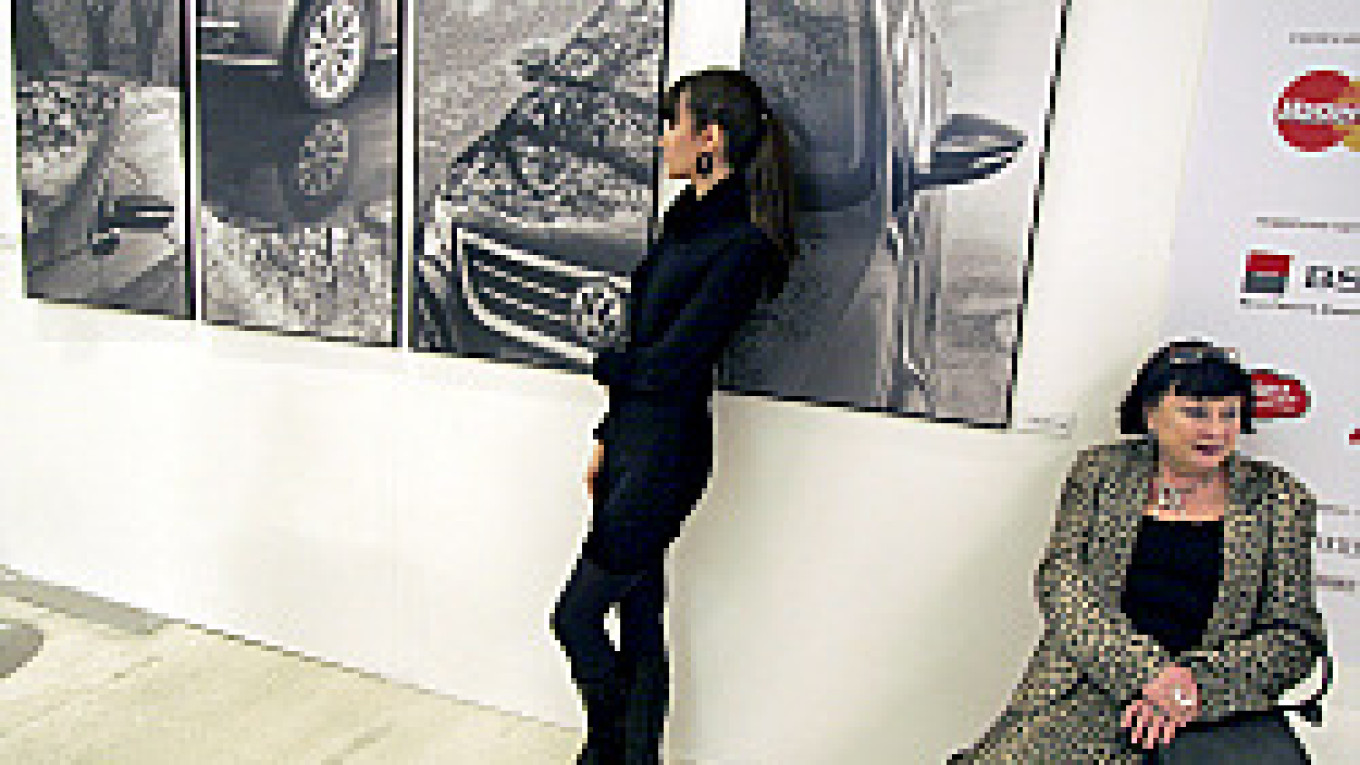
"We wanted to show how photographic aesthetics changed over the last century, right up to today," festival director Olga Sviblova told Izvestia newspaper. "So it's not just about fashion photography, the festival's much broader. 'Fashion' may be the first word in the festival title, but in essence the word style carries the bulk of the sense -- with all its connotations."
Nonetheless, a good part of the festival's accent falls squarely upon fashion. One of the three exhibitions in the New Manezh with which the festival opened last week details the extraordinary life and career of American photographer Lee Miller. Starting out as a model for Vogue in the late 1920s, she quickly dropped her ambitions and moved to Paris, where she fell closely in with the circle of artist Man Ray, not only as muse but as co-author.
Miller was hardly the first or the last model to take up photography, but saying she took the road less traveled would be putting it lightly. When she returned to Vogue, it was to cover World War II: The exhibition includes numerous photographs she took of Blitz-era London, the war in Alsace, the liberation of Dachau and an infamous shot of Miller herself in Hitler's bathtub.
Frenchman Guy Bourdin, who took many of Vogue's most iconic photographs over the second half of the century, can be found at the Manezh proper with a retrospective detailing his bright and glossy attempts to bring sexuality into the printed mainstream.
But Bourdin has some very strange bedfellows just around the corner from him, who perverted Western ideals of fashion and style with an anarchic, low-budget glee against the backdrop of Gorbachev's Soviet Union. The exhibition "Hooligans of the '80s" documents everyday scenes from the then-emerging Soviet punk, goth, new wave and nonconformist art movements, including now-canonized figures such as Kino frontman Viktor Tsoi and artist Sergei "Afrika" Bugayev.
"A hooligan its someone who doesn't go parallel to the crowd, but perpendicular," curator Irina Meglinskaya said at Monday's opening.
"The '80s was the freest time in the history of Russia," Meglinskaya went on. "The young people who came of age at that time had a huge chance, by comparison with other generations, to express themselves."
Nostalgia of a different sort can be found at Zurab Gallery. Notable in particular is rising star Youssef Nabil, who brightly colors his gelatin photo prints by hand in homage to the glamorous "Golden Age" of 1940s and '50s Egypt. The adjoining "Consumer Goods" exhibition of snaps from Ogonyok magazines forgoes conventional glamour for the simple life of 1950s and '60s ladies sewing and choosing their Soviet Sunday best.
Elsewhere, you can find everything from French surrealism to Italian Felliniesque romanticism. And in the unlikely event that none of the above shows are to your taste, the full program is available from www.mdf.ru.
A Message from The Moscow Times:
Dear readers,
We are facing unprecedented challenges. Russia's Prosecutor General's Office has designated The Moscow Times as an "undesirable" organization, criminalizing our work and putting our staff at risk of prosecution. This follows our earlier unjust labeling as a "foreign agent."
These actions are direct attempts to silence independent journalism in Russia. The authorities claim our work "discredits the decisions of the Russian leadership." We see things differently: we strive to provide accurate, unbiased reporting on Russia.
We, the journalists of The Moscow Times, refuse to be silenced. But to continue our work, we need your help.
Your support, no matter how small, makes a world of difference. If you can, please support us monthly starting from just $2. It's quick to set up, and every contribution makes a significant impact.
By supporting The Moscow Times, you're defending open, independent journalism in the face of repression. Thank you for standing with us.

Remind me later.